
Interactive · 1 question
As most of you would be familiar, DNA (deoxyribonucleic acid) and RNA (ribonucleic acid) are both nucleic acids, made up from nucleotides. What exactly are the differences between these two biomolecules then?
As we'll see below, DNA and RNA differ in terms of not only their sequence composition, but also their structure, function, location, and chemical properties.
RNA is made up of these 4 nucleotides:
Sequence
As you have seen in the quiz, DNA is made up of Adenine, Thymine, Guanine and Cytosine, while RNA is made up of Uracil (and the 3 other nucleotides) instead of Thymine. The base-pairings occurs in the following patterns:
- Adenine - Thymine (DNA)
- Adenine - Uracil (RNA)
- Guanine - Cytosine
Note that the above base-pairing are known as Watson Crick base-pairing. Other base-pairings can occur too (e.g. Guanine-Uracil Wobble Pair) and they are known as uncanonical base-pairings. Such base-pairings can cause differences in chemical properties.
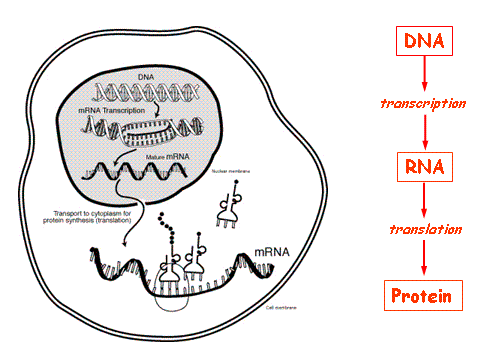
Central Dogma of Biology states: DNA codes for RNA, which codes for proteins. (Image from Google)
Function
Most of us would know that DNA is known as the blueprint of biological systems - it serves as a medium for long term and stable storage, as well as transmission of genetic information.
Following the central dogma of biology, RNA helps to carry out these "blueprint instructions". It transfers the genetic code needed for the creation of proteins from the nucleus to the ribosome.
Location in the cell
Due to the different functions they play, it is natural to expect these 2 biomolecules to be in different parts of the cell.
DNA is usually found in the nucleus, compacted and tightly folded until a protein comes to unwind it. RNA, depending on the type, can be found in a cell's nucleus, cytoplasm and ribosome.
Structure and Stability
DNA is double stranded (made up of 2 complementary strands that are base-paired), and made up of deoxyribose (a 5-carbon sugar). In contrary, RNA is single stranded, and made up of ribose (a less stable 5-carbon sugar).
Due to the different structures, DNA is more stable due to the less reactive C-H bond in deoxyribose sugar, compared to the more reactive C-OH bond in ribose.
This aligns to their respective functions. DNA needs to be more stable in order to store long-term genetic information, while RNA doesn't need to do so.