Read · 1 min
Few basic tips for solving problems on ropes(strings) and pulleys...
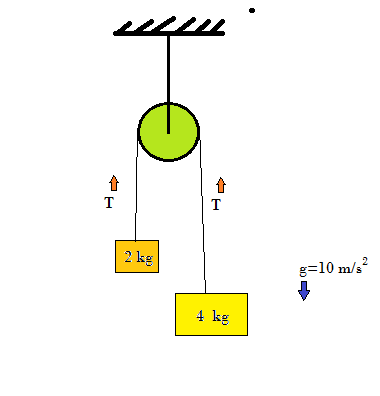
Tension in a string is a very useful concept in problem solving. It always acts towards the direction away from the connected mass.
Whenever strings are to be considered of negligible mass, then the tension throughout the string is to be kept constant.
For simplicity in many problems, pulleys are considered massless (negligible mass) and frictionless.
The effect of acceleration due to gravity is always downward, thus it's effect along with the tension in string determines the direction of acceleration of masses connected.
If , acceleration is towards the direction of tension, with the magnitude
If then acceleration is towards gravity with the magnitude of
In above note, is tension, measured in the SI unit , is mass of the connected body in , and is acceleration due to gravity, which is taken as , and in problem solving , for simplicity taken as .