Rotation Around a Point

Read · 1 min

Do you remember the olden days when you were a little kid spinning the spinner in games? Do you know what that arrow was doing when you spun? You guessed it, it was rotatingrotating. Now, in math we won't rotate arrows on spinners, but instead we will rotate geometric figures to prove useful identities. We won't get into that yet, but I would like you to leave this page with an understanding of the formal definition of a rotation. Here it is: a rotationrotation is where you turn a figure about a given point. In the spinner example, the center was the given point, and the the arrow was the figure. Hope you understand and good luck!

Interactive · 1 question

When you spin an object around, does the figure change?

Choose one answer

Video · + 1 min read

(Video) Rotation

by Planet Nutshell

Rotation is not a foreign idea--it happens all the time in everyday life. \\

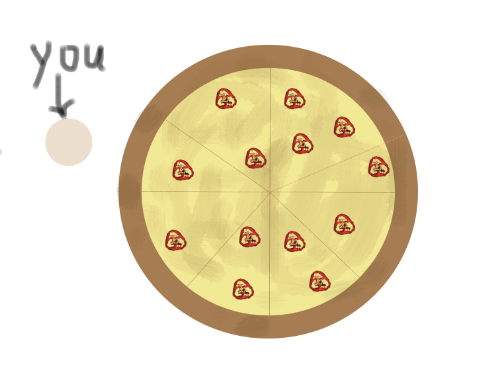
This is something that happened to me the past weekend. I was hanging out with some friends and we decided to order a pizza. It was a cheese pizza with some hot chili pepper slices on it. Below is a doodle of the pizza when we put it on the table and where I was sitting at the time.

Being the food person that I am, I wanted the slice with the most amount of pepper slices. What I had to do was obvious, I discreetly rotated the pizza so the big slice with 3 pepper pieces could be in front of me.

So how is rotation defined in a mathematical sense? Here is a video explaining this.

Rotation is "a transformation in which a plane figure turns around a fixed center point." (source: http://www.mathwords.com/r/rotation.htm) Try the problem below to test your understanding.

Does rotating something change its shape or size?

Choose one answer

Video · + 1 min read

(Video) How Do I Rotate a Figure?

by MashUp Math

A brief summary of the video: \\

A rotation is a change in orientation. It is NOT a change in size, and should not be confused with reflection. Note that rotation is always around a choose center. But as you will see in this video, often times when we talk about rotation we assume the center of rotation is the origin, or (0, 0) on the coordinate plane.

Directions for rotation: \\ clockwise \\ counter-clockwise \\ we can also describe the direction with positive or negative signs. Use either the CWW/CW system or the positive/negative system, make sure not to mix the two.

Degrees of rotation: \\ We describe how much we rotate a figure in degrees. When the degrees of movement is positive, the figure moves in a counter-clockwise direction. When the degrees of movement is negative, the figure moves in a clockwise direction.

Notation: \\ A rotation is denoted as RdR_d, d is the degrees of rotation.

The video also gives us the rotation rules, which summarize how the coordinates of a point change when it is rotated CW and CCW by 90, 180, 270 degrees. It is helpful to understand the relationship between rotating clockwise and counter-clockwise. For example, rotating 90 degrees counter-clockwise is the same as rotating 270 degrees clockwise. In other words, rotating 90 degrees is equivalent to rotating -270 degrees.

These rules look complicated, but drawing some points out and try rotating them will help you understand. Once you understand how rotation works, you won't need to memorize the rules!

Try the following problem to test your understanding!

Which of the following is equivalent to rotating counter clockwise by 270 degrees? Choose all the correct answer(s).

Choose all correct answers

Type a concept, like “slope” or “photosynthesis”.

↑ ↓ to choose · Enter to openSearch explanations and problems