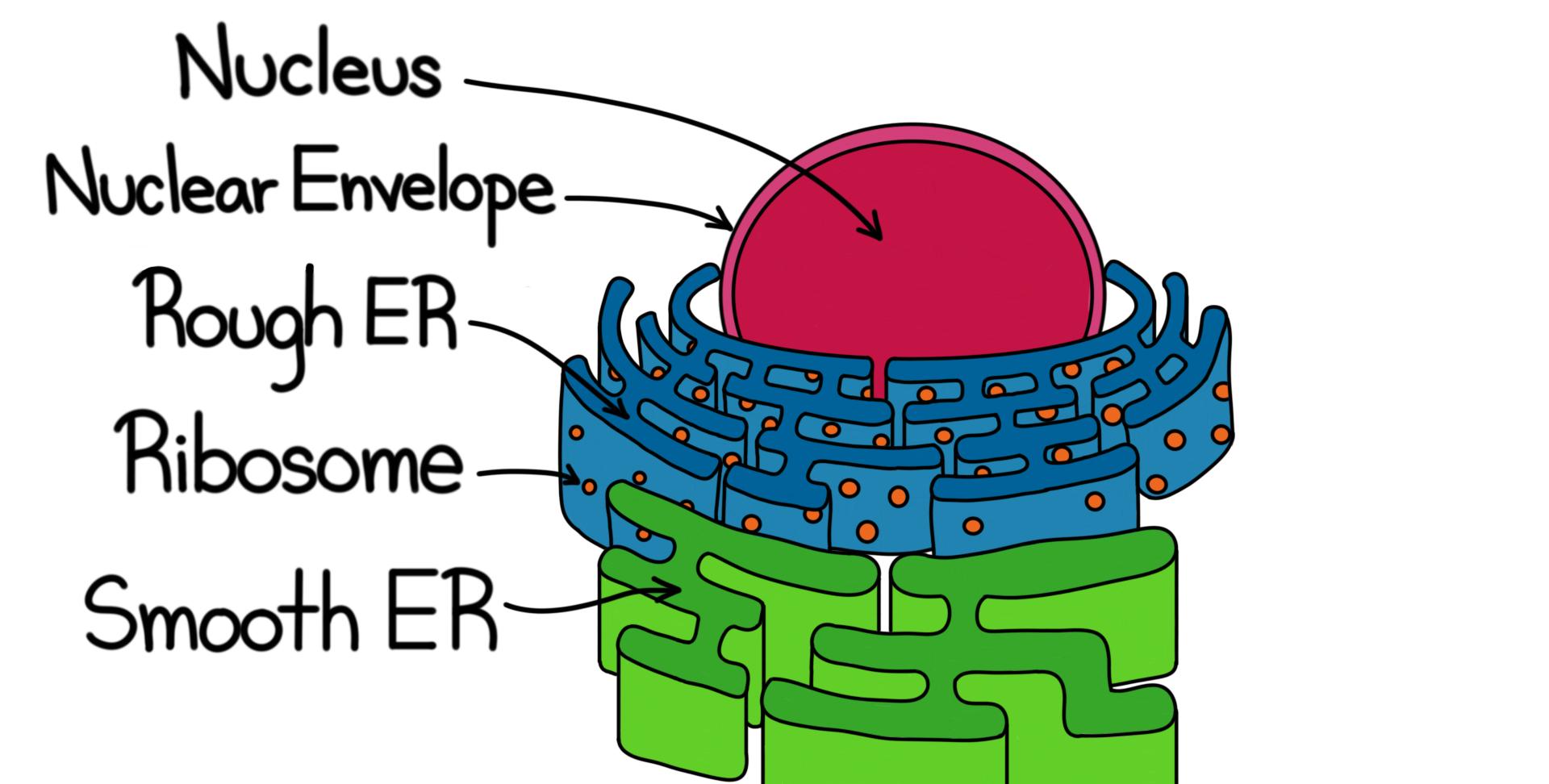
The rough endoplasmic reticulum (also called the RER), is an organelle found in both animal and plant cells. It is made up of interconnected, flattened membrane sacs. It's also attached to the nuclear membrane, which contains the nucleus. This connection lets important molecules travel directly from the nucleus to the RER.
What Does It Do?
The RER is responsible for protein synthesis, modification, packaging, and quality control.
We say that the RER makes proteins, but actually most of this is done by the ribosomes attached to its surface. These are called membrane-bound ribosomes.
One key point to remember is that the RER makes secretory proteins only. These are the proteins that will be shipped out of the cell once they are complete. Proteins that will remain in the cell after synthesis are made by free ribosomes—those that are not attached to the RER.
Protein Synthesis
The process of protein synthesis begins when the information in DNA is read and transcribed. Short strands of messenger RNA (mRNA) carry the information from the nucleus to the ribosomes on the RER, where it can be used to synthesize proteins. At the ribosome, different amino acids which correspond to the mRNA sequence are connected together to form long chains. These chains are pushed into the RER, where they can be modified, folded, and checked for errors before becoming functional proteins.
After this, a part of the RER membrane which contains the complete protein will pinch off, forming a vesicle. The vesicle can take the protein to wherever it's needed.