Interactive · 1 question

In the previous lesson in statistics, we talked about sampling methods, including convenience sampling and random sampling. When conducting research, we want to have a representative sample, which is a sample of a population that is generalizable to the whole target population. We pick a sample of people out of a population, which is considered the sample frame.
Say you have a population of 100 dogs. This population has 50 golden retrievers, 30 poodles, and 20 german shepherds.
We want to figure out the brand of dog food that all dogs like best! To do that, we need a representative sample of all of the dogs in this population. We have enough dog food for 10 dogs, so we need to use stratified sampling to get a representative sample. We can use ratios to determine what a representative sample would look like.
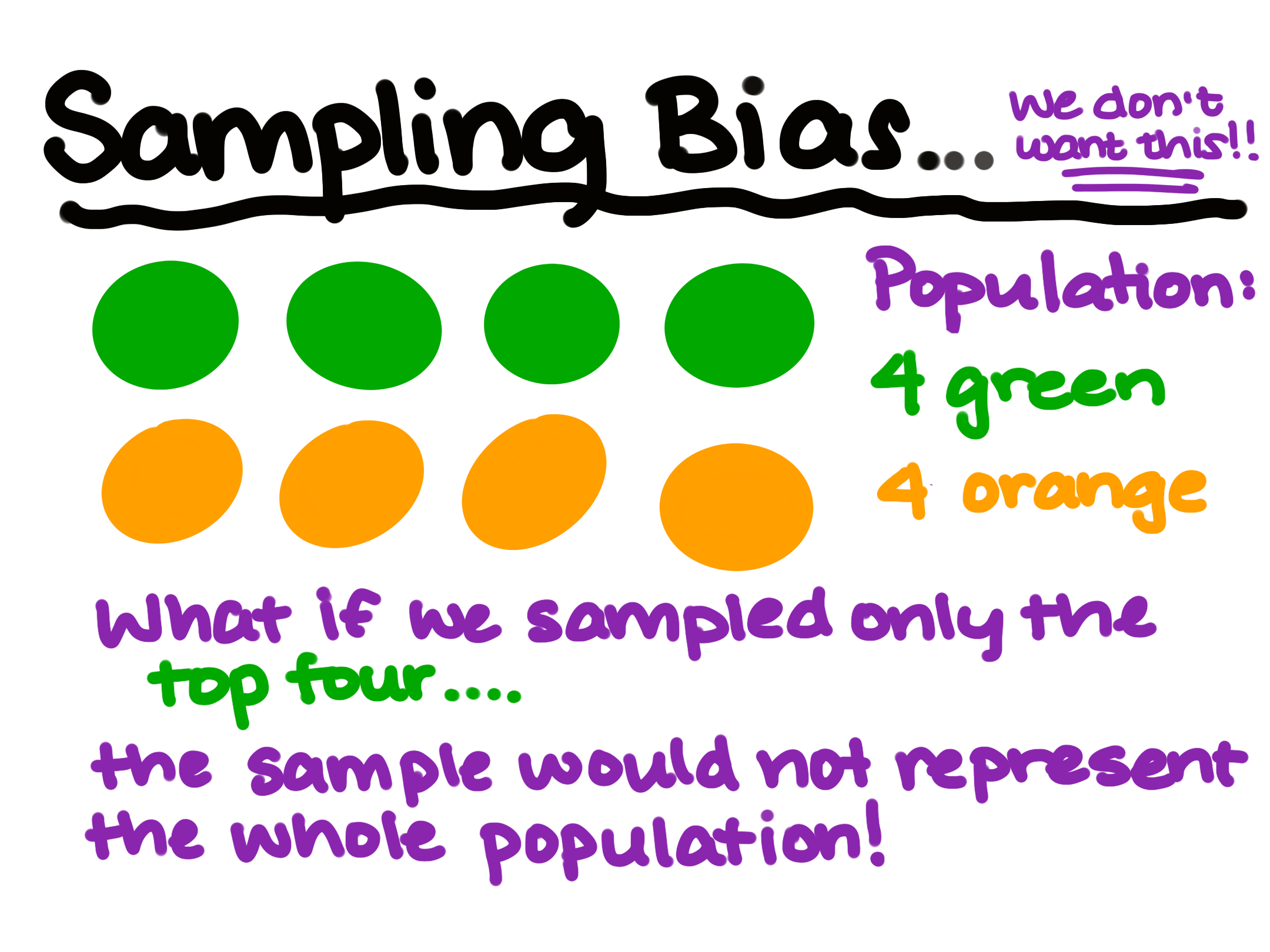
Now consider the possibility that there was some kind of error that prevented us from getting a representative sample. Let's say that german shepherds were selected to test the dog food because the researchers loved german shepherds. This would be a systematic error in sampling, which would indicate a sampling bias.
If there is some kind of error in sampling, we call that a sampling bias
Sampling Bias
When we are sampling, there may be times there are biases that are not due to the sampling itself, but due to some systematic error in sampling. These biases are called sampling biases. Let's talk through some of the most common types of sampling biases.
Self-Selection: exactly what it sounds like, when members of a population choose to be a part of the sample. Oftentimes, college students are volunteers in psychology research studies for class credit. So, this sample isn't representative because the students are choosing to make up the study sample.
Observer Bias: found primarily in human subject research, this bias occurs when the researcher's preconceptions and assumptions influence the research. For example, researchers are watching a ninth grade math class to determine which student is the best at math. If the researchers have an observer bias of boys being better at math than girls, then that preconception/assumption can influence their decision of who in the math class is best at math.
The biggest issue with sampling bias is our sample is not representative of the population, and so any data or findings can be inaccurate. This can lead to poor internal and external validity.
Internal validity: whether a study is able to accurately represent a cause-and-effect relationship between two variables, ruling out alternative explanations.
External validity: whether a study can be generalized to a larger population.
How to Avoid Sampling Bias
It's not like sampling bias is inevitable in research! Especially in human subject research (i.e., researching people), there are ways that we can avoid sampling bias.
Random sampling: when we randomly select items from a population.
Blinding: when the researcher and/or the participant does not know which study group they've been placed in. Say researchers are testing a new serum to create Super-soldiers. The researchers need to test the serum against a placebo (an injection without the serum). In order to get accurate results, the researchers cannot tell the participants whether they get the serum or the placebo, in case that influences the results. In a double-blinded study, the researchers also would not know whether the participant got the serum or placebo, in order to eliminate observer bias. Blinding will also prevent response bias, where participants may respond the way they think they're supposed to respond.
Having a large enough population can also reduce the effect of sampling bias, also known as the Law of Large Numbers.
John and Jenn are conducting a research study on Spider-Man teenagers like the best! They send an email out to all teenagers at Marvel High School, and they will analyze the data of only the students who complete the survey.
Is there any sampling bias in John and Jenn's research study?
Because John and Jenn are only analyzing the data from the teenagers who chose to complete the survey, there is self-selection bias involved.
####Other Points to Note
Whenever we do research, we also must be mindful of survivorship bias, which refers to the issue of a researcher focusing so intently on a sample selected from a population that they overlook those who did not meet the selection criteria. This bias is especially prevalent where there are criteria that participants must meet to be a part of a study. A common example of this bias showing up is during polling for a presidential election.