Scientific Fact — Definition & Examples

Illustrated · 1 min

Facts in Science

A scientific fact is an undeniably true statement accepted by the science community. It can be proven to be correct through observations and testing. This process is known as the scientific method.

However, it's important to remember that nothing is ever final in science. Even facts can change over time if new, disputing discoveries happen.

For example, scientists agreed for a long time that the appendix has no function in the body. Researchers proved that there were no health defects after removing the appendix during surgery. Therefore, they believed the appendix had no function. However, scientists recently discovered that the appendix might actually have an important role in fighting off diseases. If the function of the appendix is proven through experiments and observation, it becomes a new scientific fact.

This is a comic strip explaining what a fact is. The title panel reads: "Today's lesson: What is a fact?".
This is the second panel. It shows blobby news reporter twins (Pimby and Pumby) interviewing a man on the street (Joe Street). They ask him what a fact is, and he is not sure.
The next panel shows the reporters asking an old couple what a fact is. The old man answers that it is a fact how lovely his wife is, although that is not technically a fact.
The news reporters comment that the old man's example of a fact is actually an opinion. They then ask the local grump what a fact is, to which he responds that he doesn't know. The grump just wants to be left alone.
The next panel shows the reporters asking a little kid, "What is a fact?". The kid responds that a fact is something that's really, really true and right.
In this next panel, the reporters announce that they're all out of time and they will now turn to their panel of experts. The image shows a table of experts, including the kid from the previous panel.
The first expert, Dr. Disgust, gets disgruntled when asked what a fact is. He starts to rant about kids these days and doesn't answer the question at all.
The next panel shows Professor Snoot, who explains what a fact is by reciting the dictionary definition for fact. The blobby news boys reply that if the viewers wanted to look it up in the dictionary, they would've just done that themselves.
The last panel shows the kid from the street interview. Somehow the kid got onto the expert panel. The kid, who wasn't able to finish explaining before, says that a fact is something that is indisputably true. Facts are proven through observation and experimentation.
This is the next panel of the comic strip explaining what a fact is. The kid explains that facts are agreed on by everyone.
The kid reminds us that facts can be disproven with new information.
The kid cites the example of how for many years stomach ulcers were thought to be caused by stress and bad diet.
Dr. Barry Marshall proved that ulcers are actually caused by a bacteria called Heliobacter pylori. Marshall proved this by drinking bacteria cultured from a patient's stomach ulcer, which caused him to develop gastritis (which can lead to ulcers).

Go read about Barry Marshall. (Even Pimby and Pumby agree that he is very metal.)

Faced with the evidence, the medical community begrudgingly accepted that a bacteria, not stress, is the real cause of ulcers.
Remember, kids—opinions are not facts!

Image source: By Sylvia Freeman

Interactive · 1 question

Fact or Opinion?

Facts are unquestionably true ideas. They are often direct, objective observations about the natural world like “the sun is out" or “it is raining". They are universally accepted as true, which means that everyone who observes them agrees that they are true. They can be definitions and entries found in an encyclopedia, too.

Opinions, on the other hand, express a personal belief or feeling. They often include the phrases "I think", "I feel", or "I believe".

Select the fact.

Choose one answer

Video

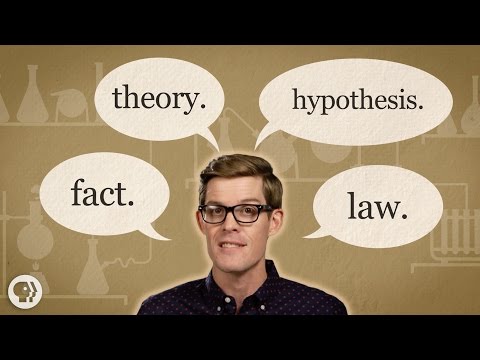
(Video) Fact vs. Theory vs. Hypothesis vs. Law

by It's Okay To Be Smart

We use words like "fact" and "theory" every day, but what do they really mean? This video explains the differences between "fact", "theory", "hypothesis", and "law" and how these words are used in science.

Read · 1 min

What Is a Fact?

It is something that can be proven to be true through direct observation.

Sometimes they can be confused for opinions. The difference between facts and opinions is that an opinion expresses an individual's personal beliefs, views, feelings, or ideas about a particular topic. On the other hand, a fact is something that is universally accepted.

Facts can also change over time. For example, people used to believe that Earth was at the center of the solar system. However, once we made more observations and gathered more evidence, we were able to show that Earth actually orbits the sun, not the other way around.

Type a concept, like “slope” or “photosynthesis”.

↑ ↓ to choose · Enter to openSearch explanations and problems