Scientific Theory — Definition & Examples

Interactive · 1 question

What Is a Theory in Science?

Do you know what the word theory means in the scientific world?

No?

Then keep reading to learn. (If you said yes, then why are you still reading this?)
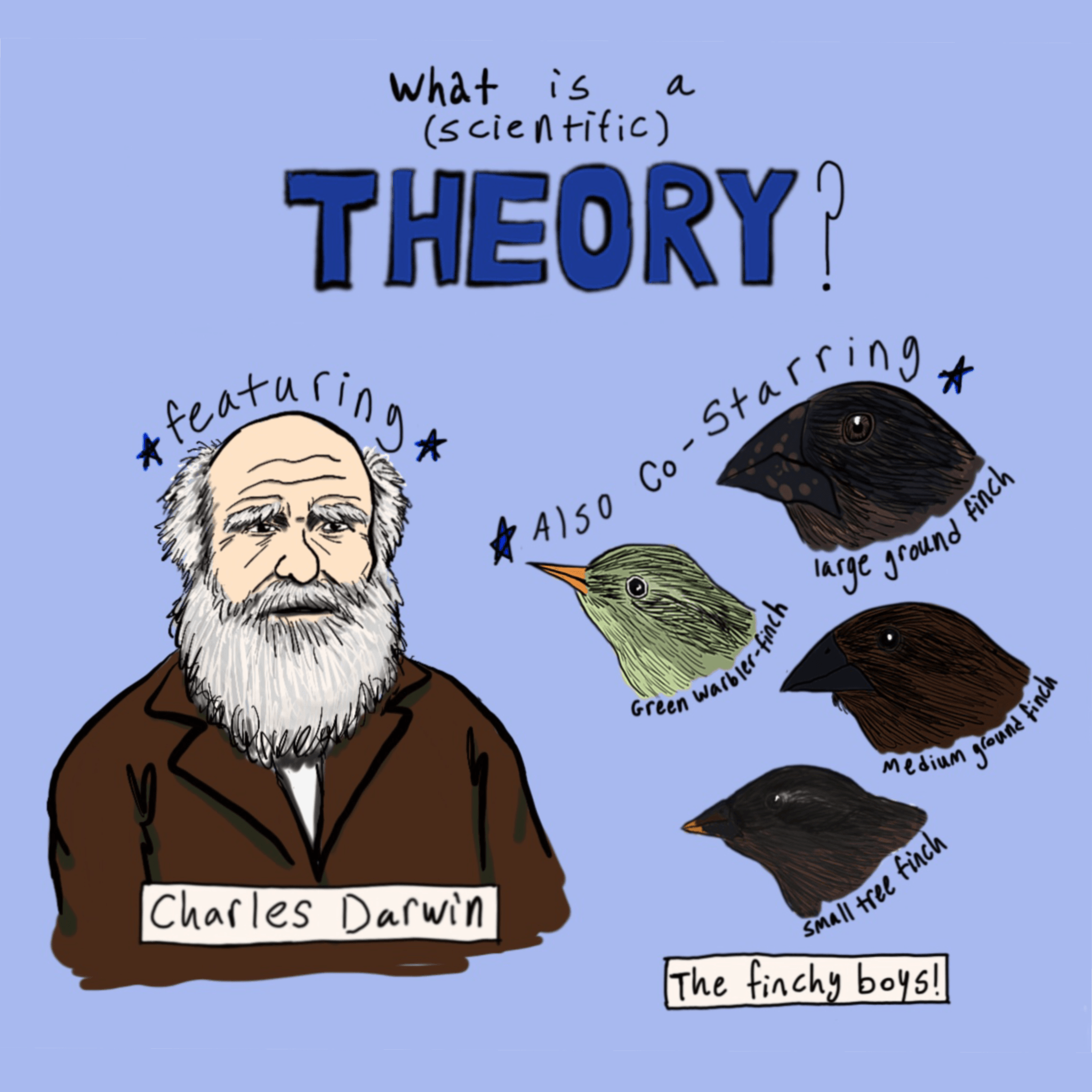
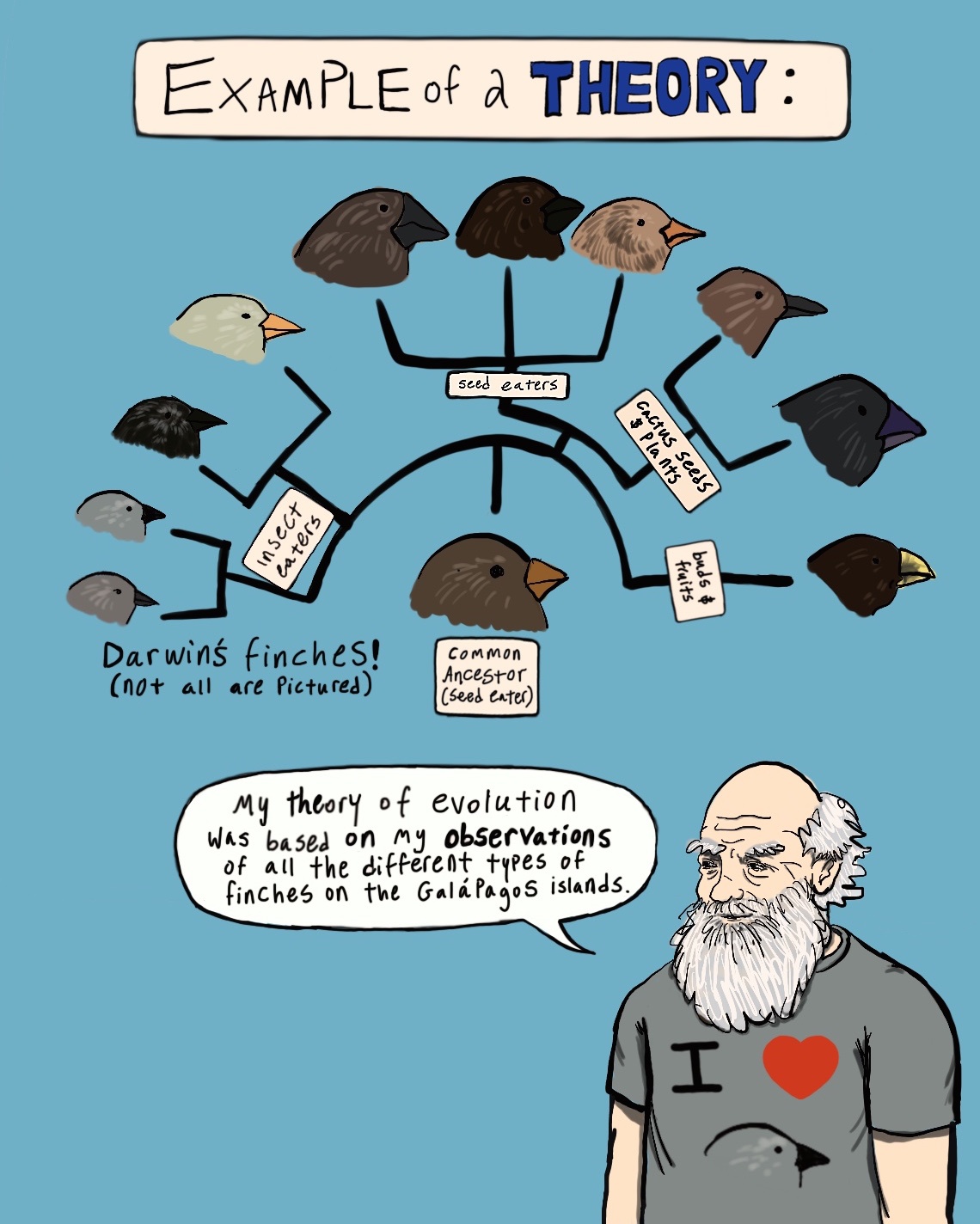
This is a comic explaining what a scientific theory is. This first panel shows Charles Darwin and some of his Galapagos finches, who will star in the comic.
The text reads: In science, a theory is not just a guess. This is different from the everyday use of the word where a "theory" often means someone has a hypothesis about something. A scientific theory is a well-tested explanation of something in nature.
The predictions that a theory makes must also be observable and repeatable. In other words, a theory must be testable. If there was no way to disprove a theory, then there would be no point to it and anybody could come up with whatever crazy theories they wanted to.

Pictured: Green warbler finch, large and medium ground finch, small tee finch (first panel), green warbler finch (middle panel), small tree finches, male and female (last panel).

Image source: By Sylvia Freeman

Just remember: theories cannot be proven right, but they can be disproven. They are only ever "correct" to the extent of our current knowledge.

Not too bad, right? Now, let's test your understanding.

Which of the following statements about scientific theories are true?

Choose all correct answers

Interactive · 1 question

Theories\color{#8925AE}{\text{Theories}}

Scientists often form many hypotheses to explain how a phenomenon occurs. They test, retest, and refine these hypotheses until they gather enough evidence supporting them to form a theory. This process is called the scientific method.

A theory is a widely accepted scientific explanation of how and why something occurs. It is backed by extensive data, but it is not considered to be the absolute truth. In fact, theories often evolve over time as more data accumulates. You may have heard of one called the Big Bang theory, which attempts to describe how the universe formed.

The evolution of the aardvark, from microscopic eukaryote to the modern mammal.

The Theory of Evolution, shown for an aardvark.

Image source: By T. Michael Keesey CC BY-SA 2.0, via flickr.com

Theories try to answer the question "Why?" They try to find out why things happen based on scientific observations and experimentation. This is very different from a scientific law, which predicts what is going to happen based on observations and experiments.

One of the most important theories in modern biology is Cell Theory. Cell Theory credits cells as the basic structural unit of all living things, states that all cells come from other cells, and says that all living things are made of at least one cell.

A color-coded image of a real cell

A human cell with colored organelles.

Image source: By Vojtěch Dostál CC BY-SA 4.0, via Wikimedia Commons

Also very important in the study of biology is the Theory of Natural Selection and the germ theory of disease.

Which of the statements about theories is false?

Choose one answer

Video

(Video) Theory vs. Scientific Theory - Bite Sci-zed

by Alex Dainis

A scientific theory is defined as an explanation for some aspect of the natural world which has been repeatedly tested through a series of observations, hypotheses, and experiments.

In this video, you will learn about four traits that make scientific theories special and also what separates them from facts.

Type a concept, like “slope” or “photosynthesis”.

↑ ↓ to choose · Enter to openSearch explanations and problems