Secondary Consumer — Definition & Role

Before this, knowTrophic Level — Definition & Examples

Illustrated · 1 min

What Are Secondary Consumers, Anyway?

A secondary consumer is an organism that eats primary consumers. Primary consumers eat primary producers. Primary producers are autotrophs, organisms that make their own food. On an energy pyramid, primary producers are at the very bottom, then primary consumers, then secondary above them.

Here's an example:
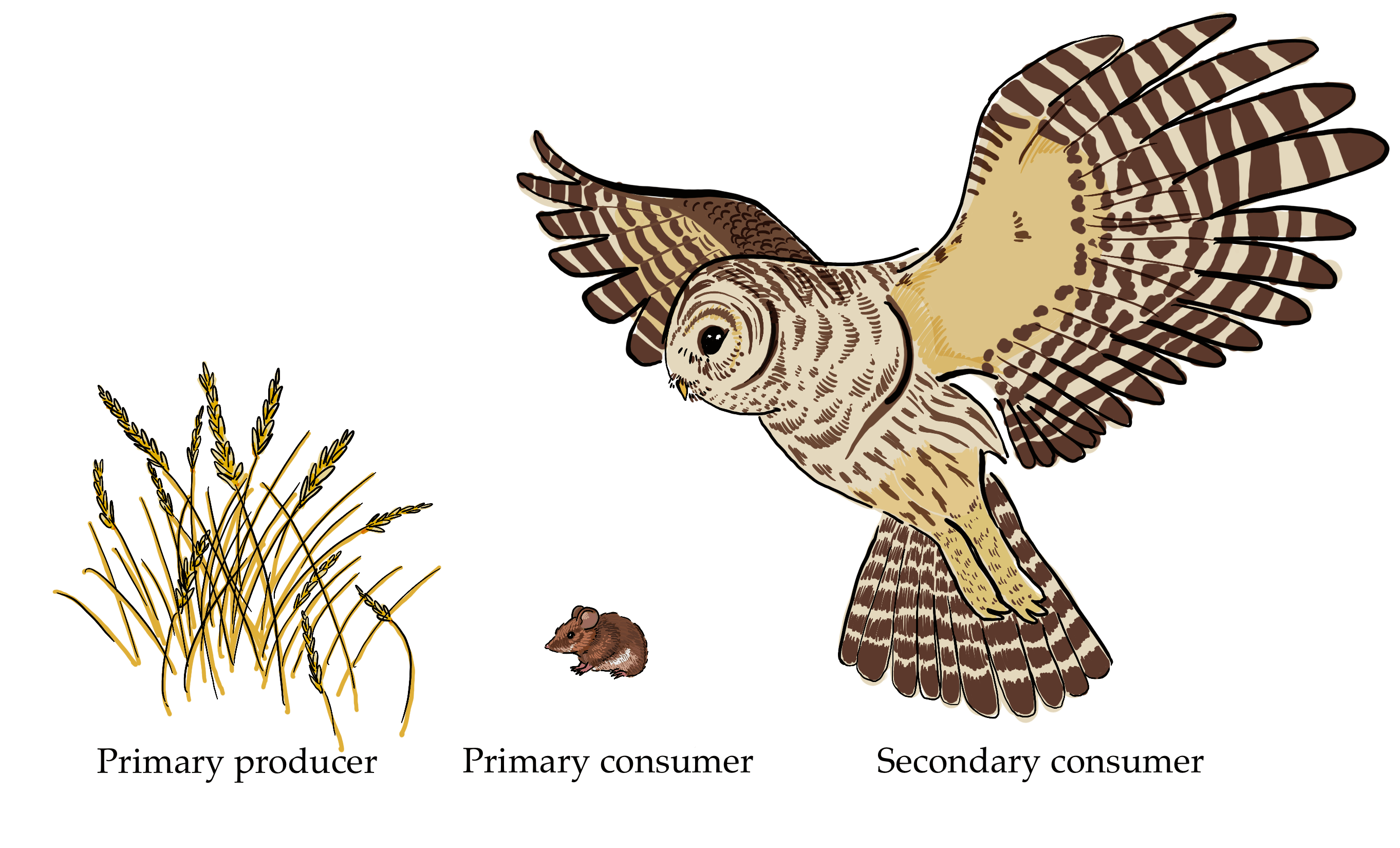
This cartoon image shows an example of a food chain. From left to right the picture shows wheat, a mouse, and an owl. The wheat is the primary producer. The mouse is the primary consumer. The owl is the secondary consumer.

The wheat is an autotroph that gets its energy from the sun, making it a primary producer. The mouse is a primary consumer who eats the primary producer. The owl eats the mouse, which makes it a secondary consumer. \\ Image source: By Sylvia Freeman

The majority of autotrophs (primary producers) are plants. This means the primary consumer animals who eat them are mostly herbivores (plant eaters). Secondary consumers are usually carnviores (meat eaters) but can also be omnivores. Omnivorous consumers eat everything—like people do. In the example above, the owl is a secondary consumer because it eats the mouse, who is a primary consumer.

Secondary consumers aren't always the last step in a food chain. Usually, they are eaten by a larger organism, the tertiary consumer. Some food chains even have a quaternary consumer.

If all these terms sound confusing, take a quick second to review trophic levels, which are the different levels in energy pyramids.


Illustrated · 1 min

What's a Secondary Consumer?

Secondary consumers are the animals that eat the primary consumers.

They are heterotrophs, specifically carnivores and omnivores. Carnivores only eat other animals. Omnivores eat a combination of plants and animals. They are typically small to medium animals like lizards, robins, and frogs. Secondary consumers are usually not the last organism in a food chain. They are often eaten by large predators, the tertiary consumers.

The picture below shows an example common to many temperate biomes. The mouse is the secondary consumer because it eats the grasshopper, which is the primary consumer.

Grass is eaten by a grasshopper. The grasshopper is eaten by a mouse. The mouse is eaten by an owl.

Image source: By Siyavula Education CC BY 2.0, via flickr.com

Vocabulary Review:\color{#8925ae}{\text{Vocabulary Review:}}

Food Chain\color{#8925ae}{\text{Food Chain}} : How energy passes through an ecosystem through organisms eating and being eaten

Producer\color{#8925ae}{\text{Producer}} : Organisms that produce their own food through photosynthesis or chemosynthesis

Consumer\color{#8925ae}{\text{Consumer}} : Organisms that consume other organisms for energy

Decomposer\color{#8925ae}{\text{Decomposer}} : Organisms that break down waste and dead matter

Illustrated · 1 min

Secondary Consumers

When we look at a food chain, the plants are eaten by small insects and animals. Those small animals are then eaten by the secondary consumers.

In terms of the food chain, the secondary consumers will be the third link, following producers and primary consumers.

The secondary consumer is a carnivore in the food chain. However, animals rarely eat just one type of food, so in reality, it can also be an omnivore. Take a look at a food web to see how this might work!

A shrub is eaten by a small purple monster. The purple monster is eaten by a larger blue monster.

The shrub is a producer and is eaten by the purple monster, the primary consumer. The purple monster is eaten by the secondary consumer, the blue monster. \\ Image source: By Gabi Slizewska

In most food chains, there are more than three links. This means that the secondary consumers get eaten too. The tertiary consumer is the next organism in the chain and feeds on the secondary consumer.

Video

(Video) Ecosystem Ecology: Links in the Chain

by CrashCourse

In this video, Hank explains how the food chain passes energy and nutrients around an ecosystem.

Where do Secondary Consumers fit into Food Chains?

Secondary consumers are the group in the food chain that eats primary consumers. This means that secondary consumers can either be omnivores or carnivores. These terms refer to whether or not they eat just meat or a varied diet. Secondary consumers don't need to have a specific diet. This is because they're getting energy from a primary consumer instead of a producer.

Illustrated · 1 min

Secondary Consumer

Secondary consumers eat primary consumers. Secondary consumers can be broken into two groups: omnivores and carnivores. Omnivores can eat both plants and animals. Carnivores eat exclusively meat.

In a food chain, secondary consumers are the third organism in the chain. They follow producers and primary consumers. Secondary consumers are often eaten by other organisms, the tertiary consumers.

For example, in an aquatic biome, tuna fish eat other fish. But they are still prey to other consumers like sharks and humans.

Yellowfin tuna swimming

Image source: By OAR/National Undersea Research Program (NURP) [Public domain], via Wikimedia Commons

Type a concept, like “slope” or “photosynthesis”.

↑ ↓ to choose · Enter to openSearch explanations and problems