Illustrated · 2 min
+3 contributors


What are Sigma Bonds?
Sigma (σ) bonds are strong covalent bonds that occur when atomic orbitals overlap. When the atomic orbitals overlap to create a bond, the electrons are shared creating electron density between the nucleus of each atom. The location of the electron density is the σ bond. A single bond is made of one σ bond.
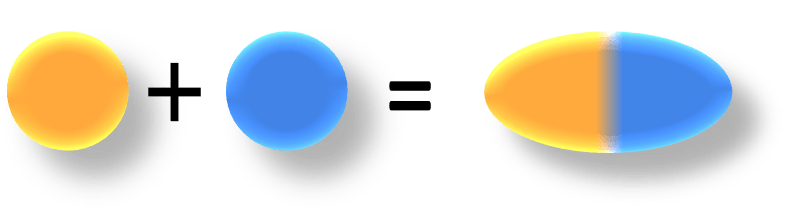
Here are two orbitals (s orbitals) of two atoms. They combine to create a σ bond orbital which is more oval in shape. The nucleus of each atom is on opposite ends.
Image source: By Cassie Gates
Think about taking two bubbles, each on a bubble wand. When they are brought close them together, they will start to merge and form an oval shape. The wand is the nucleus and the bubble is the orbital. The electrons would be in the space inside the bubble and when they merge, the most space is right between. The main difference if that you could bring the wants close together and create one large bubble, but the nucleus of each atom cannot get that close. The nucleus of each atom will repel each other somewhat so that the electron density around the sigma bond isn't perfectly round.
Types of Sigma Bonds
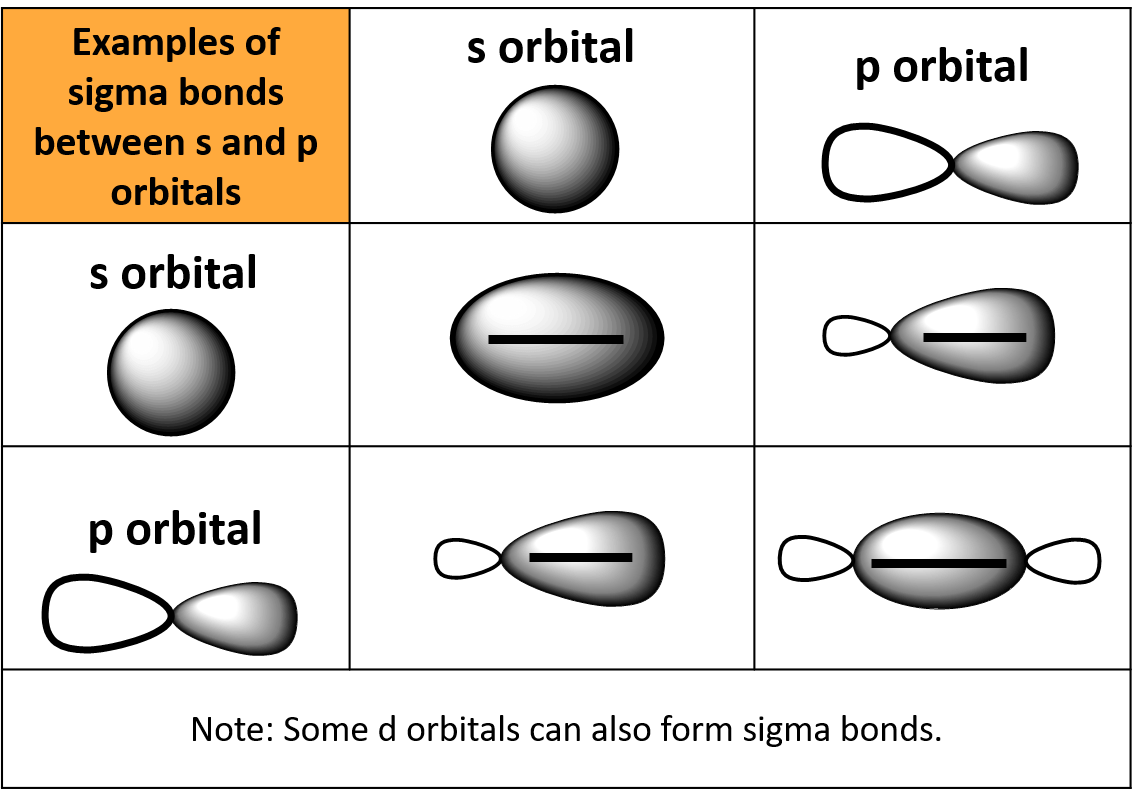
Sigma bonds can occur between different orbitals. The bond is denoted by the black line. The orbitals combine so the same shaded lobes or phases combine. If opposite phases combine it is called anti-bonding.
Image source: By Cassie Gates
An important feature of orbitals are nodes. Nodes are areas of orbitals where electrons do not exist or there is no electron density. The node often occurs between phases. For example, the p orbital which looks like a figure eight has a shaded and unshaded side or phase. The point between these two phases is a node. The s orbital has no node.
It is also important to note that when a sigma bond is formed between two orbitals, no node exists between the orbitals which form a sigma bound.
What are Pi Bonds?
Pi (π) bonds are covalent bonds where two orbital lobes on one atom combine with two lobes on another atom. This means that between these two orbitals, there are two places of overlap separated by a node.

The p orbitals combine to create a pi bond. Note that there is a node created in the pi bond.
Image source: By Cassie Gates
The π bond can form between p orbitals, d orbitals, and between these orbitals.
These bond are present in double and triple bonds. A double bond is made up of one σ and one π bond. A triple bond is made of one σ and two π bonds.