Using the Simple Interest Formula
For better or worse, financial interest is an important concept in life. Let's think positively: you might invest your lottery winnings and earn gazillions of dollars in interest over several years. Borrowing money, taking out personal loans, opening a savings account, creating a Certificate of Deposit (CD) or other big financial decisions may be in your future, only a number of years in the future.
Even though you'd be super rich, it would be helpful to know how to calculate this interest on your own. Simple interest calculators are a thing, but it's important to be able to do the math on your own. This will also help you find the life of the loan.
Before we begin, let's talk about what interest is. Interest is basically a small percent that is calculated based on your principal amount. There might be an interest charge if you take out of a loan, which is like a cost for borrowing. When you pay back the loan, there is also an interest payment. On the other hand, you may earn interest for leaving your money in a bank.
This structure looks kind of like percent change, right?
One of the more disturbing pictures I've seen in a while, but it might be a self-portrait of you after you win the lottery. You should know how to count the interest you're making on that giant pile of cash.
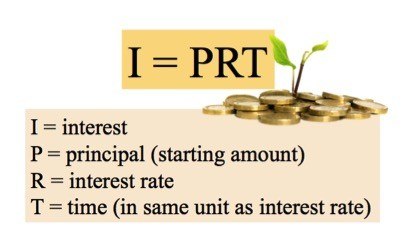
The formula above is called the simple interest formula. It's a pretty easy formula/literal equation to use, and problems that require it are generally plug-and-chug. You will basically multiply the principal amount by the time and interest rate; then interest is calculated!
Let's try out a practice problem or two.
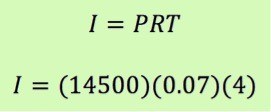
First, let's make sure that we can correctly assign each of the values in the problem to the correct variable in the simple interest formula.
Remember, percentages are parts of 100. When using them in the simple interest formula, we need to rewrite them as decimals.
Make sure that your time variable (T) is based on the same unit as your interest rate variable, R. Since our interest rate variable is in years (the account "pays 7% per year"), our time variable needs to be in years also.
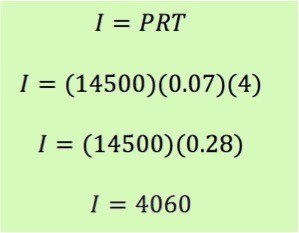
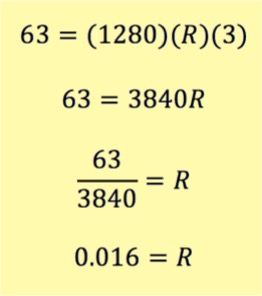
Now, let's plug and chug.
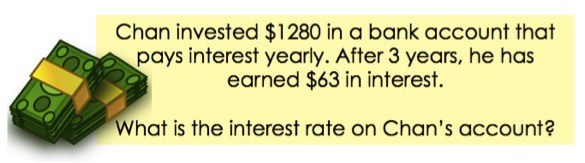
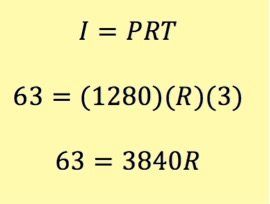
Let's start again by matching up the values in the problem with the variables in the simple interest formula.
Let's say you take out a loan. The bank wants you to pay interest on the interest. That's called compounding! You'll learn about that later. Just know that the biggest difference between compound and simple interest is that with the latter, you pay principal and interest only, not interest on interest.