Simplify with Distributive Property - Examples & Practice

Video · + 1 min read

(Video) Solving Multi-Step Equations

by Friendly Math 101

Here's a video by Friendly Math 101 showing you how to solve equations where you have to use the distributive property.

Summary\large{\text{Summary}}

The first equation she looks at is 5(−7+5a)+3a=1055(-7+5a)+3a=105. Before we begin undoing operations, we need to distribute the 55 into the parentheses terms. Distributing first allows you to more easily combine like terms and group variables. 5(−7+5a)+3a=1055 × (−7)+5 × 5a+3a=105−35+25a+3a=105\begin{align} 5(-7+5a)+3a&=105\\ {\color{#8925AE}{5\,\times}}\,(-7)+{\color{#8925AE}{5\,\times}}\,5a+3a&=105\\ -35+25a+3a&=105 \end{align} Next we can combine like terms. −35+25a+3a=105−35+28a=105\begin{align} -35+{\color{#8925AE}{25a+3a}}&=105\\ -35+28a&=105 \end{align} Finally, we isolate the variable by undoing the operations. −35 + 35+28a=105 + 3528a=14028a28=14028a=5\begin{align} -35\,{\color{#8925AE}{+\,35}}+28a&=105\,{\color{#8925AE}{+\,35}}\\ 28a&=140\\ \frac{28a}{\color{#8925AE}{28}}&=\frac{140}{\color{#8925AE}{28}}\\ a&=5 \end{align}

Always remember to solve using PEMDAS once you've used the distributive property!

Try it yourself!

Solve 7−6(1+2k)=−837-6(1+2k)=-83.

Choose one answer

Video

(Video) An Intro to Solving Linear Equations

by PatrickJMT

In this video, Patrick JMT uses the distributive property to solve some more complex linear equations.

Summary\large{\text{Summary}}

The distributive property says that if you've ever got a number multiplied by some stuff within parentheses, you can get rid of the parentheses by multiplying that number by each individual term within them. What that means, to use an example from the video, is that: 3(m−4)=3(m)−3(4)3(m-4) = 3(m) - 3(4)

In more general terms: a(b+c)=ab+aca(b + c) = ab + ac.

(Video) Solving Linear Equations

by mathman1024

In this video, he looks at one final problem: −[6−(7+x)]=10+3(2x−5)-[6-(7+x)]=10+3(2x-5) Start by distributing the negative sign on the left and the 33 on the right. −[6−(7+x)]=10+3(2x−5)−6+(7+x)=10+3(2x−5)−6+(7+x)=10+6x−15−6+7+x=10+6x−15\begin{align} {\color{#8925AE}{-}}[6-(7+x)]&=10+3(2x-5)\\ -6+(7+x)&=10+{\color{#8925AE}{3}}(2x-5)\\ -6+(7+x)&=10+6x-15\\ -6+7+x&=10+6x-15 \end{align} Next, we combine like terms on the respective sides. −6+7+x=10+6x−151+x=10+6x − 151+x=6x−5\begin{align} {\color{#8925AE}{-6+7}}+x&=10+6x-15\\ 1+x&={\color{#8925AE}{10}}+6x\,{\color{#8925AE}{-\,15}}\\ 1+x&=6x-5 \end{align} Finally, isolate the variable. 1+x=6x−51+x − x=6x − x−51=5x−51 + 5=5x−5 + 56=5x65=5x565=x\begin{align} 1+x&=6x-5\\ 1+x\,\color{#8925AE}{-\,x}&=6x\,{\color{#8925AE}{-\,x}}-5\\ 1&=5x-5\\ 1\,\color{#8925AE}{+\,5}&=5x-5\,\color{#8925AE}{+\,5}\\ 6&=5x\\ \frac{6}{\color{#8925AE}{5}}&=\frac{5x}{\color{#8925AE}{5}}\\ \frac65&=x \end{align}

Interactive · 6 questions

The Distributive Property

When you see a complex equation with parentheses in it, the PEMDAS part of your brain should remind you that you need to take care of the parentheses (and the stuff inside them) before you can go any further.

PEMDAS is a trick used to remember the Order of Operations—the sequence of steps you need to take to solve an equation. You start with anything that has parentheses (P), then move on to exponents (E), multiplication (M) and division (D), and finally addition (A) and subtraction (S).

The simplest way of managing parentheses is often through the distributive property. When using this approach, you do exactly what it sounds like: you distribute the things outside the parentheses to the terms inside them.

We'll take a look at a few examples below that combine complex equations and the distributive property.

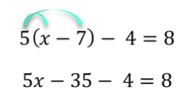
Let's start with this example: 5(x−7)−4=85(x - 7) - 4 = 8

What is the first thing we need to do in order to solve this equation?

Choose one answer

Illustrated · 1 min

When solving problems, you may encounter a situation where you'll need to use the distributive property.

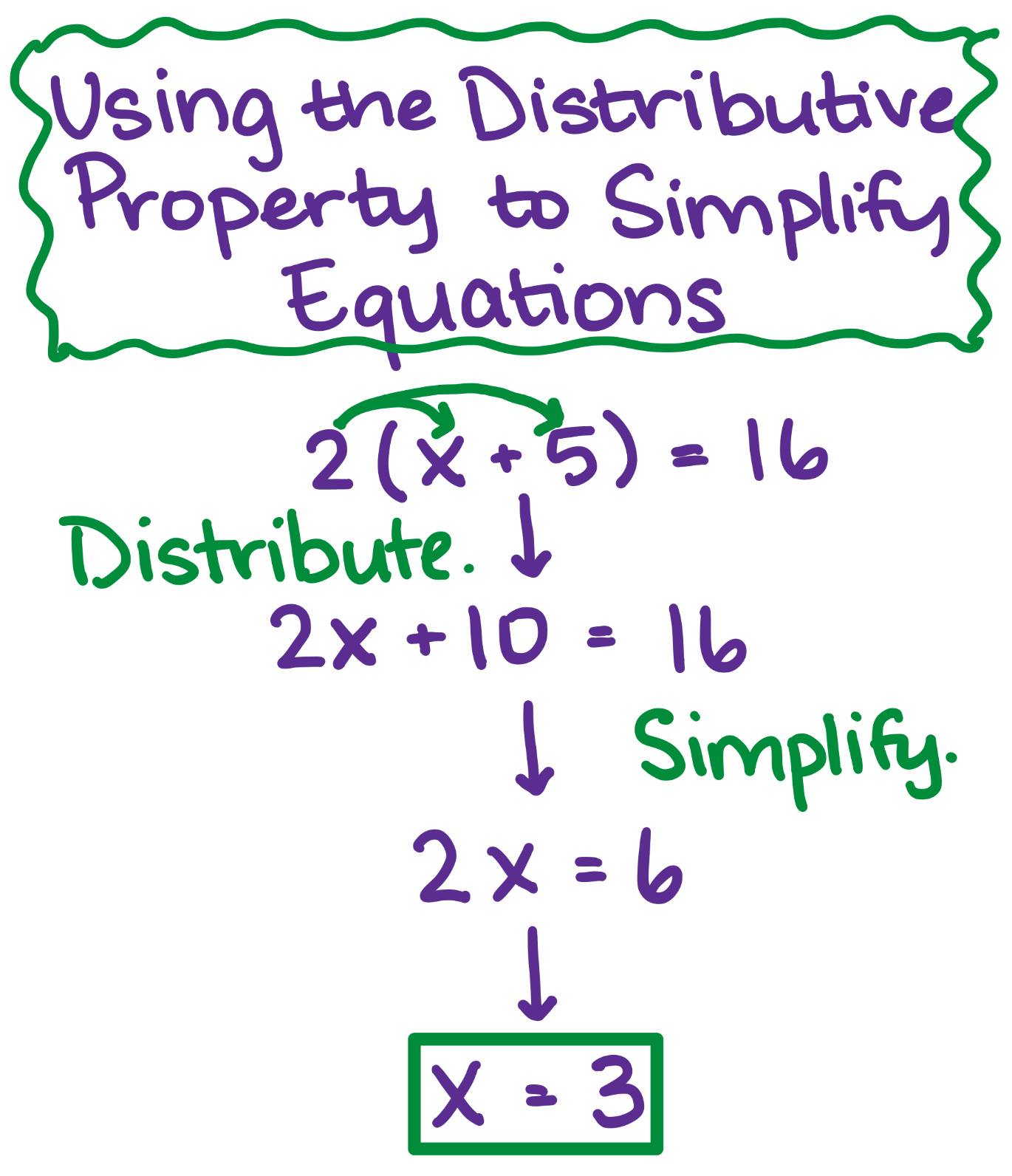
Using the Distributive Property to Simplify Equations
$$2(x+5)=16$$
Distribute.
$$2x+10=16$$
Simplify
$$2x=6$$
$$x=3$$

Image source: by Anusha Rahman

We can use the distribute property as normal to be able to solve this problem. We multiply the xx through to the individual values within the parentheses.

Type a concept, like “slope” or “photosynthesis”.

↑ ↓ to choose · Enter to openSearch explanations and problems