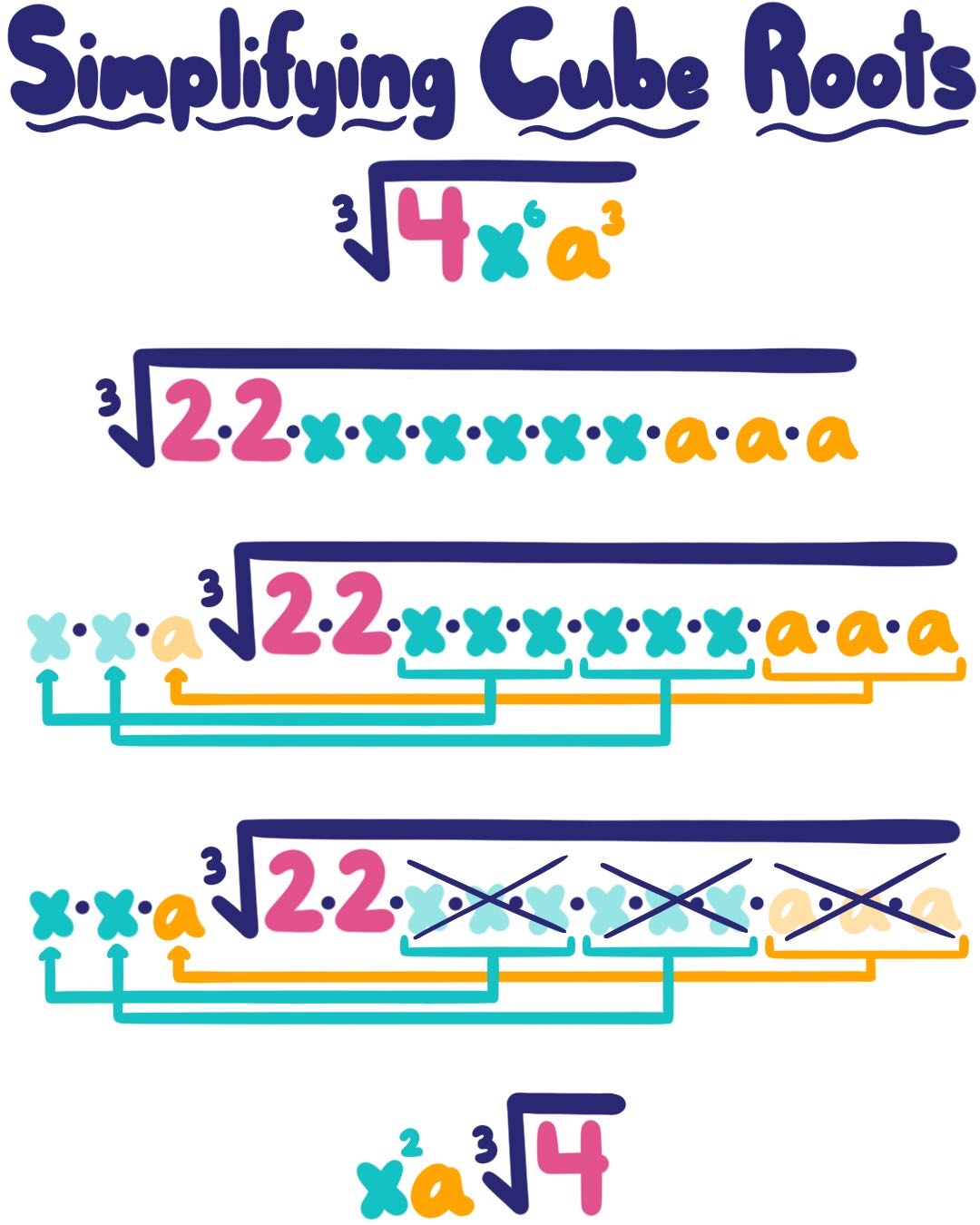
There are many different techniques you can use to simplify cube roots, similar to how you can simplify square roots. In this explanation, we will learn a slightly different method. Don't worry, you'll get the same answer either way.
Step One:
Rewrite the number or expression under the cube root in terms of its factors. You may even want to break these factors down into THEIR factors...this might help you later. For example, you might do this:
372=312⋅6=3(4⋅3)⋅(2⋅3)=3((2⋅2)⋅3)⋅(2⋅3)=32⋅2⋅2⋅3⋅3
Step Two:
Since we are taking the cube root(i.e., 398), we want to look for perfect cube factors. Every time we see a group of three of the same factors, we write one copy of that factor outside of the cube root sign. Here's how it works:
32⋅2⋅2⋅3⋅3→32⋅2⋅2⋅3⋅3, where 2 is the perfect cube factor→232⋅2⋅2⋅3⋅3
Step Three:
Next, remember the groups of three perfect cube factors we found under the cube root? Eliminate them from under the cube root, like this:
232⋅2⋅2⋅3⋅3→232⋅2⋅2⋅3⋅3→233⋅3
This result is equivalent to the cube root we are trying to simplify! In this example, 372=233⋅3.
Step Four:
Simplify everything!
372=233⋅3=239
Here's a graphic that goes through the steps, but with a different expression underneath the cube root!
Image source: By Caroline Kulczycky
(It is important to note that this method applies to monomials. You cannot split up radicals with sums and differences in the same way.)
Let's do another example!
Simplify 327x4y2z3.
Step One: Break down the expression into its factors
327x4y2z3=33⋅3⋅3⋅x⋅x⋅x⋅x⋅y⋅y⋅z⋅z⋅z
Step Two: Every time you see a pair of the same factors, write one copy of that factor outside the radical
When we simplify roots—cube roots or square roots—we want to get as much as we can out from underneath the radical. The term for the number or variable within the radical is called the radicand. We might not be able to get all of the radicand out, but we want to try. To do this with cube roots, we need to make sure that we're breaking down the radicand so that we can find any factor that's a perfect cube (remember that when multiplying radicals, a×b=a×b ).
Let's try it. How can we simplify 356y4? Let's think of it in terms of steps:
Separate out the different kind of numbers (variables vs. constants).
There are two different kinds of numbers in 356y4: constants (56) and variables (y4). Since we can't know what y is just by looking at the equation, we have to deal with it separately. For now, let's visualize the equation as 356×y4 so that the terms are clearly separate.
Step 2: Find the Cube Factors.
Now, we can look at 56 and y4 separately. Let's start with y4.
Does y4 have a perfect cube factor?
y4does have a perfect cube factor. y4=y⋅y⋅y⋅y, which we can also write as y3⋅y. y3 is a perfect square, so let's make that clear in our problem:
356⋅y3⋅y
Now, let's look at 56. Select all the possible factors of 56:
Right, the factors of 56 are 1,2,4,7,8,14,28, and 56.
Which of those factors are a perfect cube?
8=2×2×2=23
8 is a perfect cube! Let's rewrite 56 in terms of its factors in the original problem:
37×8×y3×y
Step 3: Pull the Cube Roots Out From Under the Radical.
Now that we have our expression expanded so that it's easy to find the perfect cubes, we can pull their cube roots out of the radical. To do that, you have to find the cube root of each perfect cube in the equation.
What is 38?
Right, the cube root of 8 is 2. Now that we know what it is, we can rewrite our original equation as:
237×y3×y
What is 3y3?
The cube root of y3 is y. So we can write the equation as:
2×y×37×y
Since there aren't any more perfect cubes inside the radical, we're just about done!
Step 4: Put Everything Back Together
Step 4 is tidying up the expression. We can get rid of the multiplication signs that we used to make everything clearer, compressing the equation down a little bit so it's easier to read:
356y4=2y37y
And we're done!
This by Math Meeting shows you how to simplify cubed root expressions.
Summary
Simplifying cube roots is similar to simplifying square roots. We want to find any factors that are perfect cubes that are a factor of our number and pull them out.
For example, suppose we want to find 372. We can factor 72 as follows:
372=38×98 is a perfect cube. Therefore, we can split it from the 9.
38×9=38×39=2×39=239