Sine Function Properties

Interactive · 1 question

Properties of Sine

Sine is a trigonometric function of an angle. It has a number of properties, such as being periodic and odd. In the context of a triangle, for the specified angle, sine is the ratio of the length of the side that is OPPOSITE the angle to the length of the longest side, or HYPOTENUSE, of the triangle.

Circle featuring a right triangle with acute angle, alpha, showing the sin(alpha)

Image by Ilmari Karonen via Wikimedia Commons

Once a triangle to analyze is chosen, we can write: sin⁡(α)=oppositehypotenuse\sin(\alpha) = \frac{opposite}{hypotenuse}

Like I said above, sine is periodic, which means that it is a function returning to the same value at regular intervals. Sine has a period of 2π2\pi, which means we can write it as: sin⁡(α)=sin⁡(α+2π)\sin(\alpha) = \sin(\alpha + 2\pi) or, in a more general sense, sin⁡(α)=sin⁡(α+2kπ),k∈allintegers\sin(\alpha) = \sin(\alpha + 2k\pi), k \in all \hspace{0.25cm} integers

A graph showing one period of sine

Image by Geek3 via Wikimedia Commons

As you can see from the graph above, the value of sin⁡(α)\sin(\alpha) will always be between the values of −1-1 and 11.

Can the sin⁡(α)=2.4\sin(\alpha) = 2.4?

Choose one answer

Video · + 1 min read

(Video) Properties of the Sine Graph

by Math with Mister A

In this video by Math by Mister A, you will learn about some of the major characteristics of sine graphs.

Summary

Here is the a graph of the sine function:

Graph of y=sin(x)

Made using Desmos

The range of the function is from [−1,1][-1,1]. The maximum is at y=1y=1, and the minimum is at y=−1y=-1, with points continuously between these two points. The xx-intercepts are at 00, π\pi, 2π2\pi, 3π3\pi, etc., on the positive side. On the negative side, the xx-intercepts are at −π-\pi, −2π-2\pi, etc. We can represent the xx-intercepts as nπn\pi, where nn is an integer.

The relative maximum is at π2\frac{\pi}{2} and 5π2\frac{5\pi}{2}. We need to go a distance of 2π2\pi units to get from one relative maximum to another, so we can mathematically represent the relative maximums with: π2+2πn\frac{\pi}{2} + 2\pi n, where nn is an integer.

The relative minimum is at 3π2\frac{3\pi}{2} and −π2\frac{-\pi}{2}. We need to go a distance of 2π2\pi units to get from one relative minimum to another, so we can mathematically represent the relative minimums with: 3π2+2πn\frac{3\pi}{2} + 2\pi n, where nn is an integer.

Illustrated · 1 min

Properties of the Sine Function

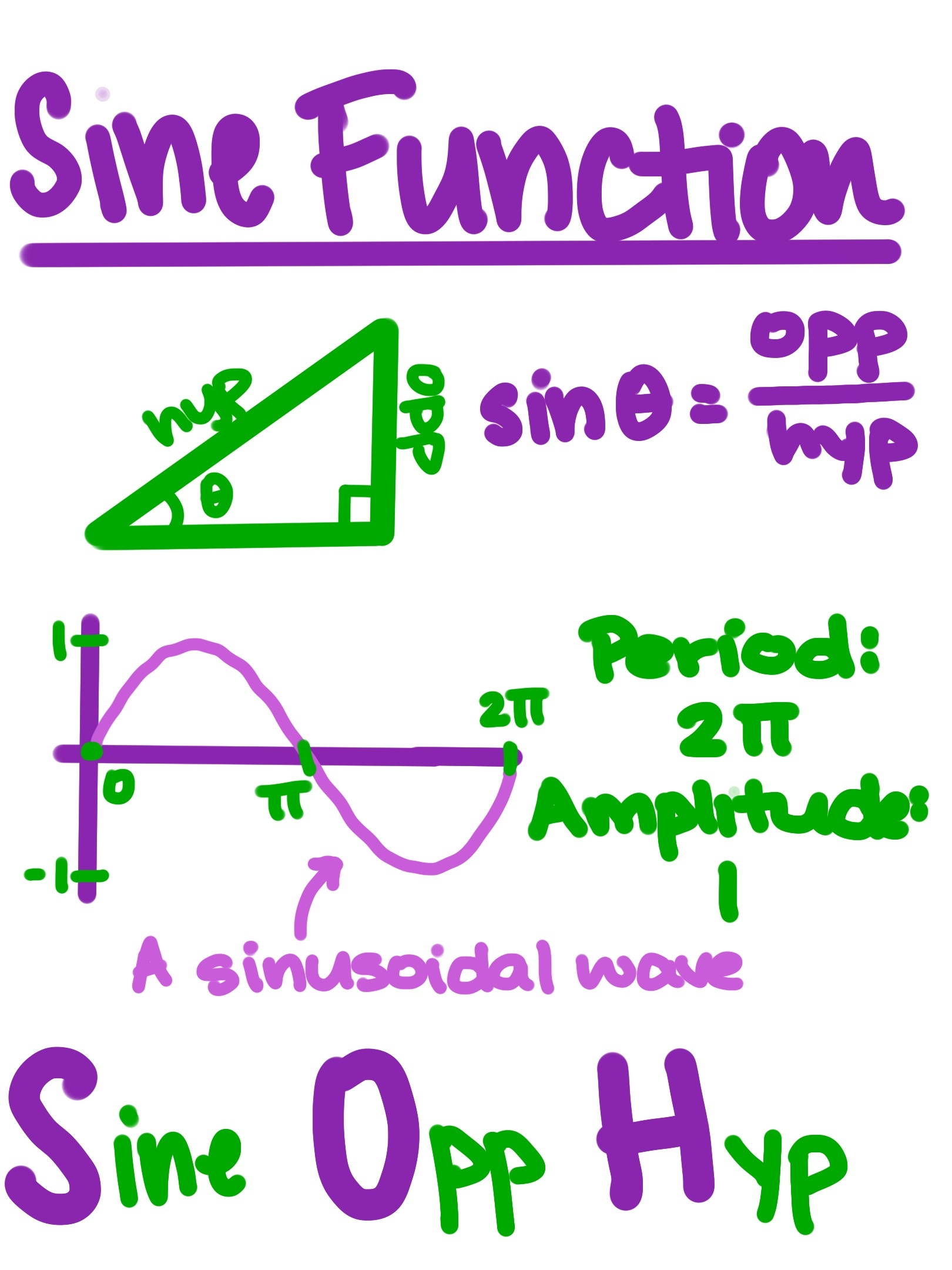
Let's look at the SOH in SOHCAHTOA! There are a few key characteristics of sine.

Sine Function
sin(theta)= opp / hyp
Period: 2pi
Amplitude: 1
A sinusoidal wave
Sine Opp Hyp (SOH)

Image source: by Anusha Rahman

We know from SOHCAHTOA, that sine functions are: sin(θ)=oppositehypotenusesin(\theta) = \frac{\text{opposite}}{\text{hypotenuse}}

Here is the graph:

Graph of sin(x)

Made using Desmos

The graph of y=sin(θ)y=sin(\theta) starts at y=0y=0 then peaks at y=1y=1. The curve then goes down, crosses the xx-axis at x=πx=\pi, and hits the trough at y=1y=1. The graph then goes back up to touch the xx-axis at x=2πx=2\pi. Sine is a periodic function, so this cycle repeats (think: the unit circle!).

We can also use the unit circle to find sine.

You can also do transformations. One example is a phase shift, where the function starts at a value on the xx-axis that is not at the origin. You can think of a phase shift as a horizontal translation.

In later lessons, you will learn about the inverse of the sine, arcsine. You will also learn about the reciprocal of sine, cosecant.

Type a concept, like “slope” or “photosynthesis”.

↑ ↓ to choose · Enter to openSearch explanations and problems