Interactive · 2 questions

When we learned about sampling biases, we talked about the importance of single-blind and double-blind experiments to protect from these biases.
Single-Blind Experiments
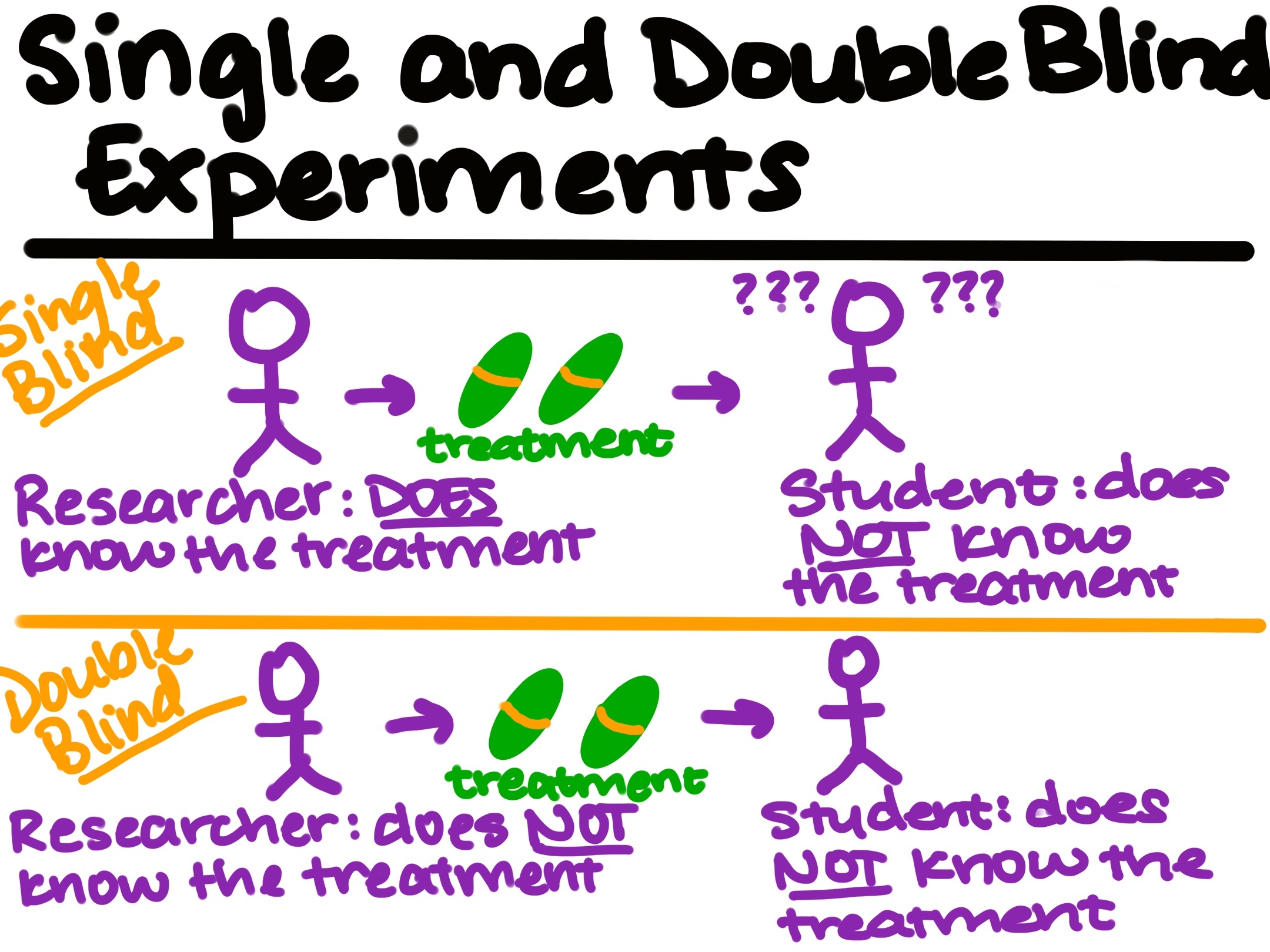
A single-blind experiment is when the participants do not know which IV group they are a part of. The goal of single-blind experiments is to protect from biases that may impact a participant's performance.
Let's talk through an example.
Harold wants to test a new drug, Hondoclaride, on people's moods. Hondoclaride is supposed to make people angry. He gives half of the participants a placebo, and he gives the other half of the participants a dose of Hondoclaride. However, he doesn't tell the participant which injection they got. Say Jenny got a dose of Hondoclaride, and Harold tells her that. Jenny starts to feel angry.
How do we know that Jenny feels angry because of the Hondoclaride, or because that's what she thinks she's supposed to feel?
That's where a single-blind experiment comes in! Harold can give Jenny a dose of Hondoclaride but not tell her that he did. That way Jenny won't know whether she got the placebo or Hondoclaride. Now, if Jenny feels angry, we can speculate that it's due to the Hondoclaride.
Single-blind experiments are designed to protect against any biases that may influence the research outcome. In single-blind experiments, the participant doesn't know which level of IV they're assigned to, but the researcher does.
Double-Blind Experiments
Double-blind experiments are similar to single-blind experiments, but have one key difference. In double-blind experiments, neither the participant nor the researcher knows what group/level of IV the participant is assigned to.
If neither the researcher nor the participant knows the level of IV the participant is assigned to, we can still determine the research effects. A research team is made up a bunch of people, so a coordinator on the team will be able to separate which participants are in which group. It's cool!
So, now let's talk go back to the previous example with Hondoclaride.
We could make that experiment a double-blind experiment is neither Harold, the researcher, nor Jenny, the participant knew whether Jenny got the placebo or the dose of Hondoclaride.
Similar to single-blind experiments, we use double-blind experiments when we want to reduce bias in our research.
Examples
Now, it's your turn! Answer the next couple of example problems by yourself.
Maria hypothesizes that people who drink more water are more energetic. She sets up an experiment to test this theory. She recruits participants for her study, and randomly assigns them to one of two groups. The first group drinks of water in four hours. The second group drinks of water in four hours.
After those four hours, each participant meets with Maria. Neither Maria nor the participant knows which group each individual is in, as the participants don't know the true nature of the experiment. During the meeting, Maria scores the participants' energy on a scale from .
Is Maria's experiment a double-blind or single-blind experiment?
Explanation:
Because neither Maria nor the participant knows the level of IV the participant is assigned to, this is a double-blind experiment. A double-blind experiment is most effective in this research study in order to eliminate both participant and researcher bias.
Try the next example.
Gary and Sasha are conducting an experiment on whether people like Coke or Pepsi more. They set up an experiment where each participant gets a cup or Coke and a cup of Pepsi, and the participant has to decide which they like more. The bottom of the cups (where the participant can't see) are labelled with the brand of soda.
Should Gary and Sasha set up a single-blind experiment or a double-blind experiment?
Explanation:
In this experiment, the researcher knows which cup has Coke and which cup has Pepsi, so there's no reason to protect against researcher bias, since that's very limited in this study. It is important to protect against participant bias, so Gary and Sasha should not tell the participant which cup has which soda!