Solute — Definition & Overview

Before this, knowWhat Is a Solution? — Overview & Examples

Illustrated · 1 min

Solutes

The solute is the thing being dissolved in a solution. It makes up less of the solution than the solvent. It is soluble, which is another way to say that it can be dissolved.

An image of a blue, powdery substance (labeled "solute") about to be added to a flask with liquid inside (labeled "solvent")

Solute is added to a solvent, forming a solution.

Image source: By Deena Hauze

When you mix sugar and water, the sugar is the solute being dissolved. Similarly, if you make lemonade, it's the lemon juice and sugar.

There are many types of solutes in the scientific world. Common ones in biology include sugar, carbon dioxide, and salt.

Concentration

Five glasses with varying shades of red liquid are shown. The most diluted liquid (which is pink) is on the left. The most concentrated liquid (which is dark red) is on the right.

Image source: By FirstPrinciples [Public domain], via Wikimedia Commons

The amount of solute in the solution changes the concentration of that solution. A solvent which contains very little of the substance being dissolved is called a dilute solution. A solvent with a lot of dissolved solute is called a concentrated solution because of its high concentration.

Types of Solutions

An unsaturated solution has some substance dissolved in the solvent, but it has the potential to dissolve much more.

In a saturated solution, the solvent contains a large amount of solute.

If any more is added, it won't dissolve in the solvent. Instead, the extra solute will precipitate (condense and fall) from the solution. This is known as a supersaturated solution.

Graph showing the solubility of different chemicals as temperature increases. Solubility is represented on the y-axis. Temperature is on the x-axis. The solubility of nearly every chemical increases with an increase in temperature.

Image source: By OpenStax CC BY 4.0, via Wikimedia Commons

Heating a solution up can increase the solubility of a substance, meaning that more stuff can dissolve faster. This is true for most solutes, but not all. Think of making iced tea and hot tea. The hot tea gets darker (more concentrated) much faster than the iced tea.

Vocabulary Review:\color{#8925AE}{\text{Vocabulary Review:}}

Solution\color{#8925AE}{\text{Solution}} : A homogeneous mixture made of two or more substances

Solute\color{#8925AE}{\text{Solute}} : The substance dissolved in another substance

Solvent\color{#8925AE}{\text{Solvent}} : The substance doing the dissolving–the majority of the solution
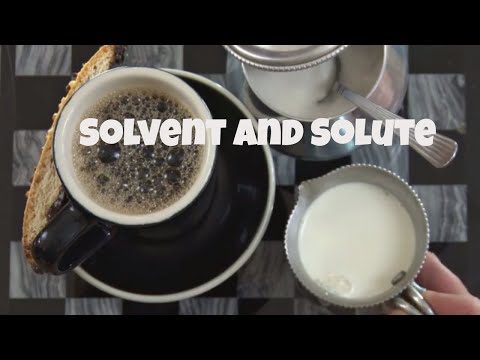
Video

(Video) Solvent Solute Solution: What Is the Difference?

by MooMoo Math and Science

Watch this video to learn about solutes and solvents. These are the ingredients of a solution.

Illustrated · 1 min

What Is a Solute?

A solution is a homogenenous mixture composed of one or more solutes uniformly dissolved in a solvent.

Solutes are the substances dissolved in solvents.

Image source: By Hannah Bonville

The main requirement for solutions is that the solute is distributed uniformly (evenly) throughout the solvent. This makes solutions a type of homogeneous mixture.

While we most often think of solutions as solids dissolved in liquids (for example, salt dissolved in water, sugar dissolved in tea, etc.), both solvents and solutes can be solids, liquids, or gases. This means we can have things like solid solutions or gaseous solutions.

Vocabulary:

  1. Solution
  2. Solvent
  3. Solute

Illustrated · 1 min

What Is a Solute?

The image shows a small chunk of a beach. A section of it is zoomed in to reveal molecules. The saltwater (a solution) is made of salt (the solute) and water (the solvent). The molecules are colored red to represent sodium, yellow to represent chlorine, and blue to represent water.

Image source: By Sarah Morgan

A solute is a molecule that dissolves into a solvent.

There's a reason water in the ocean is called "salt water" and not "water salt". In this case, water is a solvent that contains dissolved salt. The salt is the solute. There is much more water in salt water than there is salt.

Type a concept, like “slope” or “photosynthesis”.

↑ ↓ to choose · Enter to openSearch explanations and problems

