Solvent — Definition & Overview

Before this, knowWhat Is a Solution? — Overview & Examples

Illustrated · 1 min

Dissolving Other Compounds

A solvent is a liquid which dissolves a solute. It makes up most of a solution. There are many types including water, alcohols, and organic compounds. Water is known as a universal solvent because it can dissolve most other chemicals, with the exception of nonpolar liquids like oil.

Solutions with water as the solvent are called aqueous solutions. You can kind of see the word aqua (which means water) in the word "aqueous".

An image of a blue, powdery substance (labeled "solute") about to be added to a flask with liquid inside (labeled "solvent")

Solute is added to a solvent, forming a solution.

Image source: By Deena Hauze

Concentration

The amount of solute in the solution changes the concentration of that solution. A solvent with very little dissolved solute is called a dilute solution. One with a lot of dissolved solute is called a concentrated solution because of its high concentration.
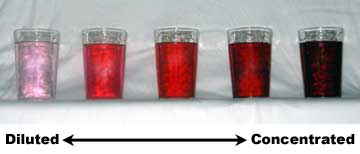
Five glasses with varying shades of red liquid are shown. The most diluted liquid (which is pink) is on the left. The most concentrated liquid (which is dark red) is on the right.

Image source: By FirstPrinciples [Public domain], via Wikimedia Commons

Types of Solutions

  • An unsaturated solution has some solute in the solvent, but it could dissolve much more.

  • In a saturated solution, the solvent contains a large amount of solute.

  • If any more solute is added, it won't dissolve. Instead, the extra solute will precipitate (condense and fall) from the solution. This is known as a supersaturated solution.

Vocabulary Review:\color{#8925AE}{\text{Vocabulary Review:}}

Solution\color{#8925AE}{\text{Solution}} : A homogeneous mixture made of two or more substances

Solute\color{#8925AE}{\text{Solute}} : The substance dissolved in another substance

Solvent\color{#8925AE}{\text{Solvent}} : A substance capable of dissolving another substance. It makes up the majority of a solution

Video

(Video) Solvent Solute Solution What Is the Difference?

by MooMoo Math and Science

You deal with solvents, solutes, and solutions in your everyday life, but which is which? This quick video gives examples of all three, like which part of your morning coffee is a solute, or how oxygen is dissolved in that awesome waterfall you saw while hiking.

Illustrated · 1 min

What Is a Solution?

A solution is a homogenenous mixture composed of one or more solutes uniformly dissolved in a solvent.

The most important and common solvent in biology is water. While there are many important solutes, the two you are most likely to see are salt and sugar (glucose).

Components of a Solution

Solutes are the substances dissolved in solvents.

Image source: By Hannah Bonville

While we most often think of solutions as solids dissolved in liquids (for example, salt dissolved in water, sugar dissolved in tea, etc.), both solvents and solutes can be solids, liquids, or gases.

The main requirement for solutions is that the solute is distributed uniformly (evenly) throughout the solvent.

Water is the most important solvent in biology.

Water: The most important solvent in biology

Image source: By Davide Restivo CC BY-SA 2.0, via flickr.com

Type a concept, like “slope” or “photosynthesis”.

↑ ↓ to choose · Enter to openSearch explanations and problems