Read · 1 min

As we learn about the myriad of applications of logarithms, like the Richter Scale, Benford's Law, and e, one of the most useful is compound interest. It is similar to continuously compounded interest, but not quite the same. Let's learn more!

##Compound Interest

Compound interest is interest that is taken on both the principle and the interest. In other words, interest is taken on the original value (principal) plus any interest that has been previously added.

Compound interest is most often used in bank accounts. In fact, most bank accounts (checking and savings accounts) compound interest multiple times a year. They can compound monthly, compound quarterly, or compound annually.

##Calculate Compound Interest There is a compound interest formula we can use to calculate compound interest.

A=P(1+rn)ntA = P(1+\frac{r}{n})^{nt}

Where...

A = Amount of money in account

P = Principal, the original amount

r = the interest rate (decimal)

t = time

n = the number of times interest is compounded per unit of time (t)

##Example Let's try an example in a word problem!

Sally put 5000 dollars into her bank account 4 years ago. The bank has an interest rate of 1.5%, which is compounded monthly. How much money is in her bank account now?

We can use the compound interest formula to help us solve.

We are solving for A and we know that P = 5000, r = 0.015, t = 4, and n = 12 (since there are 12 months in a year). We can then plug into the formula...

A=5000(1+.01512)(12)(4)A = 5000(1+\frac{.015}{12})^{(12)(4)}

Therefore, A = 5,308.985,308.98 dollars. There is $5,308.98\$5,308.98 in Sally's bank account after 4 years.

Video · + 1 min read

(Video) Compound Interest

by The Organic Chemistry Tutor

In this video by the Organic Chemistry Tutor, you will learn about some applications of the compound interest, which will help you to solve compound interest math problems.

We've been learning about applications of exponential and logarithmic functions, like the Richter scale and Benford's law, but now let's learn about compound interest.

Compound interest is when interest is taken on money in a bank account or money borrowed with a loan. Compound interest is different from continuously compounded interest because it is compounded at certain times, like monthly or annually.

The video above by The Organic Chemistry Tutor works through many great example problems to help you learn how to calculate compound interest. Let's work through the first problem together.

The first key information to know is the formula for compound interest:

A=P(1+rn)ntA = P (1+ \frac{r}{n})^{nt}

Where...

A = final amount of money

P = principal/initial amount

R = interest rate (as decimal)

n= number of times interest is compounded per unit of time (t)

t = time

In the first problem, we are given that P, the initial amount, is 1000 dollars and the annual interest rate is 9%. We are asked to find the final amount of money in the bank account after 10 and 20 years.

A key hint in the question is that the annual interest rate is given, meaning we know the interest is compounded once per year. As the time is given in the unit of years, we know that n=1n=1. Now we can plug the information given in the question into the formula.

A=1000(1+0.091)(1)(10)A= 1000(1 + \frac{0.09}{1})^{(1)(10)} A=1000(1.09)10=2,367.36A=1000(1.09)^{10}= 2,367.36

So after ten years, the final amount in the bank account is 2,367.36 dollars, so 1,367.36 dollars were accrued in interest.

A=1000(1+0.091)(1)(20)A= 1000(1 + \frac{0.09}{1})^{(1)(20)} A=1000(1.09)20=5,604.41A=1000(1.09)^{20}= 5,604.41

After 20 years, the final amount in the bank account is 5,604.41 dollars, so 4,604.41 dollars were accrued in interest.

Keep watching the video to work through more practice problems!

Illustrated · 1 min

Compound Interest

Compound interest is the money you earn not only on your original amount (called the principal), but also on the interest you've already earned. This makes your money grow faster than it would with simple interest.

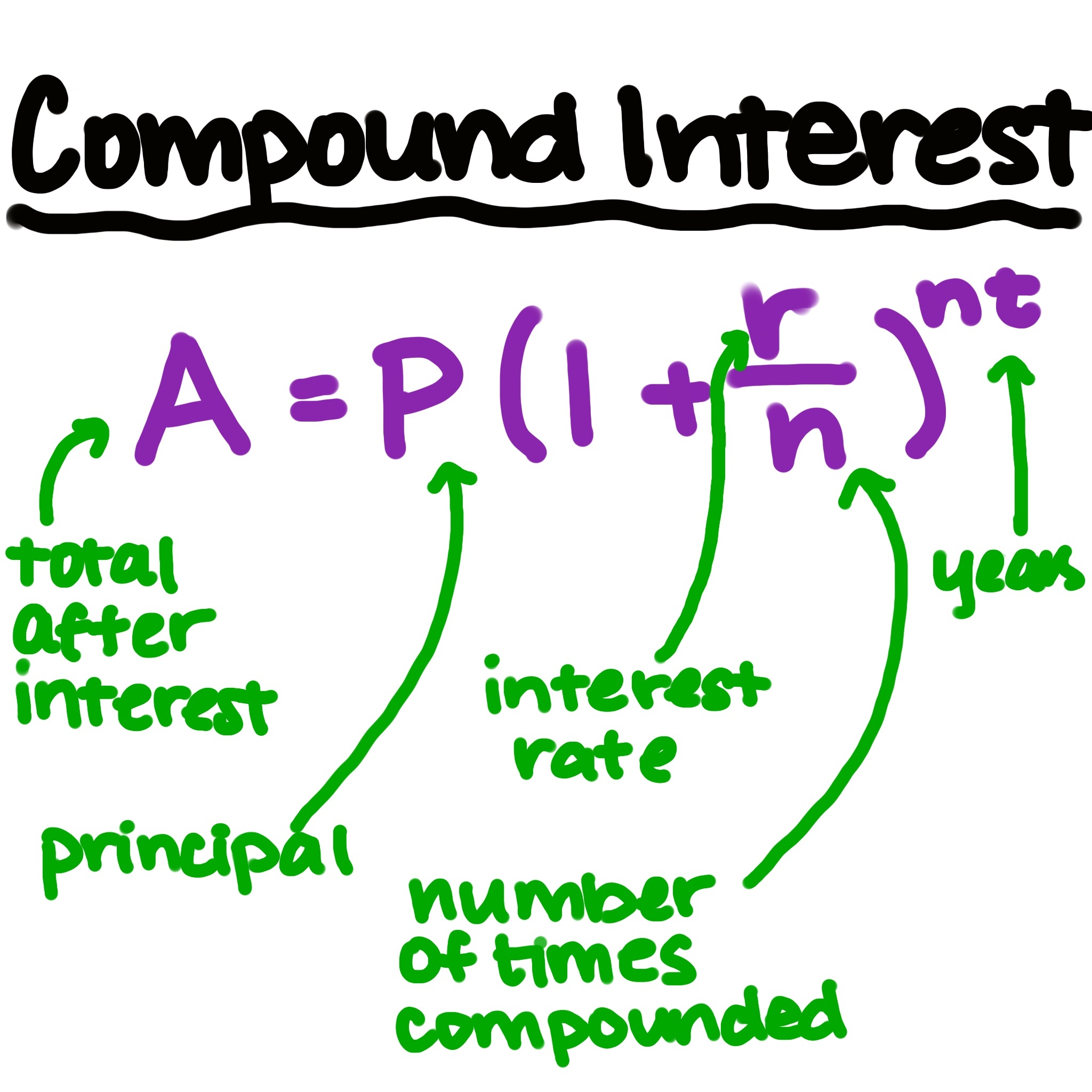
Compound interest formula

Image source: by Anusha

The formula for compound interest is:

A=P(1+rn)ntA = P (1+\frac{r}{n})^{nt}

, where:

  • AA is the total amount of money after interest
  • PP is the principal amount (or the starting amount)
  • rr is the interest rate (written as a decimal)
  • nn is the number of times interest is added (or compounded) per year
  • tt is the number of years

To solve compound interest problems, you will plug in the values you know and solve for the values you don't know.

Example

For example, say you invest 1,0001,000 at a 5%5\% interest rate compounded yearly for 33 years.

The equation would look like:

A=1000(1+0.051)1⋅3A = 1000 (1+\frac{0.05}{1})^{1 \cdot 3}

If we were to solve that equation for AA, we would find that A=1,157.63A=1,157.63.

So, after three years of compounding interest, you would have $1,157.63\$1,157.63. The more often interest is compounded (monthly, daily), the faster your money grows. Solving these problems will help you to understand how savings accounts, loans, and investments work over time.

In the next lesson, we will round out the last of applications of logarithms.

Type a concept, like “slope” or “photosynthesis”.

↑ ↓ to choose · Enter to openSearch explanations and problems