Read · 1 min
+1 contributors

As we learn about the myriad of applications of logarithms, like the Richter Scale, Benford's Law, and e, one of the most useful is compound interest. It is similar to continuously compounded interest, but not quite the same. Let's learn more!
##Compound Interest
Compound interest is interest that is taken on both the principle and the interest. In other words, interest is taken on the original value (principal) plus any interest that has been previously added.
Compound interest is most often used in bank accounts. In fact, most bank accounts (checking and savings accounts) compound interest multiple times a year. They can compound monthly, compound quarterly, or compound annually.
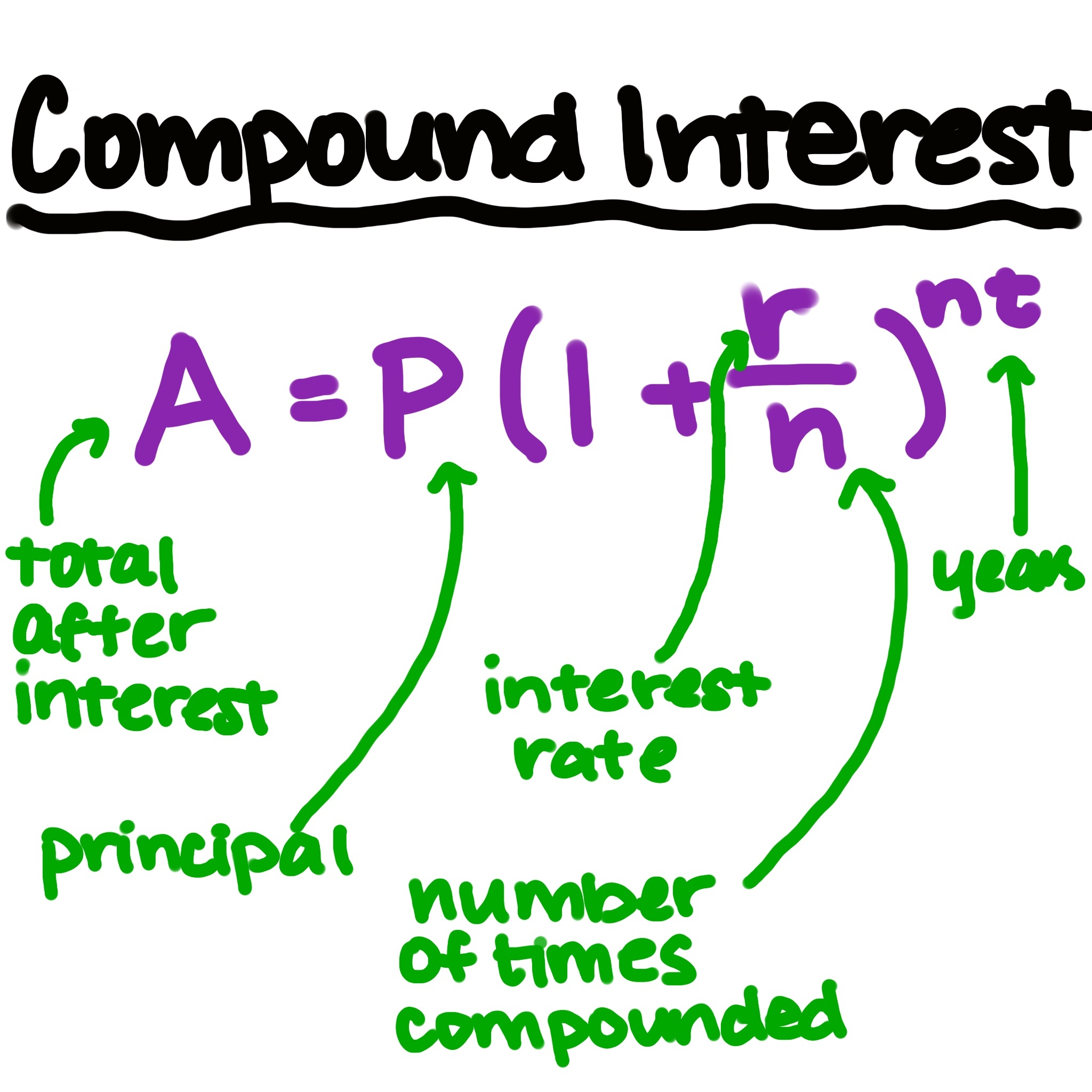
##Calculate Compound Interest There is a compound interest formula we can use to calculate compound interest.
Where...
A = Amount of money in account
P = Principal, the original amount
r = the interest rate (decimal)
t = time
n = the number of times interest is compounded per unit of time (t)
##Example Let's try an example in a word problem!
Sally put 5000 dollars into her bank account 4 years ago. The bank has an interest rate of 1.5%, which is compounded monthly. How much money is in her bank account now?
We can use the compound interest formula to help us solve.
We are solving for A and we know that P = 5000, r = 0.015, t = 4, and n = 12 (since there are 12 months in a year). We can then plug into the formula...
Therefore, A = dollars. There is in Sally's bank account after 4 years.