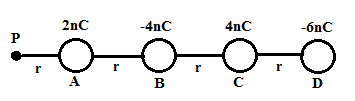
Step 1: Calculate the E caused by each charge (A, B, C, D). Ignore sign while calculating the magnitude of E and use it to determine the direction of E.
E from A = (0.5)2(9×10⁹)(2×10⁻⁹)=72cN(−i)
Note that since P has a negative charge and A has a positive charge, the E from A will move in the −i direction toward P. (72cN(−i) is the same as −72cNi)
E from B = (1)2(9×10⁹)(4×10⁻⁹)=36cN(+i)
Note that since P has a negative charge and B has a negative charge, the E from B will move in the +i direction away from P
E from C = (1.5)2(9×10⁹)(4×10⁻⁹)=16cN(−i)
E from D = (2)2(9×10⁹)(6×10⁻⁹)=13.5cN(+i)
Step 2: Add up the E at point P from A, B, C and D
E=−72+36−16+13.5=−38.5cNi
Step 3: Calculate the Electric Force using the E at point P from A, B, C and D
F=qoE=(−3×10⁻⁹)(−38.5)=1.55×10⁻⁷N
Example 2:
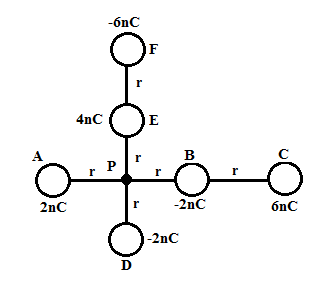
E from A = (0.5)2(9×10⁹)(2×10⁻⁹)=72cNi
E from B = (0.5)2(9×10⁹)(2×10⁻⁹)=72cNi
E from C = (1)2(9×10⁹)(6×10⁻⁹)=−54cNi
E from D = (0.5)2(9×10⁹)(2×10⁻⁹)=−72cNj
E from E = (0.5)2(9×10⁹)(4×10⁻⁹)=−144cNj
E from F = (1)2(9×10⁹)(6×10⁻⁹)=54cNj
E=72i+72i−54i−72j−144j+54j=90i−162jcN
F=qoE=(3×10⁻⁹)(90i−162j)=2.7×10⁻⁷i−4.86×10⁻⁷jN
In short, electric field at any point of space is the vector sum of the fields at that point of all individual sources for superposition.
Test Yourself:

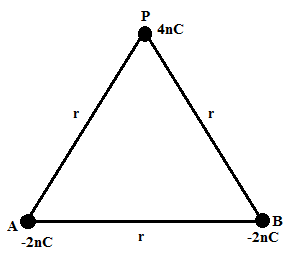 Hint: This is an equilateral triangle so the angle at A, B and P is 60 degrees
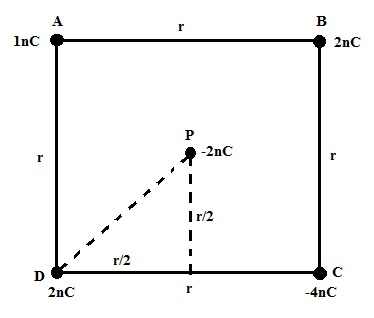 Hint: This is a square so each angle is 45 degrees