Solving One-Step Equations with Addition and Subtraction — Examples

Interactive · 3 questions

Solving By Addition

Solving an equation means that you are trying to find the values of the variables in the equation. We do this by altering the problem to isolate the variable on one side of the equation.

If your equation has a subtraction operator, we are going to use addition to isolate the variable. Let’s look at an example. x−5=2x-5=2 First, we can see that xx and 55 are on one side of the equation, while 22 is on the other. We want to figure out what xx is, so we want to isolate the variable. We'll do this by adding 55 to both sides of the equation. x−5=2x−5+5=2+5x=2+5x=7\begin{align} x-5 &= 2\\ x-5 \color{#29A603}{+5} &= 2 \color{#29A603}{+5} \\ x &= 2+5 \\ x&= 7 \\ \end{align} In summary, equations where a number is added to a variable can be solved by subtracting the number from both sides.

We can generalize this concept using a linear equation: x−a=bx-a=b where aa and bb are both constants and xx is the variable.

Now, we need to isolate the variable xx. We're going to add aa to both sides of the equation. x−a=bx−a+a=b+ax=b+ax=a+b\begin{align} x-a&=b \\ x-a \color{#29A603}{ + a} &= b \color{#29A603}{ + a} \\ x &= b+a \\ x &= a +b \\ \end{align} You can also draw a diagram to understand this concept.

Let’s start with the equation: x−3=2x-3=2

Draw a diagram that illustrates this equation.

x-3=2

From the image, we know that x=5x=5. We can check this using algebra. x−3=2x−3+3=2+3x=2+3x=5\begin{align} x-3 &= 2\\ x - 3 \color{#29A603}{+3} &= 2 \color{#29A603}{+3}\\ x &= 2 +3\\ x &= 5\\ \end{align} We are now going to take a look at some of the types of problems you might encounter about solving by addition.

Before you start these problems, make sure to go over the basics of the introduction to equations: solving by addition.

Example 1

Solve for xx in the equation: x−13=−5x-13 = -5

Choose one answer

Video · + 1 min read

(Videos) Solving Equations with Addition

by mathman1024

Here's a video by mathman1024 that shows you how to solve equations written with addition. There's another video with more examples later in the explanation.

Summary\large{\text{Summary}}

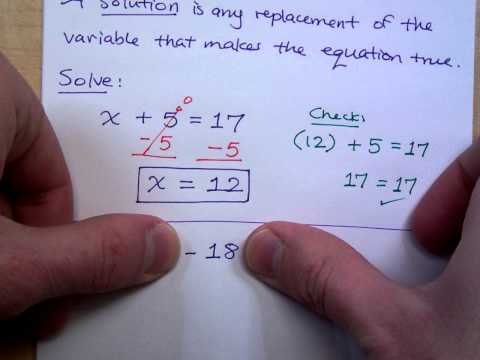
To solve means to get the variable by itself. This is called isolating the variable. Once we do this we have a solution. A solution is any replacement of the variable that makes the equation true.

The first example he does is: x+5=17x+5=17. To isolate the variable, we have to get rid of the +5+5. If we remove 55, −5-5, then the xx is left by itself. But since this is an equation, whatever we do to one side we have to do to the other. So if we subtract 55 from the side with the variable, we also have to subtract 55 from the side with the 1717. We call −5-5 the additive inverse of 55, because 55 and −5-5 cancel.

x+5=17−5   −5x+0=12x=12\begin{align} x+5&=17\\ \color{#29A603}{-5}&\ \ \ \color{#29A603}{-5}\\ \hline x+0&=12\\ x&=12 \end{align}

Try these next ones on your own and then watch the video to see the answers!

  1. w−18=−43w-18=-43
  2. 9+y=−49+y=-4

Here are some more examples. Try them on your own and then watch the video to see the answers.

  1. 3x+19−2x=143x+19-2x=14
  2. x−23=−47x-23=-47

Interactive · 3 questions

Use addition and/or subtraction to isolate the variable!

When you're solving equations, you're trying to find the value of the variables in the equations. To do this, you want to make sure that the variable is all alone on one side of the equals sign of the equation, while all the other information is on the other side.

If your equation only has addition in it (in other words, something is being added to the variable), we're going to have to use subtraction to move those numbers over!

Solving Equations using Subtraction: x+3=6. After you subtract 3 from both sides, you get x=3.

Let's look at another equation: x+5=7x + 5 = 7 First off, what do you see? xx and 55 are on one side of the equation, while 77 is on the other.

We want to figure out what xx is, so what's our next step?

Choose one answer

Interactive · 2 questions

Use addition to get the variable alone on one side of the equation

To solve algebraic equations, you have to figure out what value of the variable makes the equation true. To do that, you have to make it so that the variable is alone on one side of the equation. If you're trying to solve a subtraction equation (something is being subtracted from your variable), you're going to have to use addition.

Solving Equations using Addition: x-3=6. After you add 3 to both sides, you get x=9

Image by Caroline Kulczycky

Let's look at the equation x−14=10x - 14 = 10. What's our first step?

Choose one answer

Interactive · 2 questions

Solving a Subtraction Equation Using Inverse Operations

To easily solve one-step equations, the one rule you should always remember is to isolate the variable alone onto one side of the equation.

You’re probably wondering, "How do I isolate a variable in an equation?". Let’s look at an example.

x−4=8x - 4 = 8

To isolate the variable xx in this equation, you are going to add 44 to the left side, since addition is the inverse operation of subtraction. Doing so will ‘cancel out’ the −4-4 on the left side of the equation (−4+4=0-4 +4 =0) and leave us with just the variable, xx, on the left side. But wait, what about the right side of the equation?

Another rule to remember is that whatever we do to one side of the equation, we have to do the same for the other side of the equation. We must always balance the left and right side of the equation.

This is a scale with the left side of the scale with an equation 3+2. The scale has 5 blocks. On the right side of the scale, the equation is 5 and there are 5 blocks. The left and right have the same amounts of blocks and are balanced, just like an equation.

Balance the Left and Right Side of Equation!

Now back to the previous example.

Since we added 44 to the left side of the equation, we now have to add 44 to the right side of the equation. Doing so would leave us with 1212 (8+48+4) on the right side of the equation.

x−4=8+4=+4Add 4 to each sidex=12Simplify\begin{align} x - 4 &= 8\\ + 4 &= + 4 \quad\text{Add 4 to each side}\\ x &= 12 \quad\text{Simplify} \end{align}

Solve for xx. x−9=14x - 9 = 14

Choose one answer

Type a concept, like “slope” or “photosynthesis”.

↑ ↓ to choose · Enter to openSearch explanations and problems