Interactive · 3 questions

+4 contributors




Solving By Addition
Solving an equation means that you are trying to find the values of the variables in the equation. We do this by altering the problem to isolate the variable on one side of the equation.
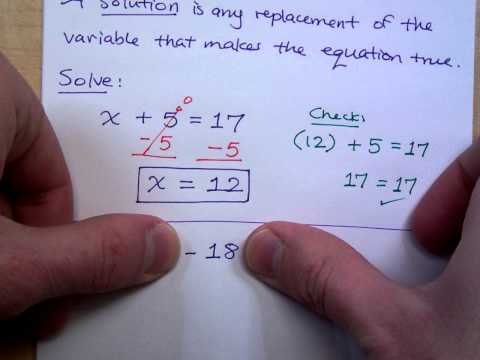
If your equation has a subtraction operator, we are going to use addition to isolate the variable. Let’s look at an example. First, we can see that and are on one side of the equation, while is on the other. We want to figure out what is, so we want to isolate the variable. We'll do this by adding to both sides of the equation. In summary, equations where a number is added to a variable can be solved by subtracting the number from both sides.
We can generalize this concept using a linear equation: where and are both constants and is the variable.
Now, we need to isolate the variable . We're going to add to both sides of the equation. You can also draw a diagram to understand this concept.
Let’s start with the equation:
Draw a diagram that illustrates this equation.

From the image, we know that . We can check this using algebra. We are now going to take a look at some of the types of problems you might encounter about solving by addition.
Before you start these problems, make sure to go over the basics of the introduction to equations: solving by addition.
Example 1
Solve for in the equation:
Example 2
Given that , solve for using the same value.
First, solve for using the equation . Now, solve for using
Example 3: Word Problem
Dan, Luke, and Mary went apple picking. After minutes, Dan picked less than Mary, and Mary picked less than Luke. Between the three of them, they picked a total of apples. How many apples did Dan pick?
Let the amount of apples Mary picked equal .
Since Dan pickled less than Mary, Dan picked a total of apples. Since Mary picked less than Luke, Luke picked a total of apples.
We know that apples were picked, so we can set up an equation and solve for . Since and we know that Dan picked a total of apples, so Dan picked apples.