
Interactive · 5 questions
+1 contributors

Let's work through an example to see what one of these word problems could look like.
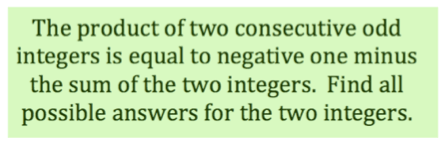
At first, this looks a little barf-worthy, right? That's a lot of words. The trick with all word problems is to translate the words into mathematical expressions.
Let's start here: "2 consecutive odd integers"
If we say that the first integer is , how can we represent the second, consecutive integer?
So, our two integers are: and .
To verify this, think of any odd number. Let's just use 3. The next (consecutive) odd integer is 5. We can see that 5 is 2 greater than 3, so it appears that our choice to represent the two integers as and is correct.
The next part of the word problem says "the product of two consecutive odd integers."
What operation do we need to perform to get a "product"?
So, the product of these two integers is: .
The rest of the word problem says that this product "**is equal to ** negative one minus the sum of the two integers."
Let's set that up.
Finish this equation:
So, we've translated the word problem into this equation:

We can then simplify this equation like we would with any other.
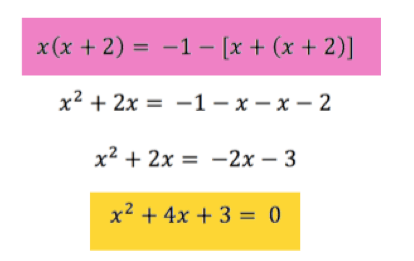
Now, we can factor our quadratic equation to solve for x.
Which of these shows the correct factored form of ?
What are the two possible values of x?