Solving Polynomial Inequalities

Before this, knowSolving Polynomial Equations, in Depth

Illustrated · 2 min

We've talked a lot about how to solve polynomial equations. However, we've given less thought to solving polynomial inequalities. There's not much of a difference, but there are a couple of extra steps we will consider.

Solving Polynomial Inequalities

Steps:

  1. Set one side of the inequality to zero.

  2. Factor as much as possible.

  3. Find the zeroes (xx-intercepts).

  4. Use the zeroes to divide the polynomial into different sections.

  5. Check test points to determine which regions satisfy the inequality.

The big difference comes in the last two steps.

The xx-intercepts show where the graph crosses the xx-axis. At these points, the polynomial changes sign. It switches from positive to negative, or from negative to positive.

This matters when you are solving an inequality. The solution might be above the xx-axis or below it.

Because of this, we need to test points, just like we do when graphing inequalities. Testing helps us choose the correct region for the solution.

Example

Solve the polynomial inequality, x3+x>+2x^{3}+x>+2

Step 1: Set one side of the inequality to zero.

x3+x>+2x3+x−2>0\begin{align} x^{3}+x>+2 \\ x^{3}+x-2>0 \\ \end{align}

We moved all terms to the left side of the inequality.

Step 2: Factor as much as possible.

We can use the rational roots test to factor this polynomial.

This is the factored form of the polynomial.

x3+x−2→(x−1)(x2+x+2)x^{3}+x-2 \rightarrow (x-1)(x^2+x+2)

Step 3: Find the zeroes (xx-intercepts).

To find the zeroes, we will set both factors equal to zero.

x−1=0x=1\begin{align} x-1 &= 0 \\ x &= 1 \\ \end{align}

Our second factor, x2+x+2x^2+x+2 has no solutions, which we could determine algebraically or graphically. Therefore, x=1x=1 is our only zero. (1,0)(1,0) is the only point at which the polynomial crosses the xx-axis.

Step 4: Use the zeroes to divide the polynomial into different sections.

Since this is an inequality, we need to figure out which parts of the polynomial graph make the inequality true. To do that, we draw a vertical line at x=1x=1. That is where the graph crosses the xx-axis. That splits our polynomial into two parts.

Here is an image of the associated equation, y=x3+x−2y=x^{3}+x-2 (in green) and the vertical line x=1x=1 (in purple).

Graph of y=x^{3}+x-2 (in green) and the vertical line x=1 (in purple).

Made using Desmos

The purple line divides our polynomial into two different sections, which will come in handy for the last step.

Step 5: Check test points to determine which regions satisfy the inequality.

To test the polynomial to the left of x=1x=1, we will test the xx-value, x=0x=0.

x3+x−2>0(0)3+0−2>00+0−2>0−2>0\begin{align} x^{3}+x-2>0 \\ (0)^3 +0-2>0 \\ 0+0-2 >0 \\ -2 > 0 \\ \end{align}

This statement is false, so this value does not satisfy the inequality. Therefore, we can assume that the solution to the inequality is {x>1}\{x>1\}, but we will still choose a test point from the other side to double check. Let's test x=2x=2.

x3+x−2>023+2−2>08+2−2>08>0\begin{align} x^{3}+x-2>0 \\ 2^3 +2-2 >0 \\ 8 +2 -2 > 0 \\ 8 > 0 \\ \end{align}

This statement is true, so this value does satisfy the inequality! We have confirmed that the region to right of x=1x=1 is shaded, so that is the solution to the polynomial inequality. The interval for the solution to this polynomial inequality is {x>1}\{x>1\} (this is interval notation).

Stretch your creativity

Contest problems rarely look like the examples you studied. Solving one means finding your own way in. These are real problems from the AMC 8, AMC 12 and AIME, the national math competitions for middle and high school students, each with a worked solution on LIVE by Po-Shen Loh.

Video · + 1 min read

(Video) Solving Polynomial Inequalities Algebraically Using the Number Line

by Mario's Math Tutoring

In this video, you will learn how to solve polynomial inequalities algebraically using the number line.

Summary

The first thing we want to do is get all terms on one side of the inequality and set the inequality equal to 00. The second step is to factor as much as possible.

Let's look at the first example together.

Example #1

4x2−25≥0(2x+5)(2x−5)≥02x+5=0 OR 2x−5=0x=−52 OR x=52\begin{align} 4x^2 - 25 \geq 0 \\ (2x+5)(2x-5) \geq 0 \\ 2x+5 = 0 \text{ OR } 2x-5 =0 \\ x = -\frac{5}{2} \text{ OR } x=\frac{5}{2} \\ \end{align}

Our next step is to plot both of these points on the number line. We now want to see which points will make the original inequality true.

Let's say we try −3-3.

4(−3)2−25≥036−25≥011≥0\begin{align} 4(-3)^2 -25 \geq 0 \\ 36 - 25 \geq 0 \\ 11 \geq 0 \\ \end{align}

We can see that this statement is true! That means that the interval of (−∞,−52](-\infty, -\frac{5}{2}] is true.

Now, let's test the middle interval with 00.

4(0)2−25≥0−25≥0\begin{align} 4(0)^2 -25 \geq 0 \\ - 25 \geq 0 \\ \end{align}

This is not true, so this middle interval is not a part of our solution.

Now, let's test the last interval, with the value of 33.

4(3)2−25≥036−25≥011≥0\begin{align} 4(3)^2 -25 \geq 0 \\ 36 - 25 \geq 0 \\ 11 \geq 0 \\ \end{align}

This statement is also true, so that means that the interval of [52,∞)[\frac{5}{2}, \infty) is part of our solution. The solution to this inequality is: x≤−52x \leq -\frac{5}{2} OR x≥52x \geq \frac{5}{2}. Watch the video to understand how this inequality will look on a coordinate plane.

Try the last two examples by yourself before watching the video!

Example #2

x2−x<12x^2 -x < 12

Example #3

x3−x2−x>−1x^3 -x^2 -x > -1

Illustrated · 2 min

Solving Polynomial Inequalities

Solving polynomial inequalities is like solving puzzles with more pieces.

Solving Polynomial Inequalities
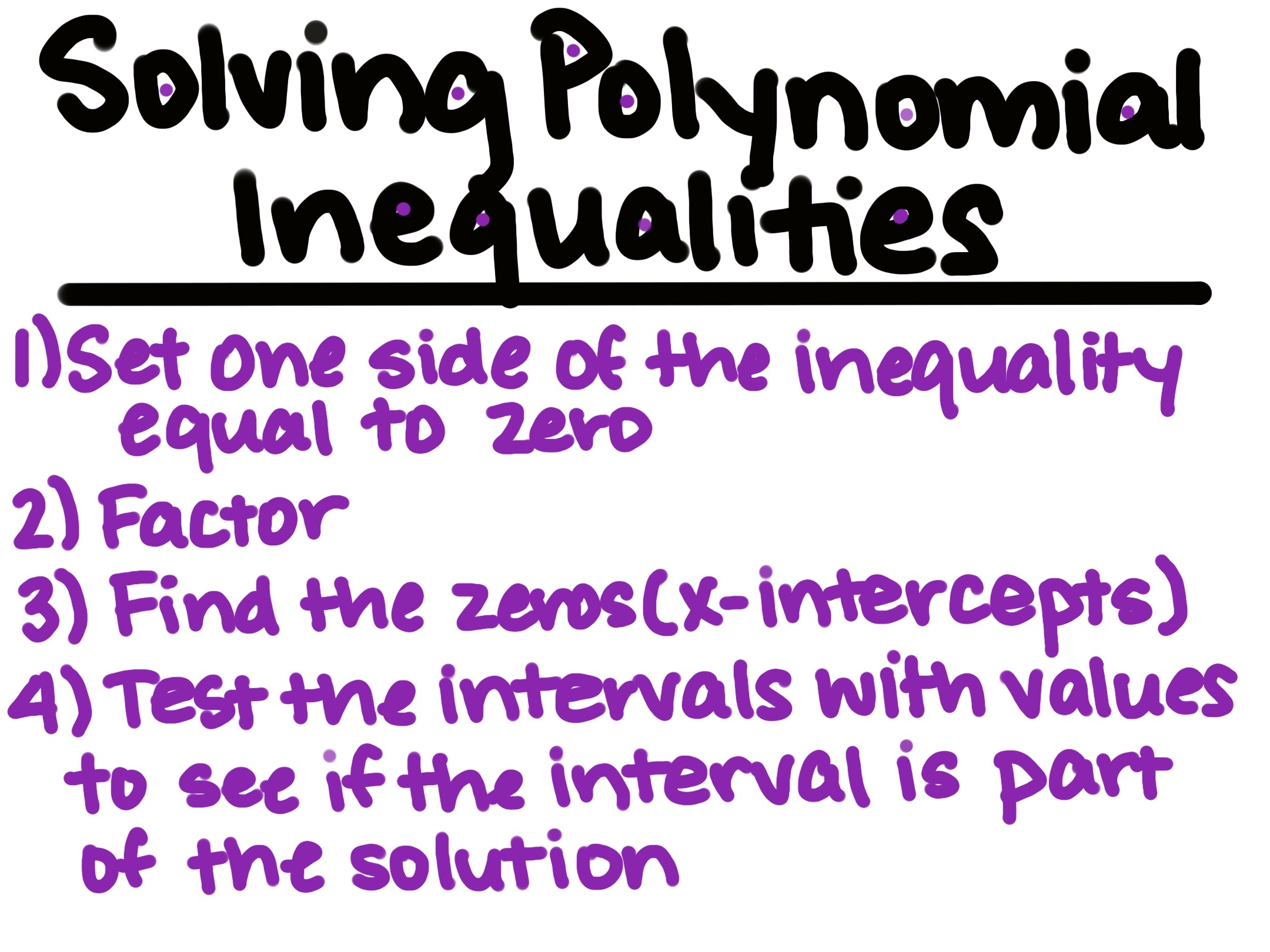
1) Set one side of the inequality equal to zero
2) Factor
3) Find the zeros (x-intercepts)
4) Test the intervals with values to see if the interval is part of the solution

Image source: by Anusha Rahman

First, you need to move all variables and constants to one side of the inequality, setting the other side equal to zero. This step will make it easier to factor.

Second, you will factor, just like you would with a quadratic.

Third, you need to find the zeros, which are the xx-intercepts. These zeros will split the polynomial graph into sections.

Fourth, you will test these intervals with values to see if the interval is part of the solution. Make sure you test both an even and an odd number.

Make sure your answer is in interval form.

####Example

Solve the polynomial inequality: x3−3x2−6x+8<0x^3-3x^2-6x+8<0

We can see that all variables and constants are already on one side of the inequality, so we are set there. Our next step is to factor.

Using our previous knowledge of factoring, we can factor the polynomial into:

(x−1)(x+2)(x−4)<0(x-1)(x+2)(x-4)<0

Now that we've factored the polynomial, we need to find the zeros (xx-intercepts). We will set each factor equal to 00.

  • x−1=0→x=1x-1=0 \rightarrow x=1
  • x+2=0→x=−2x+2=0 \rightarrow x=-2
  • x−4=0→x=4x-4=0 \rightarrow x=4

These zeros will split the polynomial graph into sections. Our four sections are:

(∞,−2),(−2,1),(1,4),(4,∞)(\infty, -2), (-2,1), (1,4), (4,\infty)

We now need to test a number from each interval.

  • Pick x=−3:(−3−1)(−3+2)(−3−4)=(−4)(−1)(−7)=−28x=-3: (-3-1)(-3+2)(-3-4) = (-4)(-1)(-7) = -28
  • Pick x=0:(0−1)(0+2)(0−4)=(−1)(2)(−4)=8x=0: (0-1)(0+2)(0-4) = (-1)(2)(-4) = 8
  • Pick x=2:(2−1)(2+2)(2−4)=(1)(4)(−2)=−8x=2: (2-1)(2+2)(2-4) = (1)(4)(-2) = -8
  • Pick x=5:(5−1)(5+2)(5−4)=(4)(7)(1)=28x=5: (5-1)(5+2)(5-4) = (4)(7)(1) = 28

We need to choose the intervals where the product is negative. Since the inequality wants where the expression is less than 00, so we want the negative sections.

  • Pick x=−3:(−3−1)(−3+2)(−3−4)=(−4)(−1)(−7)=−28x=-3: (-3-1)(-3+2)(-3-4) = (-4)(-1)(-7) = -28
  • Pick x=2:(2−1)(2+2)(2−4)=(1)(4)(−2)=−8x=2: (2-1)(2+2)(2-4) = (1)(4)(-2) = -8
(∞,−2)∪(1,4)(\infty, -2) \cup (1,4)

####When This Comes in Handy

Sometimes in real life, we need to know when something is more than or less than a certain value.

For example, imagine a skateboard ramp that can only hold a certain amount of weight. If too many people stand on it at once, the ramp could break.

We can use polynomial inequalities to help solve problems like this. A polynomial inequality looks like a regular polynomial equation, but it uses inequality symbols instead of an equal sign.

By solving the inequality, we can find which values work in the real world and which values do not. This helps us make safe and smart decisions.

Type a concept, like “slope” or “photosynthesis”.

↑ ↓ to choose · Enter to openSearch explanations and problems