Spontaneous and Nonspontaneous Reactions — Overview

Illustrated · 1 min

Spontaneous and Nonspontaneous Reactions

When reactions occur they can be either:

  • Spontaneous: occurs without an outer influence or addition to the chemical system.

  • Nonspontaneous: requires an external influence for the reaction to occur.

There are two other factors which come into play when determining the spontaneity of a system:

  1. Enthalpy: the heat of the reaction

  2. Entropy: the randomness of the reaction

Overall, these factors can be taken into account together and is described as the Gibbs free-energy.

Gibbs Free-Energy and Spontaneity

The Gibbs free-energy is a quantity which can be described by the equation:

ΔG = ΔH−TΔS\Delta G\ =\ \Delta H - T \Delta S

Where ΔG\Delta G is the free-energy change, ΔH\Delta H is the change in the heat of reaction, TT is temperature (in kelvin), and ΔS\Delta S is the entropy change.

The sign of the ΔG\Delta G value determines the spontaneity of the reaction:

  • ΔG\Delta G = negative value : the reaction is spontaneous

  • ΔG\Delta G = positive value : the reaction is nonspontaneous

  • ΔG\Delta G = zero : the reaction is at equilibrium, neither spontaneous nor nonspontaneous.
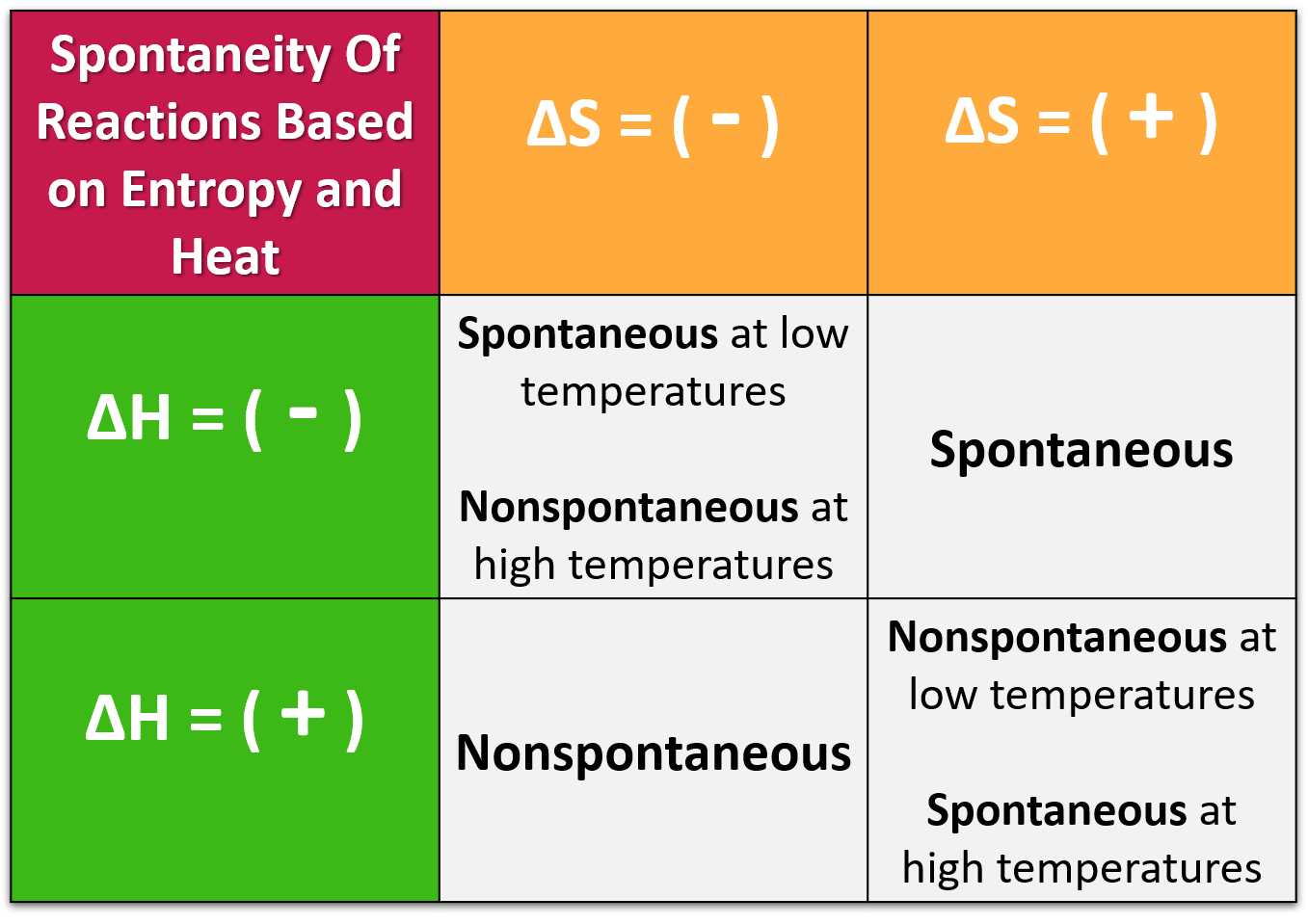
Chart depicting the spontaneity of a reaction based on entropy and heat.

The spontaneity of a reaction can be predicted by the sings of entropy and heat. When the temperature determines the reaction process, the magnitude of heat, entropy, and temperature must be taken into account.

Image Source: By Cassie Gates

Video

(Video) What are Spontaneous and Non-spontaneous Chemical Reactions?

By Scott Lawson

In this video, Scott explains that a spontaneous reaction is a naturally occurring reaction that requires no external forces. On the other hand, a nonspontaneous reaction is a reaction that requires external forces. Scott also highlights that spontaneous reactions tend to be exothermic and have positive entropy. In contrast, nonspontaneous reactions tend to be endothermic and have negative entropy.

Illustrated · 1 min

Spontaneous and Nonspontaneous Reactions: Differences between spontaneous and non-spontaneous reactions

A bonfire is an example of a spontaneous reaction since it gives off heat to the surroundings. On the other hand, melting ice at 0 degrees is an example of a non-spontaneous response since it requires heat from an external source.

Image Source: Leo Dong

When a bonfire gives off heat to the surrounding, the system (bonfire) decreases enthalpy, and the entropy of the surroundings increases.

When meeting ice at 0 degrees, the system (ice) increases entropy while the enthalpy of the surroundings decreases.

Type a concept, like “slope” or “photosynthesis”.

↑ ↓ to choose · Enter to openSearch explanations and problems