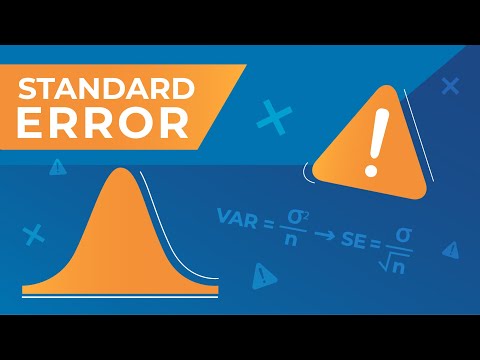
This video explains what standard error is and how it describes the spread of sample means. You will learn that the standard error is the standard deviation of the distribution of sample means.
The video shows how to calculate standard error using the population standard deviation and the sample size. It also connects the standard error to the Central Limit Theorem and the distribution of sample means.
You will also see an example on how to use the variance of the sample means to find the standard error. You will see that the standard error gets smaller as the sample size gets bigger.
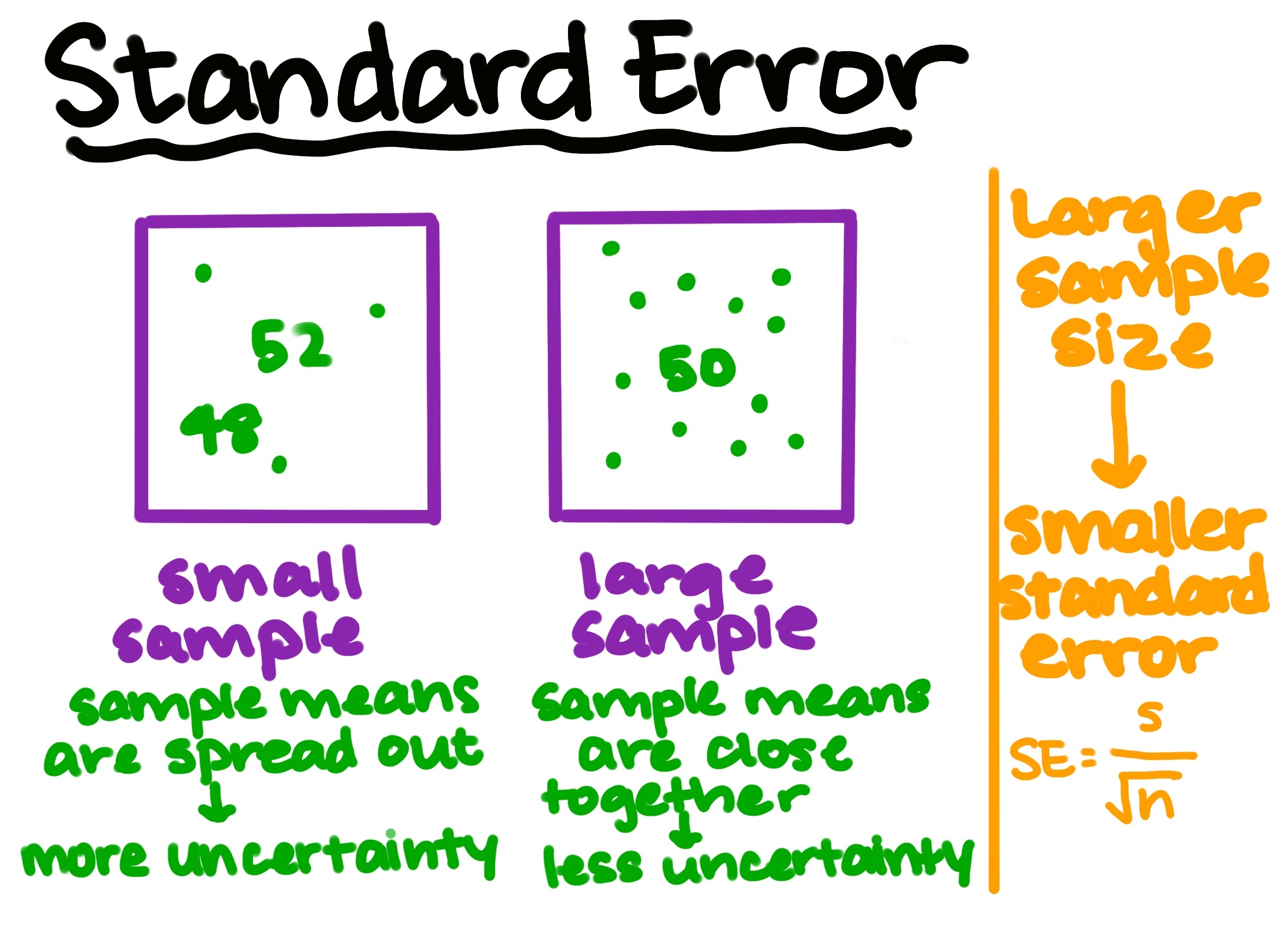
Big takeaway: Larger samples usually give a better estimate of the population, so they have less variability between their sample means.
Standard error tells us how much a sample statistic is expected to vary from sample to sample. It helps us to understand the uncertainty in an estimate. You can also think of it as how "sure" you are. You have already learned that a sample is a smaller group taken from a larger population. Because different samples can contain different values, their statistics can also be different.
For example, imagine that we want to find the average height of all students in a school. We could measure every student, but that may take too much time. Instead, we could choose a sample of students and calculate their mean. If we chose a different sample, we might get a different mean.
The standard error measures how much these sample means are expected to change. A smaller standard error means that sample means tend to be closer to the true population mean. A larger standard error means that sample means can vary more.
For a sample mean, the standard error is often calculated using the formula
SE=nσ,
where σ is the population standard deviation and n is the sample size. If the population standard deviation is not known, we can use the sample standard deviation s instead:
SE=ns.
The formula shows that the sample size affects the standard error. As the sample size gets larger, the standard error gets smaller. This happens because larger samples usually give us more information about the population.
Standard error is different from standard deviation. Standard deviation describes how much individual values vary within a data set. Standard error describes how much a statistic, such as a sample mean, varies between different samples.
Standard error is also connected to uncertainty. A larger standard error means there is more uncertainty in the sample estimate. A smaller standard error means there is less uncertainty.
Standard error is an important idea in statistical inference. It helps us understand how well a sample statistic represents a population parameter. Later, you will use standard error to build confidence intervals and perform hypothesis tests. These tools help us use sample data to learn about larger populations.
Standard error measures how much a sample statistic, such as the sample mean, may vary from sample to sample. When a random sample is used, the standard error helps us to estimate how close the sample mean may be to the true population mean.
Image source: by Anusha Rahman
The standard error of the mean (SEM) uses the sample standard deviation divided by the square root of the sample size. As the same size increases, the standard error becomes smaller. This means larger samples usually give us more precise estimates of population parameters.
Standard error is also an important part of inferential statistics, including confidence intervals and regression analysis. For example, a 95% confidence interval uses the standard error to describe a range of likely values for the true population mean.