
Interactive · 1 question

+2 contributors


What is Standard Form?
Standard form is just another way to write a linear equation equation along with slope intercept form and point slope form.
Standard form appears in the form:
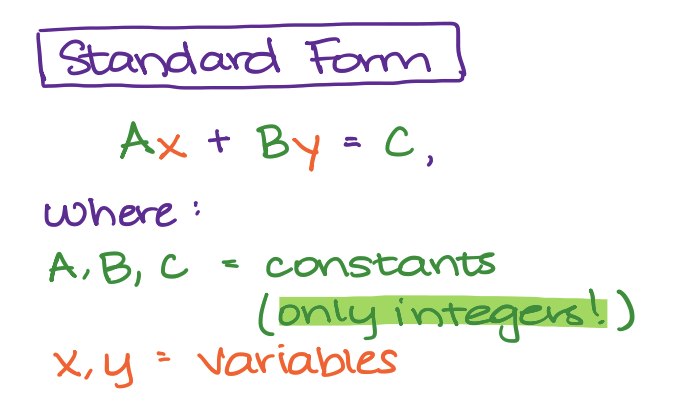
Image source: by Anusha Rahman
The constants, , , and , must be integers. And must be positive.
An example of a line in standard form would be: Here, , , and are all whole numbers, and is positive.
Example 1
Turn into standard form.
First, we need to remove the fractions by multiplying each term by the LCM. Here, the LCM of and is . Then, since our term is negative, we multiply everything by to make it positive. This is now in standard form.
Always keep in mind: whatever you do to one side of the equation, you have to do to the other. Always following the Multiplication Property of Equality.
Why Use This?
In my opinion, it's the least important of the three. But one thing it's very good at is finding the - and -intercepts of a line.
The -intercept occurs when . Similarly, the -intercept occurs when . So to find these, you just need to plug in and solve for , then plug in and solve for .
Example 2
Suppose we want to graph the following equation by plotting its - and -intercepts. Let's start by finding the -intercept. To find this, we set . So the -intercept occurs at the point .
Next, to find the -intercept, we set . The -intercept occurs at the point .
Plotting these points, we can draw a line through them to get:

Made using Desmos
Conversion
Convert from slope intercept form to standard form and back is easy. Let's look at some examples.
Example 3
Put the following equation into standard form:
Start by getting and together on one side of the equation.
Next, remove all fractions by multiplying all terms by the LCM. In this example, it's .
Finally, multiply all terms by so the term becomes positive.
Example 4
Put the following equation in slope-intercept form:
Start by putting on the opposite side of .
Then divide to isolate the .
Practice Problem
Select all of the following equations that are in standard form.
Solution
- This is in standard form. There are no fractions and the term, , is nonnegative.
- At first glance this looks like standard form but it is not. The term is negative, which we cannot have.
- This is not in standard form. The term, , is a fraction. All terms must be integers.
- This is in standard form. There are no fractions and the term, , is positive. (The is not shown because it is in front of the . So, .)


