
Interactive · 3 questions

+3 contributors



What Are the Four States of Matter?
Matter can exist in four states (sometimes called phases): solid, liquid, gas, and plasma. You've probably learned a bit about solids, liquids, and gases at some point, so we'll begin with those.

Image source: By Yeya18 CC BY-SA 3.0, via Wikimedia Commons
Solids have a fixed volume and shape. Their atoms are arranged in an ordered, rigid pattern. There is little space between the particles, so the solid cannot be easily squashed or compressed. Because the particles are arranged in a tight, ordered way, solids cannot flow.
What is not a feature of a solid?
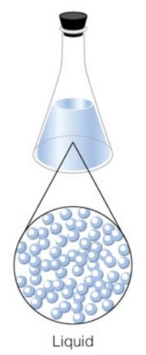
Image source: By Yeya18 CC BY-SA 3.0, via Wikimedia Commons
Liquids have a fixed volume but can take the shape of their container. The atoms are no longer in an ordered, rigid pattern; instead, they can flow past one another. There is still little space between the particles in a liquid, so it cannot be easily squashed or compressed.
What is not a feature of a liquid?
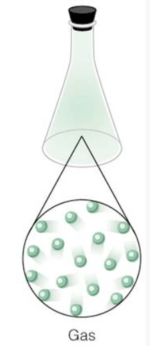
Image source: By Yeya18 CC BY-SA 3.0, via Wikimedia Commons
Gases do not have a fixed volume or shape; they are free-flowing. Gases will shrink or expand to fully fill the shape and volume of their container. Much like liquids, the particles of a gas are able to flow around one another. Unlike solids and liquids, however, gases have a whole lot of space between their particles which allows them to be compressed.
How are gases different from solids and liquids?
Changes of State
A change of state happens when one state of matter transitions into another.
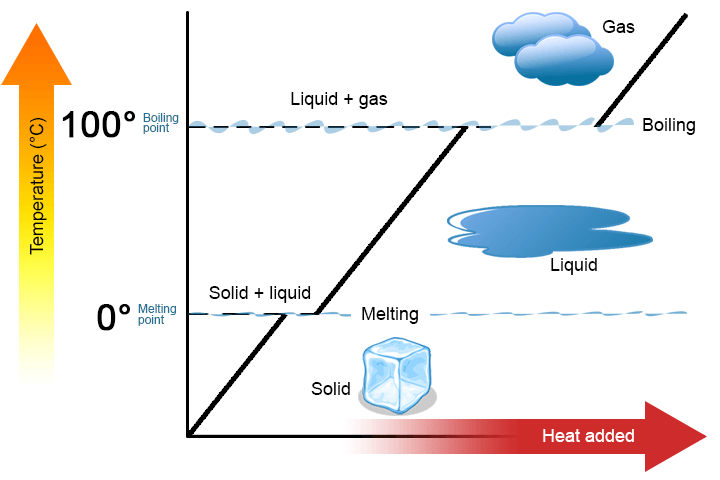
Image source: By Community College Consortium for Bioscience Credentials CC BY 3.0, via Wikimedia Commons
For instance, solid ice undergoes a change of state when heated, becoming liquid water. If you continue heating the liquid water, it will also undergo a change of state, becoming water vapor. If this water vapor is heated even further, it can become ionized into a plasma. Cool, right?
This change of states plays a big role in the water cycle, which is how water moves through Earth and its atmosphere.
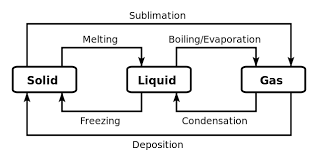
The many processes that cause a phase change.
Image source: By AnyFile CC BY-SA 3.0, via Wikimedia Commons
What About Plasma?
Plasma is the final state of matter. It is similar to a gas. It expands or shrinks to fit the size of its container. The particles have a lot of space between them, which allows them to be free-flowing. Unlike the other states of matter, plasma is made of ions. Ions are atoms that have a positive or negative charge. They get this charge by either gaining or losing extra electrons.
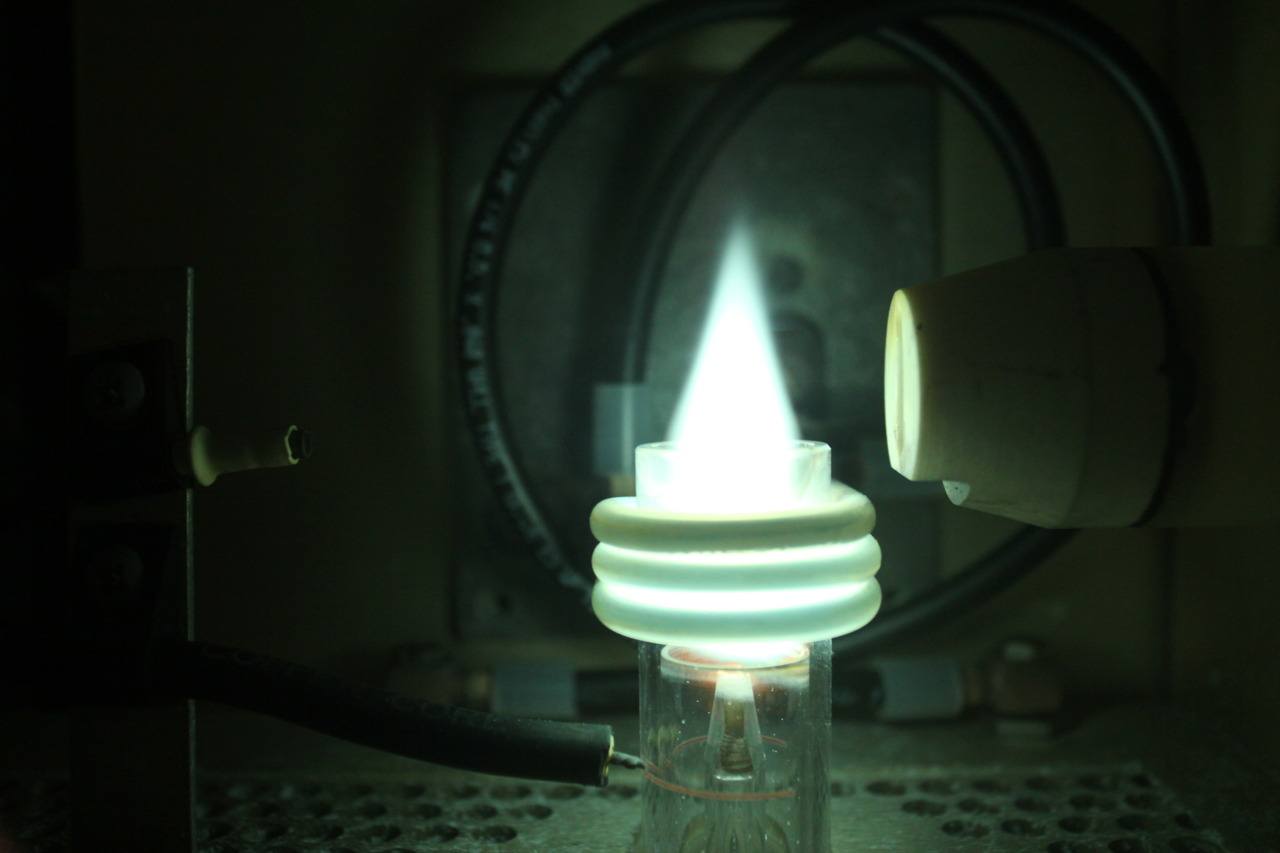
Plasma Torch
Image source: By Wblanchard CC BY-SA 3.0, via Wikimedia Commons


