States of Matter — Overview & Examples

Before this, knowBiology: Structure of Matter

Interactive · 3 questions

What Are the Four States of Matter?

Matter can exist in four states (sometimes called phases): solid, liquid, gas, and plasma. You've probably learned a bit about solids, liquids, and gases at some point, so we'll begin with those.

A solid contained in a flask. It keeps its shape no matter what container it is placed in.

Image source: By Yeya18 CC BY-SA 3.0, via Wikimedia Commons

Solids have a fixed volume and shape. Their atoms are arranged in an ordered, rigid pattern. There is little space between the particles, so the solid cannot be easily squashed or compressed. Because the particles are arranged in a tight, ordered way, solids cannot flow.

What is not a feature of a solid?
Choose one answer

Illustrated · 2 min

What Are the Phases of Matter?

Matter exists in three main states: gas, liquid, and solid.

Image source: By Yelod CC BY-SA 3.0, via Wikimedia Commons

Matter can exist in multiple states, called phases. Under normal conditions on Earth, most matter is in one of three main phases: solid, liquid, or gas.

We're going to focus on solid, liquid, and gas, although there are two more that don't really get talked about much: plasmas and Bose-Einstein condensates (BEC). You don't need to worry about these two right now. Phew.

The solid, liquid, and gas phases of matter are distinguished by their atoms' arrangement and movement. The picture above (in blue) shows differences among the three states in terms of volume and shape. Here's what you need to know:

Solids have a definite shape, definite volume, and molecules that are packed closely. Liquids take the shape of their container, have a definite volume, and molecules that can move somewhat. Gases take the shape of their container, expand to the volume of the container, and have molecules that can move freely.

Image source: By Mario Janakis

Movement

Let's look a little more closely at the movement of particles in each state.

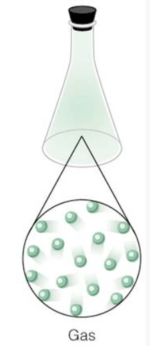
Solid particles move less freely than liquid molecules, which move less freely than gas molecules.

Image source: By Sadi Carnot [Public domain], via Wikimedia Commons

Movement of particles is very limited in solids, greater in liquids, and greatest in gases.

Let's think about an example to help illustrate this. Imagine a big empty room.

  • If we put a solid chair in the corner of the room, it won't move. This is because its particles are organized and they don't shift around much.
  • If we dump a big bucket of liquid water in the corner of the room, it'll spread out a few meters. This is because water molecules can move past each other.
  • If someone is smoking in the corner of the room, that smoke (a gas) will spread, meaning that someone standing on the opposite side of the room can smell it. This is because gas molecules aren't organized and they can move really far apart from each other.

Phase Changes

There's one more thing to talk about: How does matter change from one phase into another?

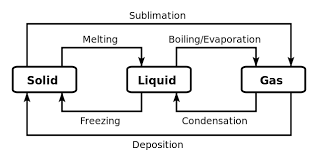
This is called a phase change. Take a look at this diagram:

Matter can change from one phase or state to another.

The phase changes with the pink stars are the ones you should focus on. Sublimation and deposition aren't nearly as common.

Image source: By F l a n k e r, penubag [Public domain], via Wikimedia Commons

To summarize:

  • To go from solid to liquid, the substance needs to melt.
  • To go from liquid to solid, the substance needs to freeze.
  • To go from liquid to gas, the substance needs to vaporize.
  • To go from gas to liquid, the substance needs to condense.

It helps to think about the phase changes of a familiar substance, like water.

Key Vocabulary:

  1. State/phase
  2. Solid
  3. Liquid
  4. Gas
  5. Phase change

Illustrated · 1 min

The Four States of Matter

  • Solid: A solid occurs when the atoms forming an object are packed together in a stable, definite position and just vibrate in place. Solids can't be compressed. Solids have low entropy. Entropy is the amount of disorder in a system. Having low entropy (disorder) means you are dealing with a highly ordered system.

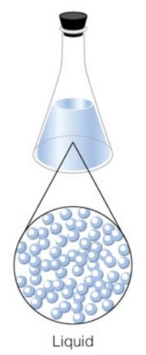
  • Liquid: Liquids have atoms that are more loosely packed together than solids and are able to slide past each other and move freely. Liquids conform to their container and are not compressible. A system that is in a liquid state has higher entropy (disorder) than a solid but less than a gas. Just think about ice. You have to heat ice, which is a solid, in order to get it to become a liquid. This means that liquid water has more energy than its solid form.

  • Gas: A gas is a high-energy state of matter. Gases are compressible and will also readily expand or contract to fill their container. Gases are free-moving and have a high level of entropy. So, water vapor (water in the gas phase) has more energy than water in the liquid phase.

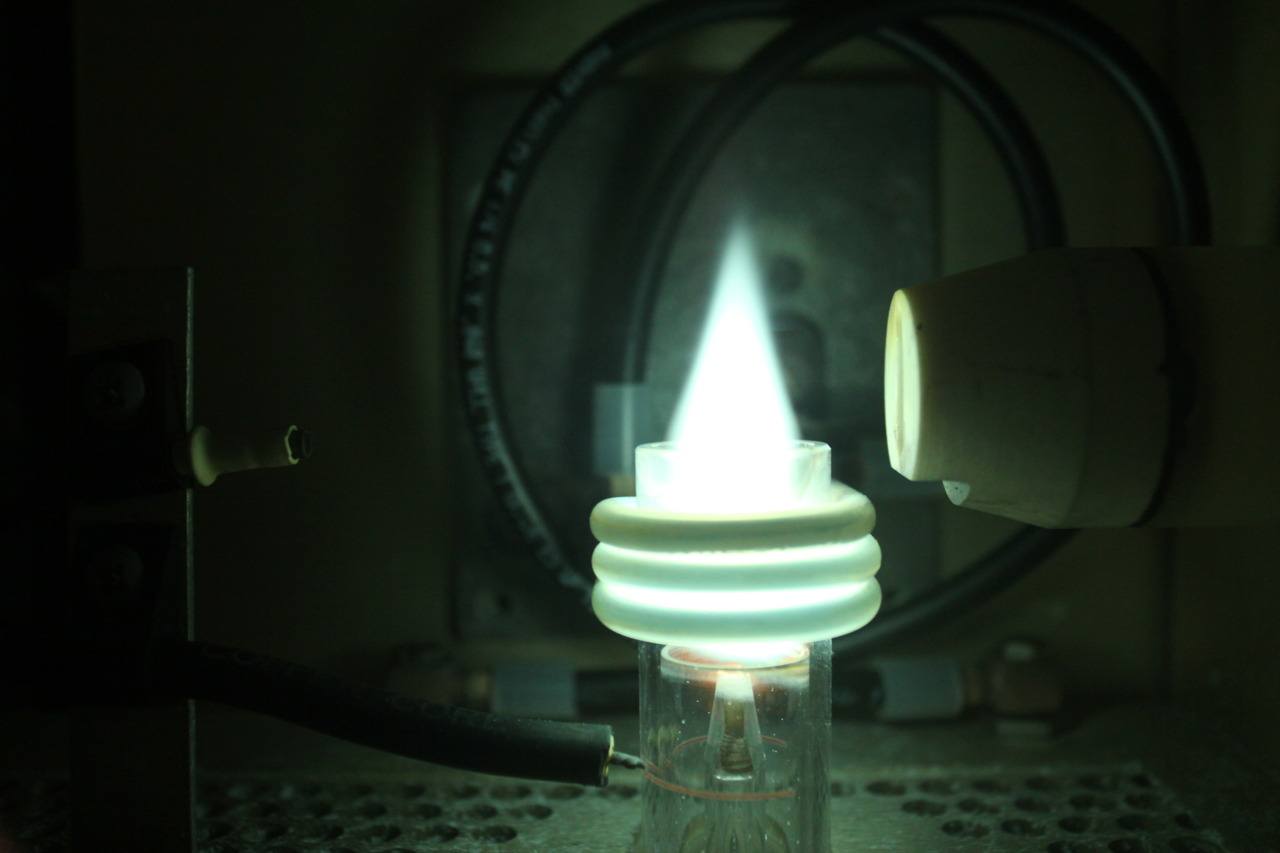
  • Plasma: Plasmas are weird and surprisingly common. They have no definite shape or volume and are also electrically conductive. Things that are in a plasma state are lightning, electric sparks, neon signs, and all of the stars.

Four states of matter: solid, liquid, gas, and plasma

Image source: By Spirit469 CC BY-SA 3.0, via Wikimedia Commons

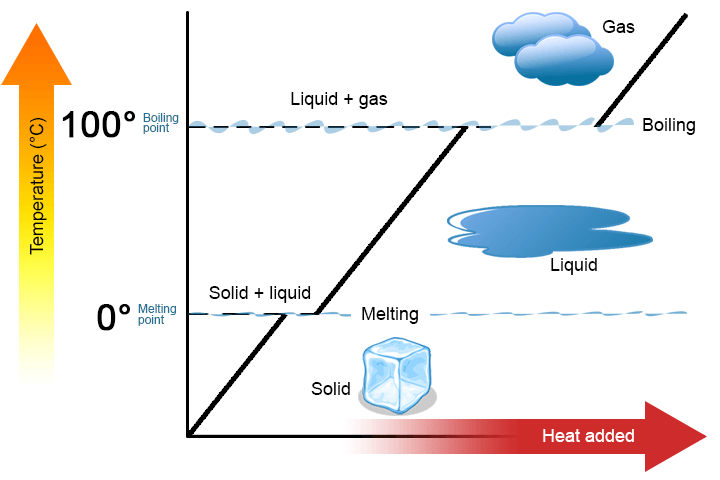
Reminder: To go from any state of matter to another, energy needs to either be added or removed. This can be done by raising or lowering temperature, adding electrical current, or changing the volume of the container.

Phase Changes

The four states of matter are solid, liquid, gas, and plasma. A solid melts to become a liquid and sublimates to become a gas. A liquid freezes to become a solid and vaporizes to become a gas. A gas deposes to become a solid or condenses to become a liquid.

Image source: By Valeri Natole

Video · + 1 min read

(Video) Changes of States of Matter

by Teacher's Pet

In this video, you will learn about what states matter exists in and also what the changes they undergo are called.

There are three main states: solid, liquid, and gas.

A substance can go from one state to another when the temperature and/or pressure is changed. This physically changes the substance, but it does not change any chemical properties.

  1. Solid: Has the least kinetic energy. Molecules move slower than those of a liquid or gas.

  2. Liquid: Has more kinetic energy than a solid but less than a gas. Molecules move faster than those of a solid but slower than those of a gas.

  3. Gas: Has the most kinetic energy. Molecules move faster than those of a solid or liquid.


Substance Changes

Melting: solid →\rightarrow liquid (energy is added)

  • The temperature at which a solid becomes a liquid is the melting point‾\underline{\text{melting point}}.

Freezing: liquid →\rightarrow solid (energy is removed)

Condensation: gas →\rightarrow liquid (energy is removed)

Vaporization: liquid →\rightarrow gas (energy is added)

  • The temperature at which a liquid starts becoming a gas is called the boiling point‾\underline{\text{boiling point}}.
  • Evaporation occurs slowly at the surface of liquids
  • Boiling happens very rapidly, when liquid is heated to the boiling point

Sublimation: solid →\rightarrow gas (energy is added)

Deposition: gas →\rightarrow solid (energy is removed)

Video

(Video) What Is Plasma?

by FuseSchool - Global Education

Did you know there is a fourth state of matter called plasma? Plasma is similar to a gas, but its ions float freely. Plasma can also conduct electricity. You can see an example of plasma in the video above.

Type a concept, like “slope” or “photosynthesis”.

↑ ↓ to choose · Enter to openSearch explanations and problems