Read · 1 min
+1 contributors

Hypothesis Testing
Hypothesis testing is another form of statistical inference. The main purpose of hypothesis testing in statistics is to test the results of a research study with a random sample to see if the results are meaningful or not and look for evidence to support the null hypothesis. If we can confidently say our null hypothesis is true, we can then confidently make decisions with it.
Technically, we are testing if a population parameter is different from its hypothesized value.
Hypothesis testing (The Test To Guide Decision Making) developed by Neyman and Pearson looks at evidence that supports () being true.
This is done by setting up both a null hypothesis and an alternative hypothesis, choosing an acceptable rate of allowable error "alpha" (usually 0.05), then either accepting or rejecting the null hypothesis based on whether the p-value is above or below alpha. We can do so by changing the sample size.
-
if --> reject the null hypothesis
-
if --> fail to reject the null hypothesis
We need to make a decision soon, and suspect that our null hypothesis is true and will greatly influence our decision. Thus we see how unlikely we are to be wrong by examining the likelihood of the alternative hypothesis (), and if we are sufficiently unlikely to be wrong we can assume the null statement is true and follow through confidently with our final decision.
Looking Further
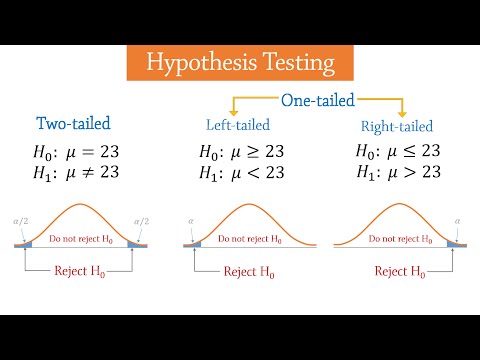
In the next lessons, we will dive deeper into Type 1 and Type 2 errors, as well as the tailed tests.