Stretch or Compress Function Vertically: cf(x)

Before this, knowWhat Is a Function Transformation?

Illustrated · 1 min

Stretch or Compress Vertically

Another transformation that can be applied to a function is stretching or compressing a function vertically. \\ We can multiply a function by a positive constant cc to stretch and compress a function vertically. \\ Given the graph of f(x)f(x), cf(x)cf(x) will be the graph of f(x)f(x) stretched vertically if the value of cc is greater than 11 (c>1c>1). cf(x)cf(x) will be the graph of f(x)f(x) compressed vertically if the value of cc is greater than 00 but less than 11 (0<c<10<c<1).

Example 1

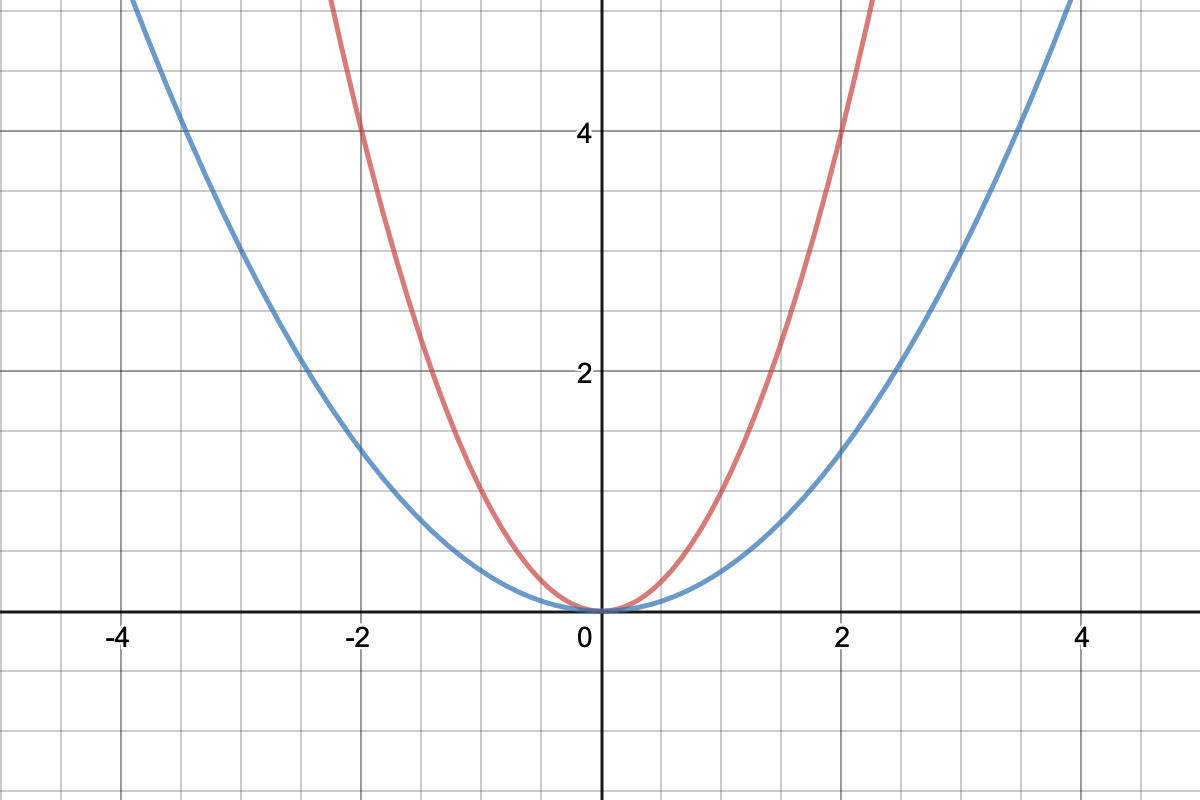
g(x)=3(x2)g(x)=3(x^2) \\ The graph g(x)=3(x2)g(x)=3(x^2) will be a vertical stretch of f(x)=x2f(x)=x^2 by 33 units.\\ The red graph is the graph of f(x)=x2f(x)=x^2 and the blue graph is the graph of g(x)=3(x2)g(x)=3(x^2).

Graph of y=x^2 and y=3(x^2)

Graphed with Desmos

Example 2

Graph of g(x)=13(x2)g(x)=\dfrac{1}{3}(x^2) \\ The graph g(x)=13(x2)g(x)=\dfrac{1}{3}(x^2) will be a vertical compress of f(x)=x2f(x)=x^2 by 33 units. The red graph is the graph of f(x)=x2f(x)=x^2 and the blue graph is the graph of g(x)=13(x2)g(x)=\dfrac{1}{3}(x^2).

Graph of y=x^2 and y=1/3(x^2)

Graphed with Desmos

Video · + 1 min read

(Video) Vertical Stretch or Compression of a Quadratic Function

by Math and Stats Help

In this video by Math and Stats Help, you'll learn how to determine whether a quadratic function has been vertically stretched or compressed.

Summary

This video mainly talks about quadratics, but the technique can be applied to any function.

If a number value is multiplied outside of the function, it creates a vertical stretch or vertical compression.

Vertical stretch: a⋅f(x)a \cdot f(x)

If a>1a>1, the graph is stretched vertically by a factor of a aa.

Vertical compression: a⋅f(x)a \cdot f(x)

If 0<a<10<a<1, the graph is compressed vertically by a factor of aa. We can think of vertical compressions as being compressed toward the xx-axis.

Example

The first example is for a vertical stretch.

f(x)=2⋅x2f(x) = 2 \cdot x^2

We know this function has a vertical stretch because 2>12>1. The graph of the parent function is in purple, f(x)=x2f(x)=x^2, and the graph of the transformed function, f(x)=2⋅x2f(x)=2 \cdot x^2, is in green.

graph of the parent function is in purple, $y=x^2$, and the graph of the transformed function, $y=2 \cdot x^2$, is in green

Made using Desmos

Example

This second example is for a vertical compression.

f(x)=12x2f(x) = \frac12 x^2

We know that this is a compression because 0<12<10< \frac12 < 1. The graph of the parent function is in purple, f(x)=x2f(x)=x^2, and the graph of the transformed function, f(x)=12x2f(x)=\frac12 x^2, is in green.

The graph of the parent function is in purple, $f(x)=x^2$, and the graph of the transformed function, $f(x)=\frac12 x^2$, is in green.

Made using Desmos

Illustrated · 1 min

Vertical Dilation

In context

In our series of function transformations, we learned about vertical translations, horizontal translations, vertical reflections, and horizontal reflections.

Next in our series of function transformations is the vertical dilation!

Vertical dilation: vertically stretching or compression a function

Image source: by Anusha Rahman

We can think of a vertical dilation as pushing or pulling a function toward or away from the xx-axis. At first, you may be thinking that the xx-axis is the horizontal axis, so that doesn't make sense! However, when we are pushing or pulling toward the xx-axis, the function is expanding or contracting vertically - making it a vertical dilation!

cf(x)cf(x)

Let's compare a couple of graphs!

Example

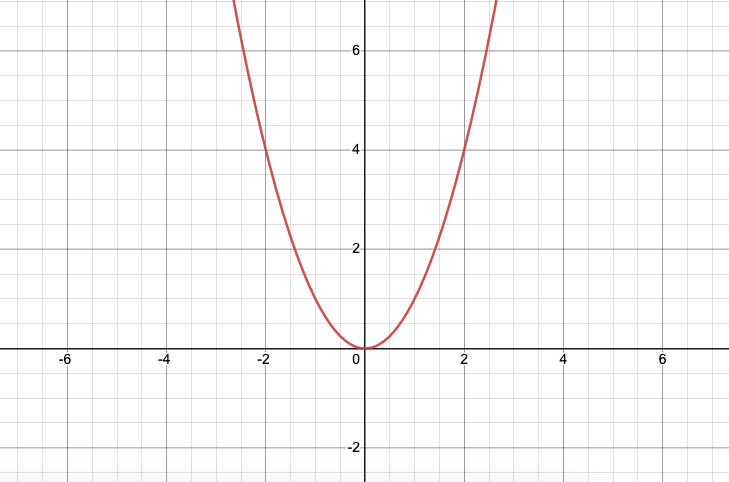
First, let's look at the parent function for the quadratic equation. We are going to sketch a graph. Here is the graph of the function of a quadratic.

Graph of y=x^2

Made using Desmos

If we want to stretch the graph, we can multiply the function by a fraction, such as 14\frac14. This is a graph of f(x)=14x2f(x)=\frac{1}{4}x^{2}. The graph of the parent function is in red.

To help understand the concept, you could follow a singular point on the graph and see how that point changes when you transform the original function.

Graphs of f(x)=\frac{1}{4}x^{2} and of f(x)=x^2

Made using Desmos

Now, let's add in a function that is compressed from the parent function. Let's add in a graph of f(x)=4x2f(x)=4x^2 in green!

Graphs of f(x)=\frac{1}{4}x^{2} and of f(x)=x^2 and of f(x)=4x^2

Made using Desmos

Looking Forward

Our next lesson will cover horizontal compressions and horizontal stretches, also known as horizontal dilations.

If you want to look at this concept the other way, you can also take a graph and write a formula or equation from the graph.

Type a concept, like “slope” or “photosynthesis”.

↑ ↓ to choose · Enter to openSearch explanations and problems