Illustrated · 1 min
What are Strong Acids/Bases?
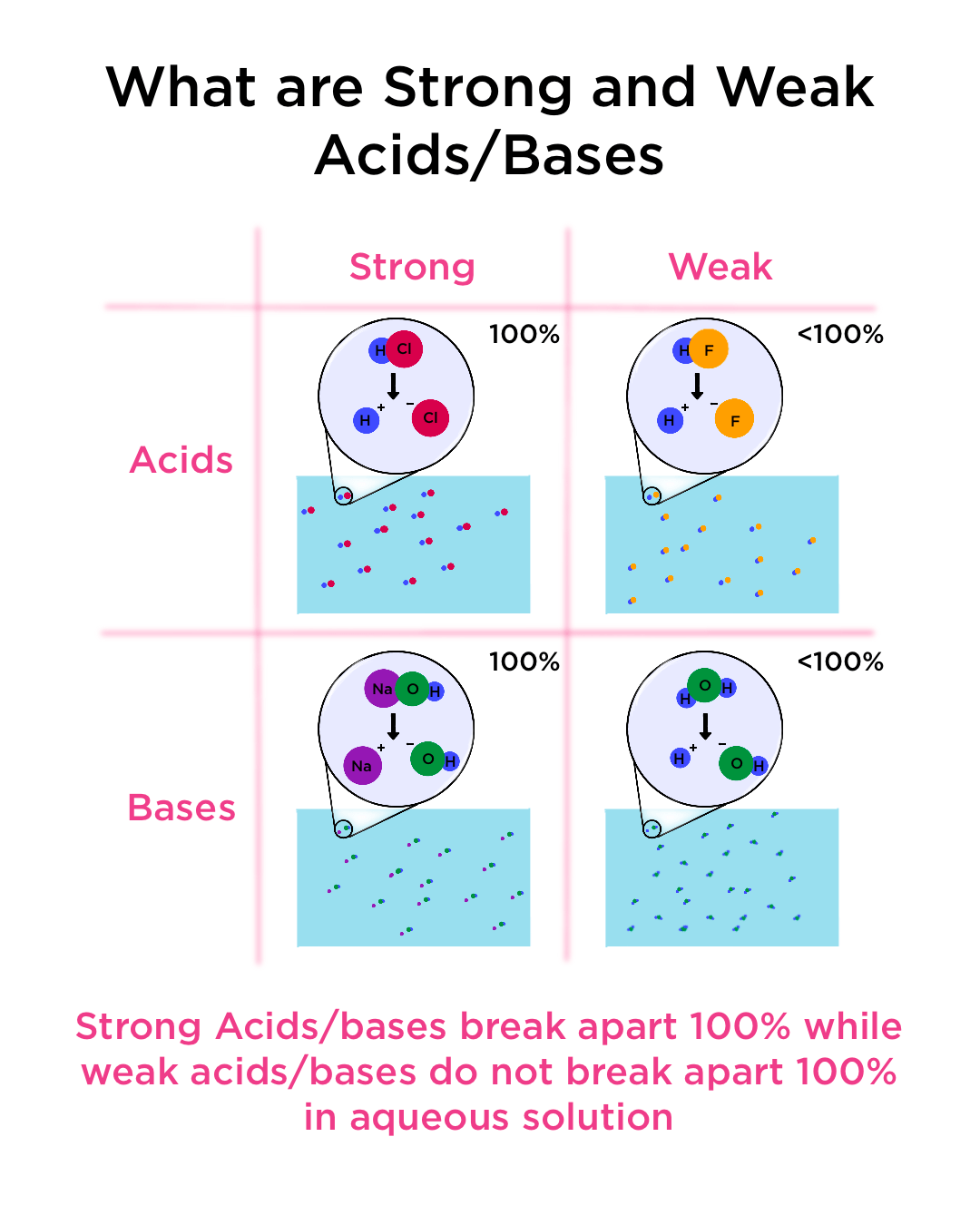
These acids/bases completely dissociate (break apart) 100% in water.
Acids are proton donors and have a general formula of , where is a negative ion. or hydrochloric acid is a strong acid and in water undergoes: Where the proton () on is dissociated (transferred) to water to form hydronium .
Bases are proton acceptors and form ions or hydroxide ions in water. Most bases have the formula or where is a positive ion. or sodium hydroxide is a strong base which is water undergoes: Where the dissociation causes hydroxide ions to form. Any dissolved in the solution from the air will also form ions.
When strong acids and strong bases react completely they create a salt and water.
Strong acids have weak conjugate bases. Strong bases have weak conjugate acids.
What are Weak Acids/Bases?
Weak acids and bases do not dissociate 100% like strong acids/bases. Weak acids/bases still form / ions when in water, but not all molecules form these ions.

Image Source: By Cassie Gates
Measuring Acid/Base Strength
The strength of an acid or base is defined by how likely it is to dissociate in water. This value can be measured and is known as for acids and for bases. The general equation to determine acid/base dissociation is:
Where the brackets denote molar concentration. Pure solids and liquids are not included in this calculation. The numerator is the multiplication of all the respective products' concentrations and the denominator is the product of each reactants' concentration. The larger the the stronger the acid/base. This value can be converted to the logarithmic scale using the equation:
From this, there is a relationship between and :
The and corresponds to the pH at which the substance will accept or donate a proton.