
Illustrated · 1 min
By Gabi Slizewska

+1 contributors
Contributors

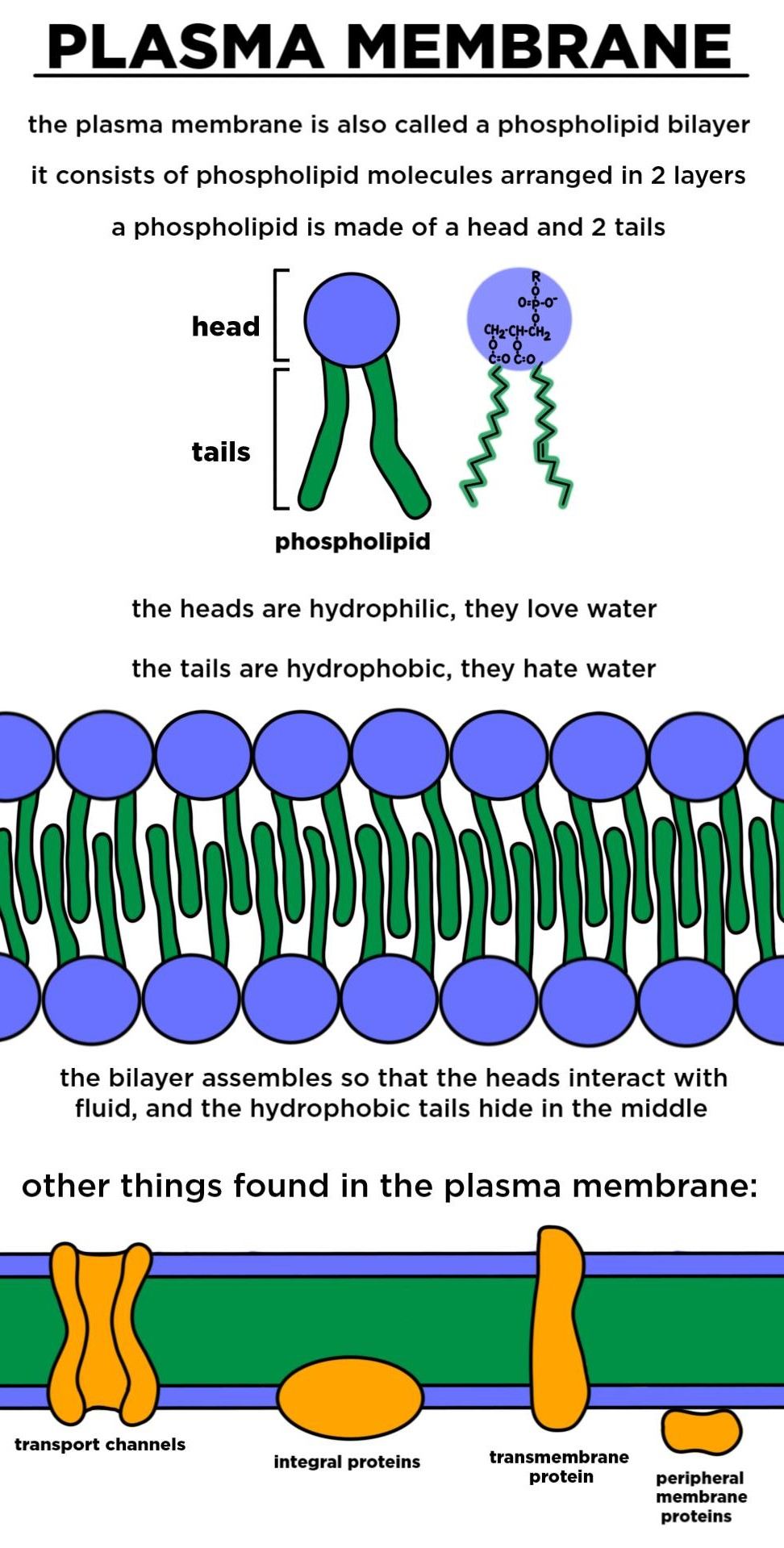
Image source: By Gabi Slizewska
Illustrated · 1 min
Image source: By Gabi Slizewska
Interactive · 1 question
The cell membrane (sometimes called plasma membrane) is a barrier surrounding cells. Plants and animal cells both have cell membranes that are semi-permeable or selectively permeable (only certain things can pass through it), keeping the cells in a state of homeostasis. The plasma membrane envelopes the cell, provides structure, and gives support. Plant cells also have a sturdy cell wall made of cellulose that surrounds the cell membrane and stabilizes the cell.
The membrane is sometimes called a "fluid mosaic" because there are so many different molecules embedded in the membrane, such as carbohydrates and proteins. All of these elements are not static; they bend and move around. Mosaics are a style of artwork, like the one seen below.

A mosaic is a type of art made up of many small tiles. Image source: By Ali Harrison CC BY-ND 2.0, via flickr.com
The cell membrane .
Select all correct options.
This membrane is made of a phospholipid bilayer, or more simply, a lipid bilayer. If you think back to when we were discussing hydrophobic (water-hating) and hydrophilic (water-loving) molecules, you will be able to understand these membranes very well.
The membrane is made of lipids that have a polar, hydrophilic phosphate head and nonpolar, hydrophobic lipid tails. They line up in a double layer with the heads facing the inside and outside of the cell, with the tails between them. You can think of it like a lipid sandwich: the tails are the filling and the heads are the bread.
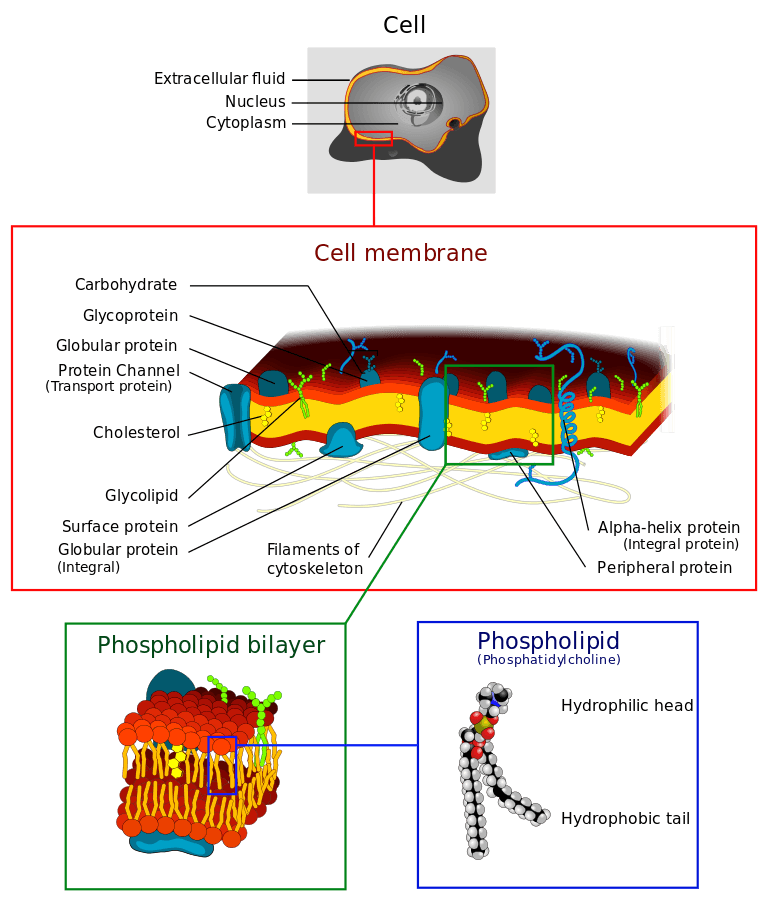
The phospholipid bilayer is basically a sandwich made of lipid tails and phosphate heads, where the heads are the bread. Image source: By LadyofHats Mariana Ruiz, derivative work: Dhatfield CC BY-SA 3.0, via Wikimedia Commons
Cholesterol fits in between some of the phospholipids, which helps the cell keep its shape and provide structure. It also helps to prevent the cell from freezing when it gets cold.
Similarly, proteins are embedded in the membrane and perform many different functions. Some of these proteins are channels, meaning they let specific substances pass through, while others can be used for identifying other cells or receiving chemical messages.
: A semi-permeable phospholipid bilayer
Video
by CrashCourse

In this video, Hank Green goes through the following five things:
Illustrated · 2 min
The plasma membrane, also known as the phospholipid bilayer, is the bubble which surrounds the cell. It makes sure all of the things that are supposed to be in the cell stay in there, and that everything outside stays outside of the cell.
The plasma membrane is made out of phospholipids. When you break apart the word, you're able to get an idea of what a phospholipid is. The phospho- part of the term comes from the phosphate molecule which makes up the head of the phospholipid. The -lipid part of the term comes from the two lipid, or fat, tails that are attached to the head of the phospholipid.
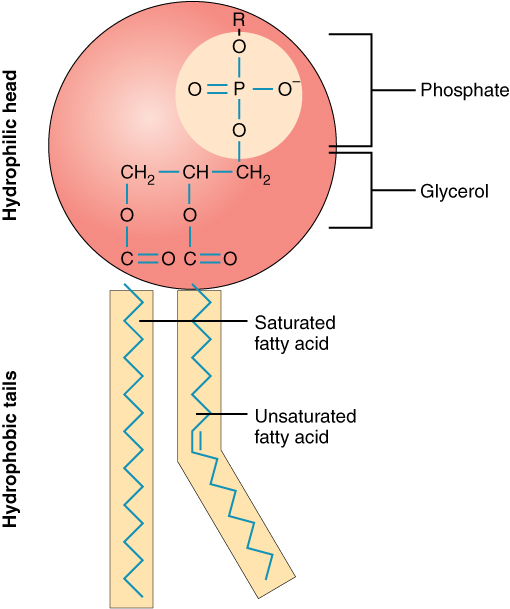
This image shows the basic structure of a phospholipid. The phosphate group at the head of the molecule is attached to the lipid (or fatty acid) tails by a glycerol molecule. Image source: By CNX OpenStax CC BY 4.0, via Wikimedia Commons
The bilayer portion of the term comes from the fact that the membrane is composed of two layers of phospholipids. Phospholipids are capable of this because they are amphipathic, or in other words they are both hydrophilic and hydrophobic.
The phosphate group at the head of the molecule is charged, which means that it is hydrophilic. Being hydrophilic means that it's attracted to water molecules. The lipid (or fatty acid) tails are hydrophobic. Being hydrophobic means that they are repelled by water. To remember what hydrophilic means, think of when you dissolve salt in water. When you begin to stir the water, the salt seems to disappear because the molecules in the salt are attracted to the water. Think of hydrophobic molecules as when when you put a drop of oil into water. The drop of oil likes to stay together because it is repelled by the water.
When a molecule is both hydrophilic and hydrophobic, it is able to form bubbles. This is because the hydrophilic portions of the molecule will want to face out towards the water while the hydrophobic portions of the molecule will want to face away from the water. This means that the two hydrophilic heads are pointed away from one another and the hydrophobic tails are touching one another.

The large black dots in this model represent the hydrophilic heads while the black lines represent the hydrophobic tails. Image source: By Sunshineconnelly CC BY 3.0, via Wikimedia Commons
In the diagram above, you'll see that along with the phospholipids there are also protein molecules in the plasma membrane. These help the cell to function in many different ways. Some small molecules can just pass right through the plasma membrane, but if a molecule is too large or if it has too big of an electrical charge, membrane proteins are needed to help with passing through the membrane. One example of this is facilitated diffusion.
The plasma membrane is very flexible with none of the phospholipids remaining in the same place. Each phospholipid can switch with the one next to it and can even sometimes switch with ones on the opposite side of the membrane. This allows for the membrane to regenerate if it were to be punctured.
Along with phospholipids and proteins in the plasma membrane, there are many other molecules which can be found there which help the cell to function and to communicate with other cells.


