Video · + 2 min read
+4 contributors



(Video) What is a Subset?
by Don't Memorise

This video by Don't Memorise covers sets and subsets with some real life examples.
Suppose that you took a trip to a museum (let's call it museum ) that specialized in Egyptian pottery, and then took a trip to the Metropolitan Museum of Art.
In this situation, you would note that all of the kinds of things that are present in museum are also present in the Met; we would say that museum covers a subset of the genres of art that museum does.
It works the same way with numbers.
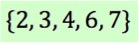
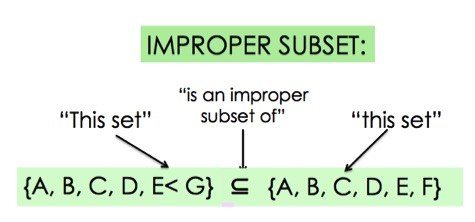
Say that we have some set that contains the numbers and ; let's call it set . Now, suppose that we also have some other set called set that contains the numbers and . Since all of the elements that are contained in set are also contained in set , we can say that set is a subset of set , and we can write that in mathematical notation like so:
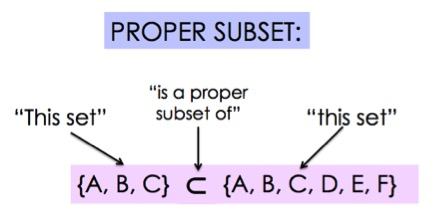
Also, returning to my first example, notice how museum and the Met do not both contain the same exact genres of art. Likewise, in my second example, our two sets do not contain the same exact elements. This means that our set is a strict subset of set , and we can express that like so:
You can think of the "subset of" and "strict subset of" symbols as being analogous to the symbols for "less than or equal to" and "less than": a bar underneath the symbol dictates that the two items being compared are allowed to be "equal," and the absence of this bar dictates just the opposite.
Finally, let's talk about how the empty set, notated mathematically as , fits into all of this.
Suppose you have a bowl of fruit containing three apples, two bananas and one orange. We can express this fruit bowl as a set like so:
Now, suppose we remove each piece of fruit from the bowl until we are left with an empty bowl. Since this leftover emptiness is in fact part of the collection of fruits that were initially inside of the bowl, we can say that "nothing," or the empty set, is a subset of the set we described above:
Going by this logic, we can say that "nothing," or the empty set, is in fact a subset of all sets, including both of the sets that we discussed prior to this example.
How many subsets does the set have?
Let's start with the number subsets: Now the number subsets: number subsets: The last two subsets are the complete set, and the empty set:
In total there are subsets for this set.