Interactive · 1 question

+1 contributors

Nonlinear Systems
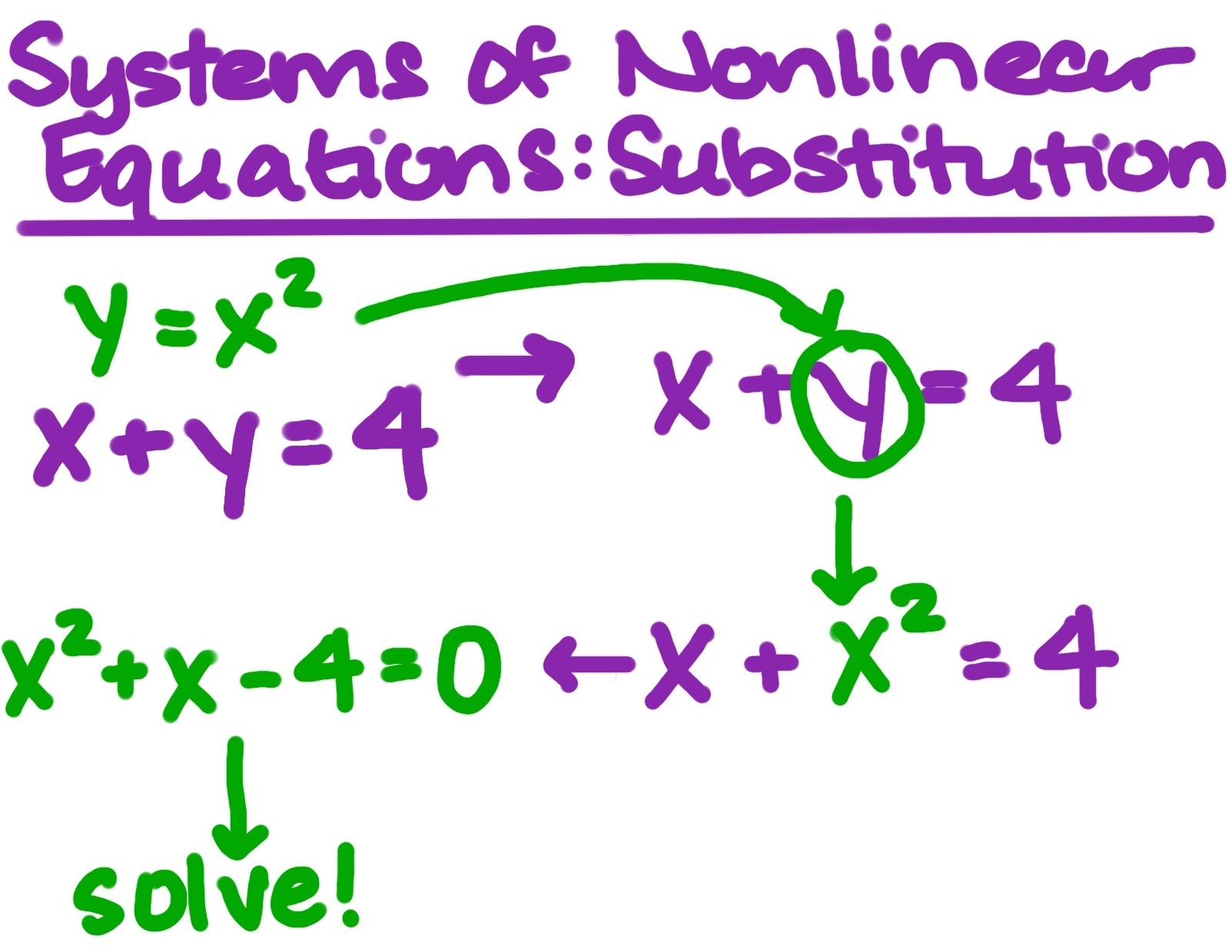
We solve nonlinear systems of equations in almost the same way we solve linear systems of equations. The steps you use are very similar, so this part should feel familiar.
The big difference is the number of solutions. A nonlinear system can have more than one answer.
Think about two lines in a system of equations. Most of the time, the lines cross at one point. That point is the solution. The only exception is when the two lines are actually the same line, which means they share every point.
Nonlinear systems work a little differently, so let’s take a closer look and see what happens.

Made with Desmos
A system that includes a line and a quadratic often has two solutions. This happens when the line crosses the quadratic in two different places.
Sometimes, the line only touches the quadratic at one point. This point is called the vertex of the quadratic. When this happens, the system has only one solution.
To see how this works, let’s look at the following system.

Made with Desmos
Here we can see two solutions where the equations and meet. There's also one solution where and meet. The most solutions you can have with a quadratic system is as it is the highest power in the system.
When we have systems that are all nonlinear, we can sometimes think that the highest power means there will be the most answers. But that’s not always true. For example, this system of a cubic and a quadratic has solutions.

Made with Desmos
A system with a quadratic and a circle can have up to four solutions.

Made with Desmos
Substitution With
The easiest time to use substitution is when one of the equations already tells us the value of a variable. In other words, one equation is already solved for a variable like or .
This makes substitution simpler because there is less algebra to do before you begin.
Now let’s take a closer look at a system that includes a circle and a parabola. We’ll use substitution to see how these two graphs work together.
We see that the parabola has already been described as a definition of . This means that we immediately substitute the first equation anywhere we see in the second equation.
Now we can plug our values back into one of our equations to find their corresponding -values.
The crossing points on our graph should be , , and . Let's take a look at the graph.

Made with Desmos
The graph matches up with our math! We see that the bottom point, just touches the circle. The other two points, and , are crossing points.
Substitution Without
Some systems are not as easy to work with. In many problems, we like equations that are written as a definition of . This makes substitution quick and straightforward.
However, not all equations are set up this way. Sometimes, neither equation is already solved for a variable, which means we have to do a little more work first.
Let’s try solving the following system and see how to handle a harder case.
This one doesn't have too many steps before we have a defined variable. Let's look at the second equation.
We can plug this into our first equation then solve for .
Let's make sure we have valid -values before we plug these back into the other equation. Look at . Remember that we can't use any -value that will make the denominator equal . This means that is an invalid answer. Now, we can plug back into our definition of to find our solution.
The solution to this system is . Let's take a look at the graph.

Made with Demsos
The two functions cross twice, but we have a discontinuity at .
Practice Problem
Find the solution for the following system:
First, let's find a definition of using the first equation. We can plug this into the second equation to find our -value(s).
We only have -value that fits into these equations. This means that the two functions just touch. Let's plug this into our definition of to find our -value in the solution.
Our final answer is the point . Let's look at the graph.
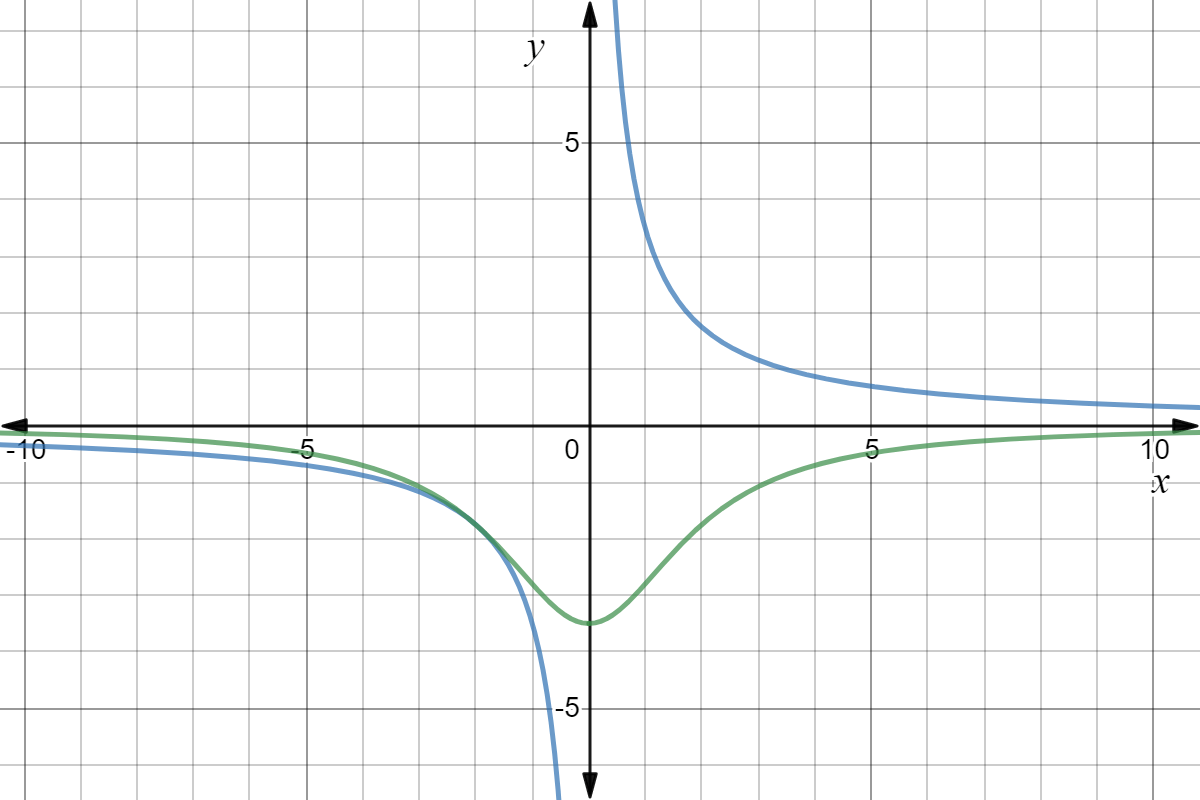
Made with Desmos
The two functions just barely touch, but they meet at the point .
Wrap-Up
Systems can be tricky, and many of them take several steps to solve. That’s normal, especially with nonlinear equations.
The key to solving a system using substitution is to rearrange one of the equations. You want to solve it for a single variable, such as or .
Once you have a definition for a variable, you can substitute it into the other equation. This makes it much easier to solve the system and find the final answers.