Read · 2 min

Background
As we've seen in statistics so far, there are many types of ways to collect data, known as data collection. We've previously talked about sampling methods, suchWe previously talked about observational studies, and the next lesson will cover experiments. This lesson will talk about survey studies, which is the most common method of data collection in research. Surveys are just one of the many research methods researchers can use in a variety of fields, like biomedicine, psychology, public health, and market research.
Survey Research
When we are researching human subjects, we often just want to collect data. Maybe we are trying to understand the behaviors and emotions behind certain groups of people, or we want to just gain knowledge. That's where survey research comes in. We can conduct surveys to understand people's thoughts, behaviors, and emotions. Survey research can also be used to collect demographic information, such as age, sex, race, or socioeconomic status. Political scientists, lobbyists, and government agencies use survey research to understand the political climate and citizen's views on candidates, policies, and laws.
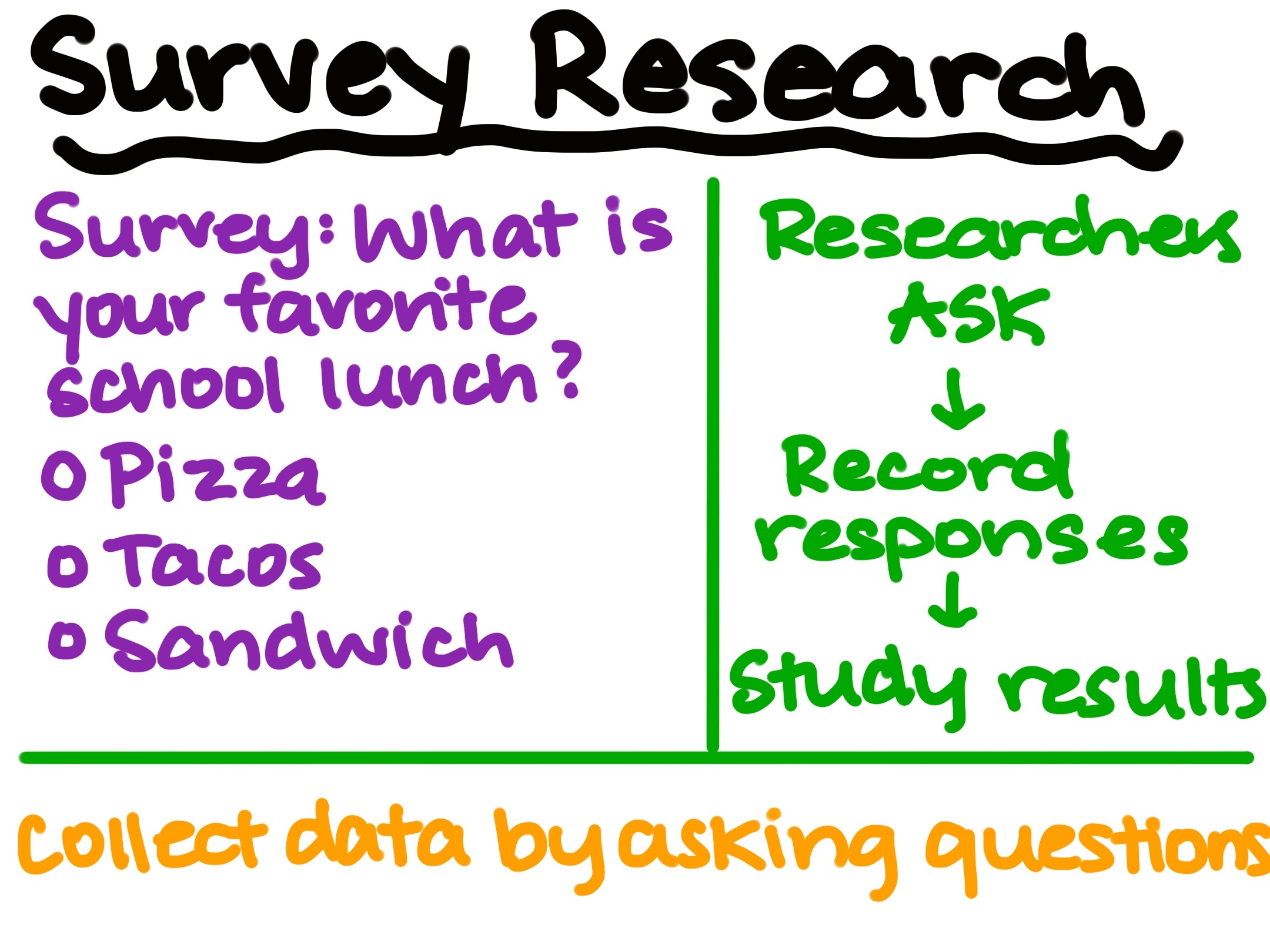
With survey research, participants answer a list of questions on the phone, on paper, or online about themselves or something else. This type of research does not require any variable manipulation, so it is the easiest to conduct. Survey research also tends to be very inexpensive because of the limited amount of work required to actually conduct the research.
The best example of survey research is the U.S. Census! Every years, the U.S. government conducts this huge survey to understand all people in the United States. They ask a bunch of demographic information, like the number of people in the household, annual household salary, and citizenship status. The goal is to understand the number of people currently living in the United States, and to understand the population as a whole.
Implications
With the census, a major implication is redrawing district lines, which is the area that determines your Representative in the United States House of Representatives. This data is really important for federal legislation and when electing the President of the U.S.!
If we have a representative sample taking a survey, we can easily generalize the results of the survey to a larger population. Say you conduct a survey to understand the political climate of a college campus. You randomly select students from a campus of students. All students complete your survey, and you find that of surveyed students support all-gender bathrooms on campus. You could realistically generalize your results to say that the majority of college students support all-gender bathrooms.
If a survey asks about two different variables, researchers can use that data to understand the correlation or causation between the two variables.