
Read · 1 min
By Freya Edholm

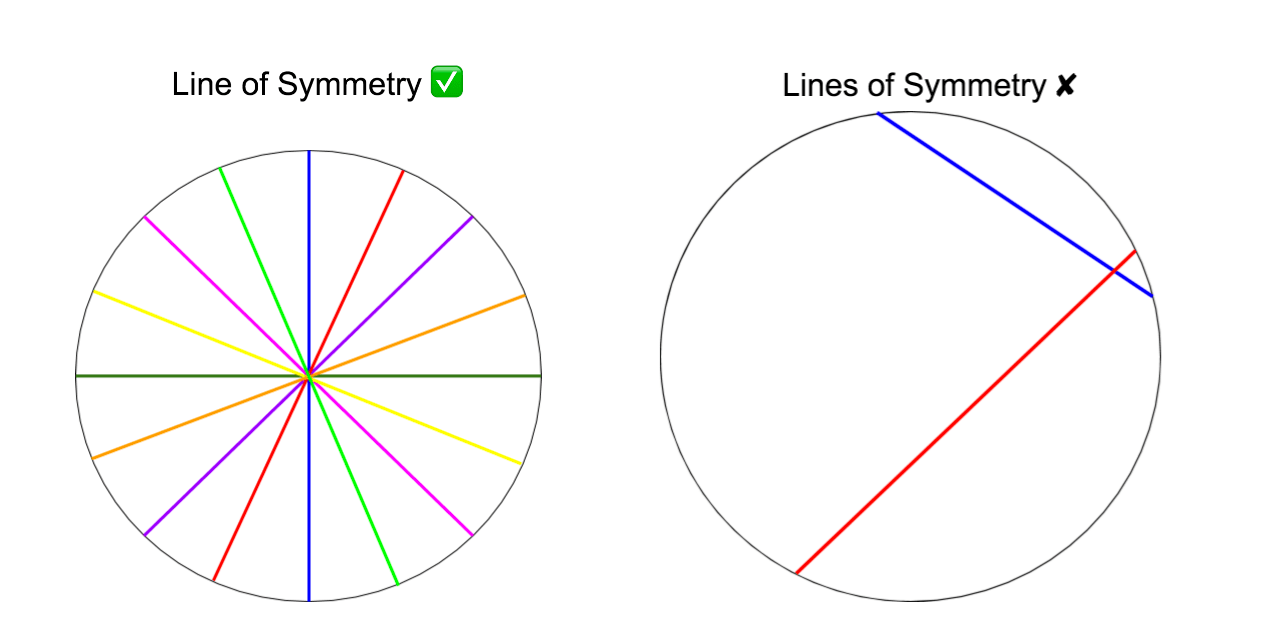
Circles have infinite lines of symmetry: their diameters.
Read · 1 min
Circles have infinite lines of symmetry: their diameters.
Read · 1 min
"Circles have infinite lines of symmetry: their diameters." - Freya Edholm
Here is a further look into this:
infinite lines of symmetry: their diameters
This makes a lot of sense if you think about it. Any diameter must go through the center and two points on the circle; making it the circle's circumference into two equal parts
This makes it a line of symmetry;
But why are there infinite?
Think about the diameters of a circle;
If you rotate the diameter around the center of the circle by any very small part of a fraction it becomes a different line of symmetry.
Because the very small part of a fraction can be infinitely small; there are infinite possible lines of symmetry
Illustrated · 1 min
When considering all the lines of symmetry in a circle, we simply take all of its diameters which is infinitely many.
Read · 1 min
Symmetry comes in two forms: reflectional and radial. Reflectional symmetry is symmetry across a line of symmetry; radial symmetry is symmetry about a center point. To learn more about symmetry, check out the symmetry section here.
A circle (somewhat trivially) has both of these kinds of symmetries. Since a circle has infinitely many diameters, it has infinitely many lines of reflectional symmetry. Furthermore, any size sector in the circle can be rotated about the center point, so this creates infinitely many instances of radial symmetry.
