Synthetic Division for Polynomials

Before this, knowRemainder Theorem for Polynomials

Video

(Video) Synthetic Division

by PatrickJMT

This video by patrickJMT walks you through synthetic division using polynomials.

Synthetic division is a useful shortcut for long division. It emulates the process of long division by removing the variable terms from the polynomial. As a result you no longer have to distribute the constant multiple across the divisor.

Video

(Video) Synthetic Division vs. Long Division

by Learn Math Tutorials

When dividing polynomials with more than one term in the divisor, it is often necessary to use either the method of Long Division or Synthetic Division. The video below from the YouTube channel Learn Math Tutorials explains the difference between these two methods of polynomial division and how to do the computations.

Illustrated · 1 min

We have already learned multiple methods to divide polynomials, such as polynomial long division and polynomial division by factoring. Now, let's learn all about synthetic division!

##Synthetic Division

Synthetic division is another method of polynomial division. It is often simpler than polynomial long division and is used when the divisor is a polynomial of degree 11.

##How It Works

Let's walk through an example.

We are given the expression (3x4−6x3+x2+4x)÷(x−2)(3x^4 - 6x^3 + x^2 + 4x) \div (x-2).

As the divisor has a degree of 11, we can do synthetic division.

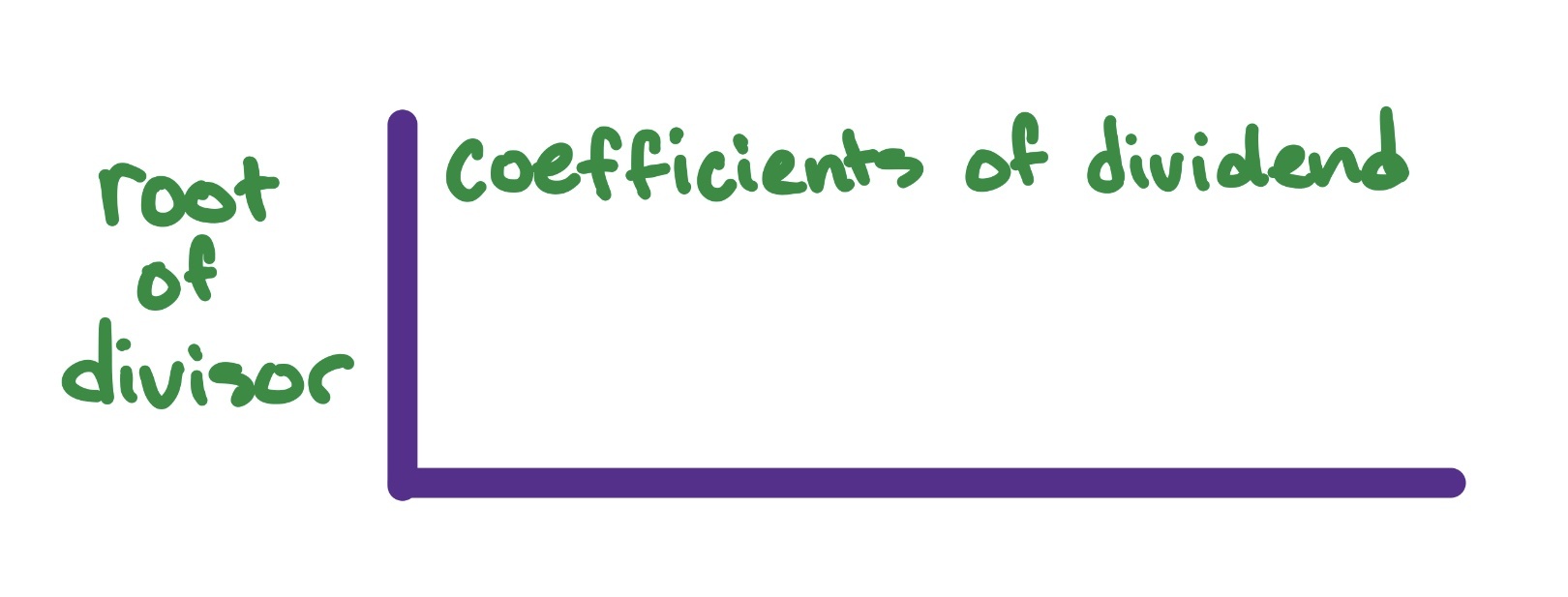
To set up synthetic division, we set up what looks like a little house.

Half of rectangle drawn to symbolize synthetic division. Root of divisor on the outside. Coefficients of dividend on the inside.

Image source: by Trisha

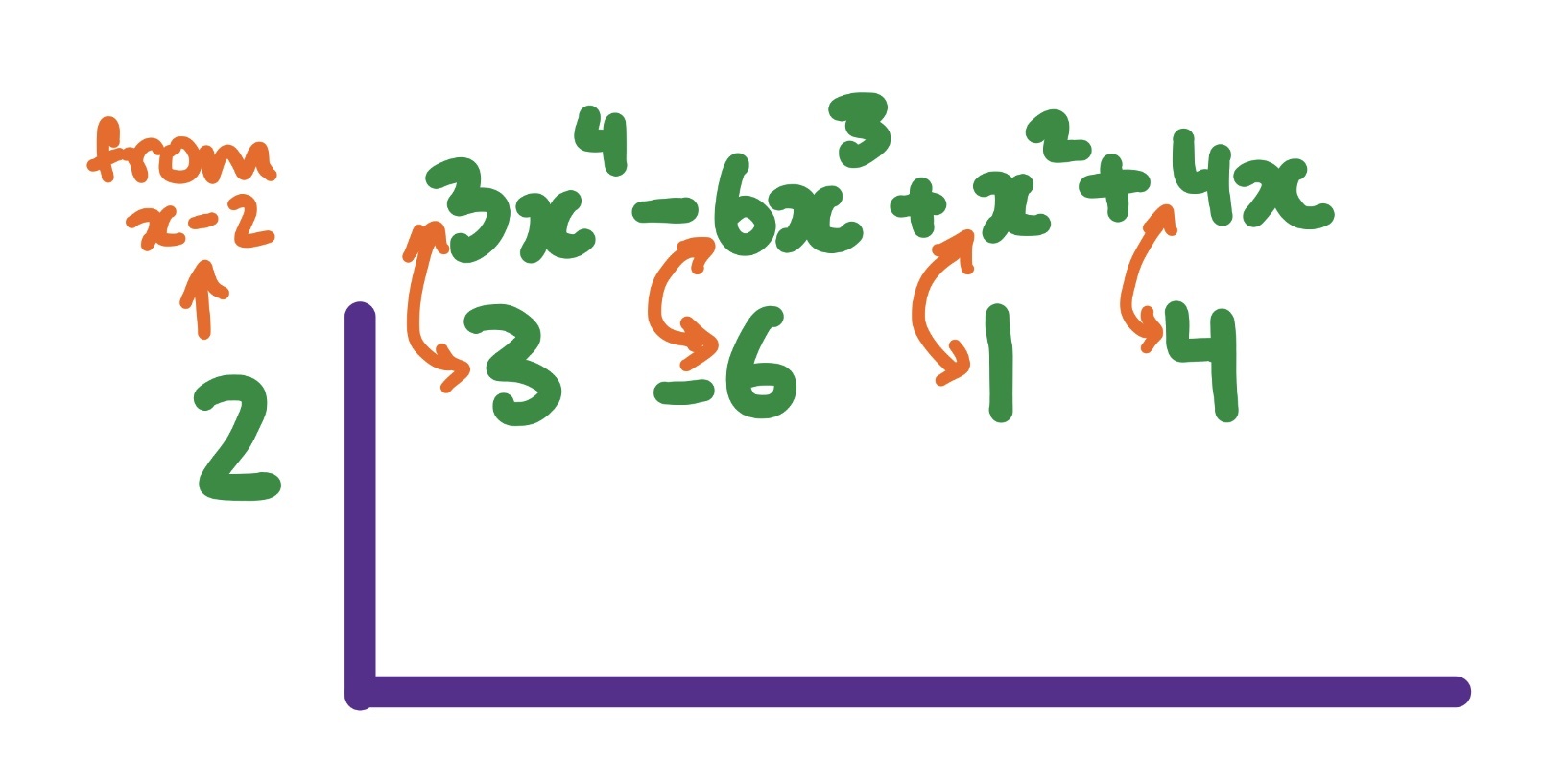
Let's input our example polynomial into this setup.

original dividend: 3x^4 - 6x^3 + x^2 + 4x

inside little house: 3, -6, 1, 4 

outside house: 2 
from x-2

Image source: by Trisha

We know the root of x−2x-2 is 22 using the factor theorem for polynomials. Now that we have the setup, we can work on solving this problem.

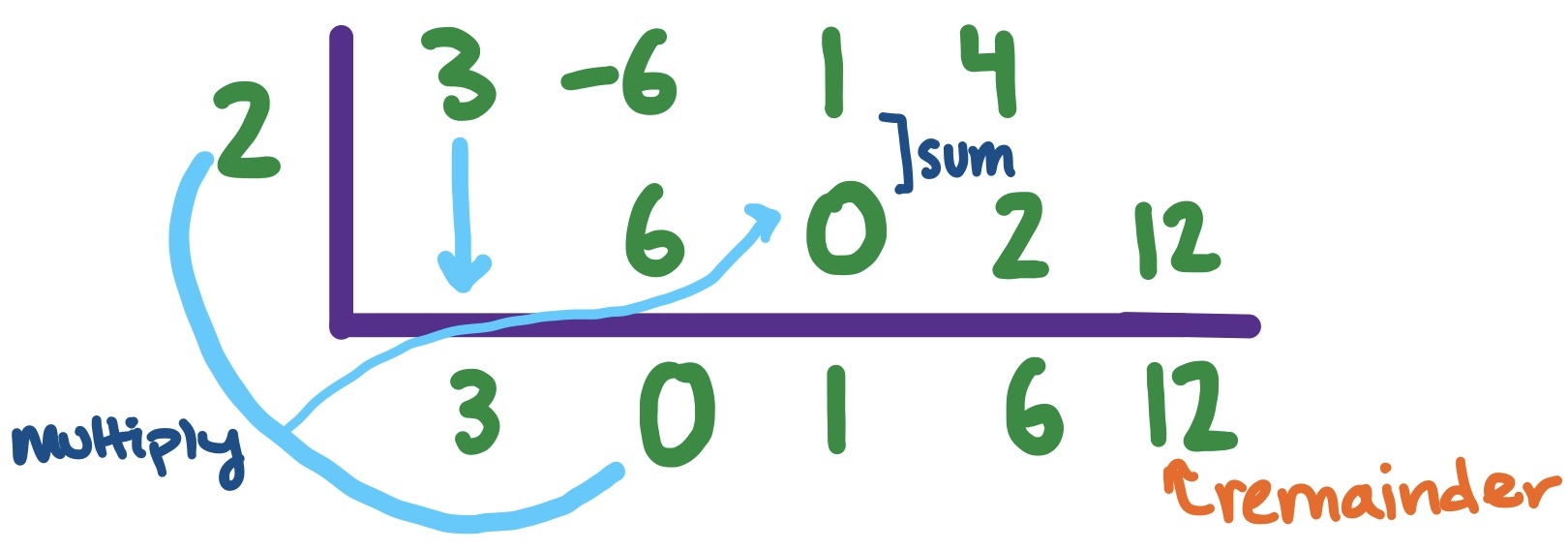
To begin, bring the leading coefficient down below the line. Then, multiply the value below the line by the divisor, in this example 22.

Inside house: 3, -6, 1, 4
bottom row below line: 3, 0

2 is outside the house and is multiplied by three to make 6. Put 6 right below the second coefficient to sum to 0.

Image source: by Trisha

After we multiply, we can write the new value below the second coefficient, add the second coefficient to this new value, then write the result below the line. Then, repeat the pattern with the other coefficients.

Inside house, first row: 3, -6, 1, 4
Inside house, second row: _, 6, 0, 2, 12

outside house: 2
below house: 3, 0, 1, 6, 12

12 is the remainder

Image source: by Trisha

We can use the numbers on the bottom row to get the quotient. Keep in mind that the last number is the remainder. We also know that the degree of the first coefficient of the quotient is one less than the highest degree of the dividend.

In our example, the quotient without the remainder would be 3x3+x+63x^3 + x +6. Using the remainder theorem for polynomials, we can write the quotient and remainder together as:

3x3+x+6+12x−23x^3 + x +6 +\frac{12}{x-2}

Illustrated · 1 min

Synthetic Division for Polynomials

In this lesson, we are going to learn about synthetic division, a useful shortcut for polynomial division. It only works in certain cases, though, but it is much faster than polynomial long division.

We use synthetic division when we're dividing a polynomial by something like x–cx – c, where cc is a number. For example, let's say we want to divide 2x3+3x2–5x+62x³ + 3x² – 5x + 6 by x–2x – 2.

First, we write down the coefficients: 2,3,−5,62, 3, -5, 6. Then, on the left, we write down 22, which is the opposite of −2-2. 22 will be the number we divide by.

First, write down the coefficients (just the numbers in front of the variables): 2, 3, -5, and 6. Then, write 2 (the opposite of -2) to the left. This is the number we divide by.

Next, bring down the first number (2). Multiply it by 2 and write the answer under the next number. Add the numbers in that column. Keep repeating this: multiply and add.

When you finish, the last number is the remainder. The other numbers are the coefficients of your answer.

Image source: by Anusha Rahman

Next, you'll bring down the first number, 22. Multiply 22 by 22 and write the number under 33. Add the numbers in the second column, 3+43+4, and write the sum under the line.

Keep doing this until you reach the last number. The last sum is the remainder of the division. The other numbers are the coefficients of your answer.

Synthetic division seems confusing at first, but it gets easier the more and more that you do it. It's a great tool if you want to check if something is a factor of a polynomial.


Type a concept, like “slope” or “photosynthesis”.

↑ ↓ to choose · Enter to openSearch explanations and problems