System of Linear Equations with 3 Variables: Elimination

Video

(Video) Solving Systems of 3 Equations Elimination

by Mario's Math Tutoring

Check out this video by Mario's Math Tutoring to learn how to solve a system of 33 equations using elimination!

Let's look at the example Mario uses in the video.

x+2y−z=2x+2y-z = 2 2x−3y+z=−12x-3y+z = -1 5x−y−2z=−35x-y-2z=-3

Focus on the first two equations. Then, solve for a variable just like you would in a two equation system of equations.

x+2y−z=2x+2y-z = 2 +2x−3y+z=−1‾\underline{+2x-3y+z = -1} 3x−y=13x-y=1

Now, solve the system of equations between the second and third equations given. Hint: Multiply the second equation by two to help eliminate!

2⋅(2x−3y+z)=(−1)⋅22\cdot (2x-3y+z) = (-1) \cdot 2 5x−y−2z=−3‾\underline{5x-y-2z=-3}

Solve like you normally would.

4x−6y+2z=−24x-6y+2z = -2 +5x−y−2z=−3‾\underline{+5x-y-2z=-3} 9x−7y=−59x-7y=-5

Take the two equations you have solved for so far and use elimination to solve for a variable.

9x−7y=−59x-7y=-5 −7⋅(3x−y=1)=(1)⋅−7‾\underline{-7\cdot (3x-y=1) = (1) \cdot -7}

Which when you simplify, equals:

9x−7y=−59x-7y=-5 −21x+7y=−7‾\underline{-21x+7y=-7} −12x=−12-12x = -12 x=1x=1

Now you can plug x=1x=1 into the given equations and solve for yy and zz!

3x−y=13x-y=1 3(1)−y=13(1)-y=1 −y=−2-y=-2 y=2y=2 (1)+2(2)−z=2(1)+2(2)-z = 2 5−z=25-z = 2 −z=−3-z = -3 z=3z = 3

Therefore, x=1x=1, y=2y=2, and z=3z=3.

Read · 2 min

In the previous lesson, we learned how to solve a linear system of equations with 33 variables using substitution. This lesson will cover another method, elimination!

How we eliminate is similar to the method we used for 22 variables. Let's review that before diving into this lesson.

Elimination

When using elimination to solve a system of linear equations, our main goal is to cancel terms between equations. We're able to do elimination because of the Addition Property of Equality and the Multiplication Property of Equality.

In order to cancel terms, the terms need to be "opposites" or additive inverses. Think back to the Inverse Property of Addition, where we can say that:

−3+3=0-3+3=0

We want to find the additive inverse or "opposite" of the term. The key difference between eliminating with 33 variables and eliminating with 22 variables is that: you need to eliminate the same variable in order to get a new, simpler system of equations. That's confusing! Let's walk through the steps, then go through an example.

There are a few basic steps to solving using elimination:

  1. Manipulate all equations into standard form.

  2. Ensure all coefficients are non-fractional.

  3. Eliminate one variable from two equations.

  4. Eliminate the same variable from a different set of two equations.

  5. Solve the new system of equations that has 22 variables.

  6. Substitute and solve!

  7. Check your work.

Example

Problem: Use elimination to solve the following system of linear equations:

a:8x−4y+6z=2b:2x+6y−4z=−14c:6x+2y+4z=10\begin{align} a: 8x-4y+6z&=2\\ b: 2x+6y-4z&=-14\\ c: 6x+2y+4z&=10\\ \end{align}

Step-By-Step Solution

Step #1: Manipulate all equations into standard form.

It looks like all of our equations are in standard form!

Step #2: Ensure all coefficients are non-fractional.

It looks like all of our coefficients are non-fractional!

Step #3: Eliminate one variable from two equations.

It doesn't matter which two equations we pick. Let's go with equations a and c!

8x−4y+6z=26x+2y+4z=108x−4y+6z=2[6x+2y+4z=10]⋅28x−4y+6z=212x+4y+8z=2020x+14z=22\begin{align} 8x-4y+6z&=2\\ 6x+2y+4z&=10\\ \hline 8x-4y+6z&=2\\ [6x+2y+4z&=10]\cdot2\\ \hline 8x-4y+6z&=2\\ 12x+4y+8z&=20\\ \hline 20x+14z&=22\\ \end{align}

We can call this new equation, 20x+14z=2220x+14z=22, d.

Step #4: Eliminate the same variable from a different set of two equations.

We are going to go with equations b and c!

2x+6y−4z=−146x+2y+4z=102x+6y−4z=−14[6x+2y+4z=10]⋅−32x+6y−4z=−14−18x−6y−12z=−30−16x−6z=−44\begin{align} 2x+6y-4z&=-14\\ 6x+2y+4z&=10\\ \hline 2x+6y-4z&=-14\\ [6x+2y+4z&=10]\cdot-3\\ \hline 2x+6y-4z&=-14\\ -18x-6y-12z&=-30\\ \hline -16x-6z&=-44\\ \end{align}

We can call this new equation, −16x−6z=−44-16x-6z=-44, e.

Step 5: Solve the new system of equations that has 22 variables.

If you notice, now we have two new equations, d and e. Each has two variables, x and z! We're going to set up another system of equations for these two equations.

20x+14z=22−16x−6z=−44[20x+14z=22]⋅8[−16x−6z=−44]⋅7160x+112z=176−112x−112z=−30848x=−132x=−2.75\begin{align} 20x+14z&=22\\ -16x-6z&=-44\\ \hline [20x+14z&=22]\cdot8\\ [-16x-6z&=-44]\cdot7\\ \hline 160x+112z&=176\\ -112x-112z&=-308\\ \hline 48x&=-132\\ x&=\boxed{-2.75}\\ \end{align}

Step 6: Substitute and solve!

We've found xx, so we can substitute to find yy and zz. Let's first plug xx into one of our new equations. I've chosen d, but it doesn't matter if you chose e!

20(−2.75)+14z=22−55+14z=2214z=77z=5.5\begin{align} 20(-2.75) +14z &=22 -55 +14z&=22\\ 14z&=77\\ z&=\boxed{5.5}\\ \end{align}

We've found both xx and zz! Let's plug both of these values into one of the original equations. I've chosen cc, but it doesn't matter if you chose aa or bb.

6(−2.75)+2y+4(5.5)=10−16.5+2y+22=105.5+2y=102y=4.5y=2.25\begin{align} 6(-2.75)+2y+4(5.5)&=10\\ -16.5 +2y +22 &=10\\ 5.5+2y&=10\\ 2y&=4.5\\ y&=\boxed{2.25}\\ \end{align}

So, the solution to this system of equations is: x=−2.75,y=2.25,z=5.5\boxed{x=-2.75, y=2.25, z=5.5}

Step 7: Check your work.

We can plug in our newly solved variables into one of the original equations! I've chosen equation b, but it doesn't matter if you chose a or c.

2(−2.75)+6(2.25)−4(5.5)=−14−5.5+13.5−22=−14−14=−14✓\begin{align} 2(-2.75)+6(2.25)-4(5.5) &=-14\\ -5.5 +13.5 -22 &=-14\\ -14 &= -14 \checkmark\\ \end{align}

Illustrated · 1 min

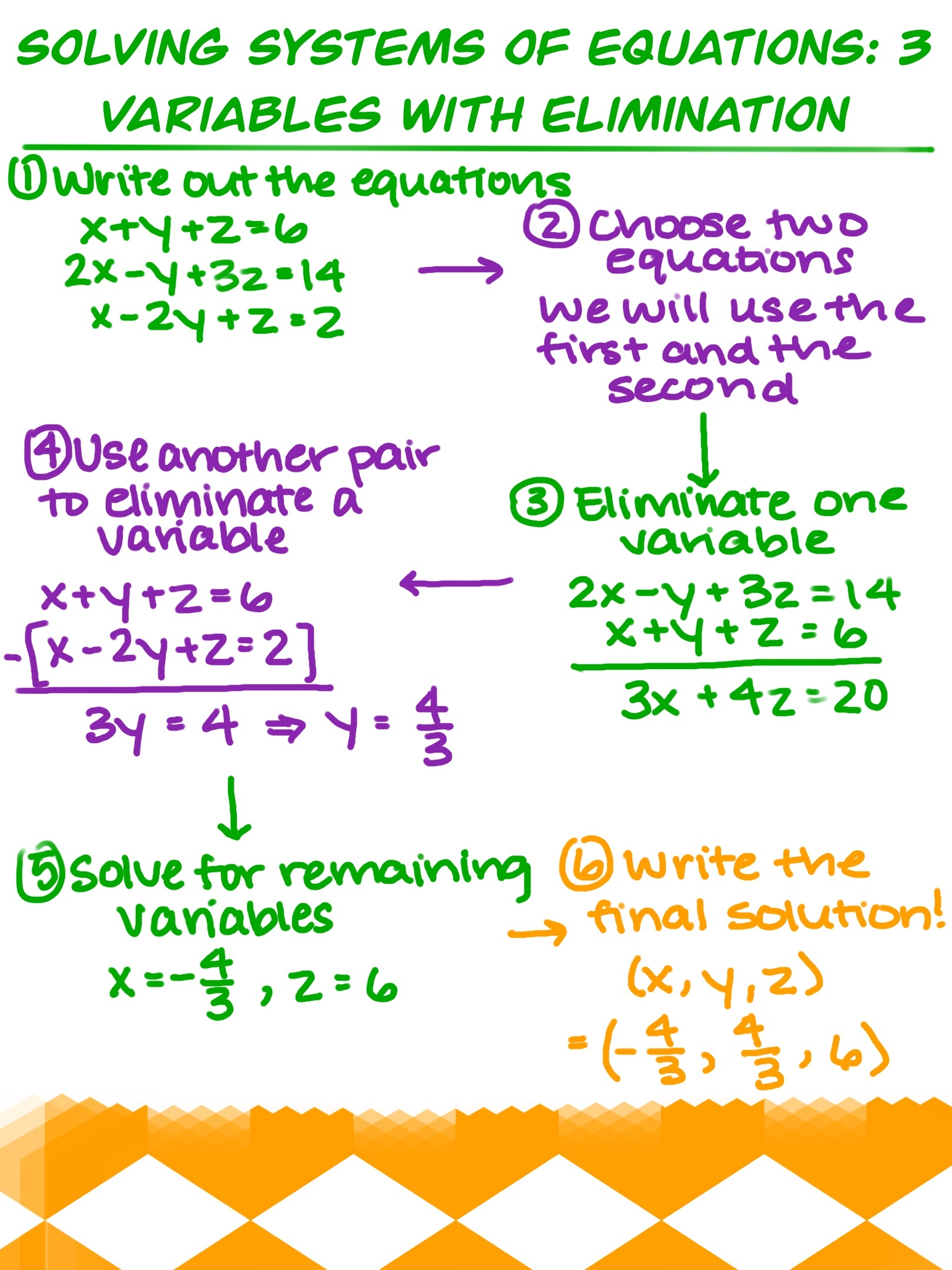
Systems of Linear Equations: Elimination with 3 Variables

Solving a system of linear equations with 3 variables can seem really overwhelming at first, but with a few steps, you'll be able to tackle any problem!

Six-step handwritten guide to solving a 3-variable system by elimination. Example: x+y+z=6, 2x-y+3z=14, x-2y+z=2 gives 3y=4, y=4/3, then x=-4/3, z=6; solution (-4/3, 4/3, 6).

Image source: by Anusha Rahman

Type a concept, like “slope” or “photosynthesis”.

↑ ↓ to choose · Enter to openSearch explanations and problems