
Interactive · 5 questions
+6 contributors





Systems with No Solution
Some systems of equations have no solutions. We know that sounds a little odd. All problems have solutions, don't they?
Nope.
The good news is that spotting a system of equations with no solution is pretty straightforward. Let's take a look at an example:
Are the equations in this system in their most reduced form?
The first step to solve a system is ALWAYS simplify, reduce, and rearrange. We want the simplest form of each equation, and the same order of variables.
We kept the second equation the same, but divided each element in the first equation by .
Notice that both equations are in standard form.
Now that we've got our equations simplified, let's solve for one of the variables. We'll choose as our variable and as the equation.
Solve for in . What is the value of ?
Now, let's solve for just like we would normally do. Plug the value we have for into the second equation .
What result do we get when we plug in our value for into the second equation?
We know that does not equal . This scenario is called nonsense. (Seriously, that's the math term for it.)
Check off all of the nonsense solutions in the list below:
When you get a nonsense answer, you need to CHECK YOUR WORK. You must be absolutely sure that you haven't made any math errors before you decide you have nonsense. Try solving for the other variable using the other equation.
If you truly have a nonsense response, then the system of equations has no solution. Think about it like this, there is no value for or that can make true. There is no solution.
Graphing
Another effective way to check your work is to graph both equations in the system. You can do this in their reduced (simplified) or non-reduced (original) form—it doesn't matter.
Here are the graphs of two equations.
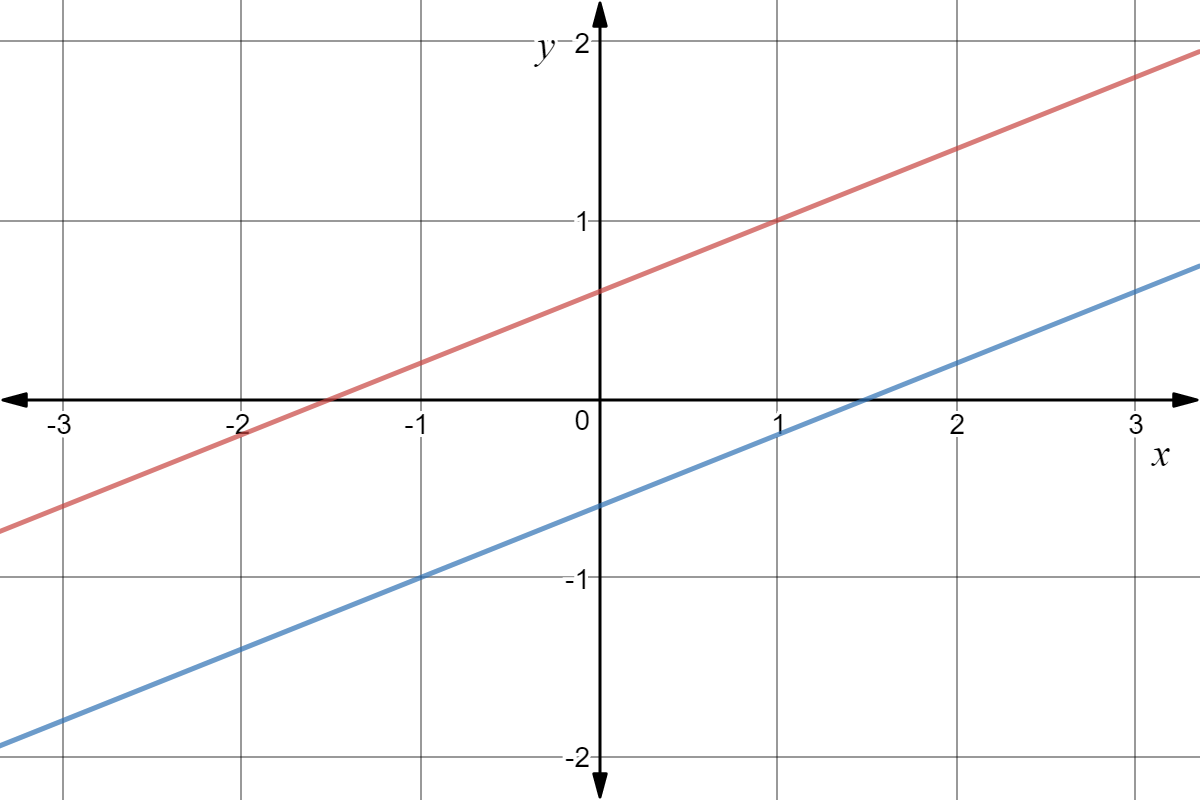
Created using Desmos
Which line represents the second equation in our system
()?
*Recall that the values for and come from the intersection point of the system.
Hmmmm. Our lines are parallel. That means that, no matter how far we extend them in each direction, they will never cross. There's no point of intersection. This means that there are no values for and - i.e., there is no solution.


