Two Ways to Solve Systems of Linear Equations
Substitution
Substitution is one of the easiest ways to solve a system of linear equations once you get the hang of it.
The best part about substitution is that once you figure out a variables value in one equation, you can use that in the other equation. Let's look at an example.
Example 1:
{y=6x+35y−2=2x+6
First, we get a variable alone. In this case, we already have y alone and know that y=6x+3. We can now plug in or substitute 6x+3 for y in the other equation.
5(6x+3)−230x+15−228x+1328xx=2x+6=2x+6=6=−7=−4
Now, we know x=−4, we can plug that in or substitute it to either equation to find y.
yyyy=6x+3=6(−4)+3=−24+3=−21
Let's take a look at a harder example.
Example 2:
{y=x2−x−13y=x+1
In this case, we need to find x first to plug it into the quadratic equation. Since y=x+1 that means x=y−1. We can now plug that in for x in the quadratic equation.
yy=x2−x−14=(y−1)2−(y−1)−14
Now we expand (y−1)2 and simplify.
yyyy=(y−1)(y−1)−(y−1)−14=y2−2y+1−(y−1)−14=y2−2y+1−y+1−14=y2−3y−12
Now, move everything to one side to set the equation equal to zero. Then, factor to find solutions for y.
0=y2−4y−12=(x+6)(y+2)=−6,2
Now, we can substitute those values for y into the linear equation.
y−6x=x+1=x+1=−7
y2x=x+1=x+1=1
Therefore, the solutions are the ordered pairs (1,2) (−7,−6)
Elimination
Elimination is another way to solve systems of equations. You simply make one equation look like the other and subtract in order to remove one of the variables and solve for the other. Let's take a look at an example.
{2x+y=9−1=y−3x
There are two options here. We can: (1) Rearrange the equations so that the variables are on the same side in each OR (2) continue with the equations as is
We'll start with the rearrangement method. Either way, start by stacking the equations, one on top of the other.
2x+y=9−3x+y=−1
Notice that we've rearranged the second equation so that we have the variables on the same side and in the same order in both equations.
The variable we'll be eliminating is the one that is the same in both equations (regardless of whether its sign differs). Now, you have to decide whether you need to use addition or subtraction to do the eliminating.
In our case, we've got a +y in the top equation and a +y in the bottom equation. So, we need to subtract the two equations to get rid of the y.
− 2x+y=9(−3x+y=−1)
2x+y−(−3x+y)=9−(−1)
Before we clean up that equation, it's important that we note: When you are adding or subtracting equations from each other, be mindful of negative signs.
Now, we clean up the equation a bit.
2x+y−(−3x+y) 2x+y+3x−y 5x x =9−(−1)=9+1=10=2
Now we know x=2 so we can plug it in to find the value of y.
2x+y2(2)+yyy=9=9=9−4=5
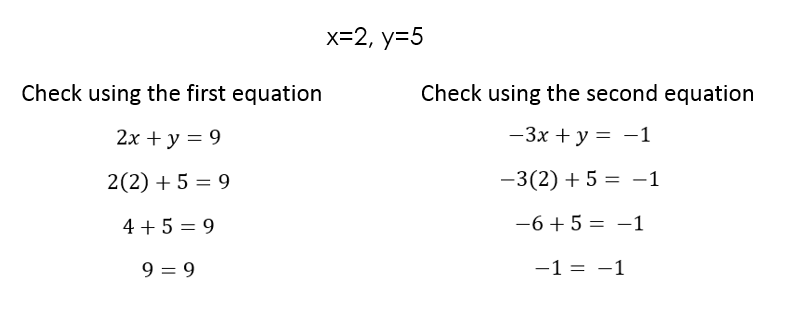
Now we need to double check!
Substitute x=2 and y=5 into both of the original equations; when you get the same number on both sides of the equation you know the solution actually works; we won't run into any problems this time around.