Systems of Linear Equations with 3 Variables: Substitution

Interactive · 4 questions

If you see a system of equations (such as the one below) that would be very confusing to solve with normal substitution, you can use the Elimination Method. These are our example equations:

(8=x+y+z)(8 = x + y + z), (11=2x+y+3z)(11 = 2x + y + 3z), (17=3x+2y+2z)(17 = 3x + 2y + 2z)

The Elimination Method uses the fact that if 22 equations have a term in common, such as 4x4x, we can subtract one equation from the other, cancelling out the common term's variable.

For the first step, which equation do you think we should subtract from which?

Choose all correct answers

Read · 2 min

Combine the terms (...a lot)

First off: to solve a system of equation with nn variables using algebraic methods, you need to have at least nn equations. For example, if you have two variables you'll need two equations, if you have three variables you'll need three equations...and so forth.

So let's say we have three variables, x,y,x, y, and zz. We're also going to need three equations:

A) x−y=zx - y = z

B) 3z+4y=2x+83z + 4y = 2x + 8

C) y+2z=2−xy + 2z = 2 - x

There's a lot to work with right now, so we want to use the substitution method to figure out what the variables are in terms of each other until we can construct one equation with one variable, and then use that one to figure out all the others.

First Step

There's a clear place to start here, so let's begin: what is zz in terms of xx and yy?

The answer to this question is actually right above in equation A! x−y=zx - y = z, so we know that we can replace zz in the other equations with x−yx - y.

Now, let's start to figure out yy in terms of xx. What is expression C if we replace zz with x−yx - y? Hit continue when you've figured it out.

y+2(x−y)=2−xy + 2(x - y) = 2 - x

y+2x−2y=2−xy + 2x - 2y = 2 - x

2x−y=2−x2x - y = 2 - x

2x−y=2−x2x - y = 2 - x

Now, we have both sides fully simplified... but there's a term with xx in it on both sides! It should be pretty easy to figure out what yy is in terms of xx from here. Isolate yy on one side of the equation, and then hit continue.

2x−y=2−x2x - y = 2 - x

−y=2−x−2x-y = 2 - x - 2x

−y=2−3x-y = 2 - 3x

y=−2+3xy = -2 + 3x

Awesome! Now that we know that z=x−yz = x - y and y=−2+3xy = -2 + 3x, we can figure out what zz is in terms of xx, too.

If z=x−yz = x - y and y=−2+3xy = -2 + 3x, what is zz in terms of xx? Fully simplify your answer.

z=x−yz = x - y

z=x−(−2+3x)z = x - (-2 + 3x)

z=x+2−3xz = x + 2 - 3x

z=2−2xz = 2 - 2x

Now, we know everything in terms of xx! Since we haven't used equation B yet, we can plug everything into it so that everything is in terms of xx.

Try it on your own first!

Using the equation 3z+4y=2x+83z + 4y = 2x + 8, and the fact that z=2−2xz = 2 - 2x and y=−2+3xy = -2 + 3x, find a numerical value for xx. If necessary, give your answer as a fully-simplified fraction.

3z+4y=2x+83z + 4y = 2x + 8

3(2−2x)+4(−2+3x)=2x+83(2 - 2x) + 4(-2 + 3x) = 2x + 8

6+6x−8+12x)=2x+86 + 6x - 8 + 12x) = 2x + 8

−2+6x=2x+8-2 + 6x = 2x + 8

6x−2x=8+26x - 2x = 8 + 2

4x=104x= 10

x=104x= \frac{10}{4}

x=52x= \frac{5}{2}

So, the solution for xx is 52\frac{5}{2}.

Using our numerical value for xx and the fact that y=−2+3xy = -2 + 3x, find a numerical value for yy. If necessary, give your answer as a fully-simplified fraction.

y=−2+3xy = -2 + 3x

y=−2+3(52)y = -2 + 3(\frac{5}{2})

y=−2+152y = -2 + \frac{15}{2}

y=−42+152y = -\frac{4}{2} + \frac{15}{2}

y=−42+152y = -\frac{4}{2} + \frac{15}{2}

y=112y = \frac{11}{2}

So, the solution for yy is 112\frac{11}{2}.

We've got xx and yy--now just zz is left. Using any of the equations we know, find the numerical value for zz. If necessary, give your answer as a fully-simplified fraction.

I chose to just use z=2−2xz = 2 - 2x, so:

z=2−2(52)z = 2 - 2(\frac{5}{2})

z=2−102z = 2 - \frac{10}{2}

z=2−5z = 2 - 5

z=−3z = -3

So, the solution for zz is −3-3.

And we're done!

Finally, we know that x=52x = \frac{5}{2}, y=112y = \frac{11}{2}, and z=−3z = -3. If you plug these numbers into the original equations, they'll all still be true (and, in fact, that's the best way to check your work)!

So finally, a short summary in steps:

1. Find all the variables in terms of one of the variables using all but one of your equations.

2. Use the one remaining equation to find the numerical value of your chosen variable.

3. Use that number to figure out the solution to all the rest of the variables!

Video

In both of the following examples by patrickJMT, you will have the chance to walk through examples of how to solve systems of equations with 33 variables, using the process of elimination by addition.

(Video) Solving a System of Equations with 33 Variables Using Elimination by Addition

by patrickJMT

In this video by patrickJMT, you can see an example of using elimination to solve a system of equations with 33 variables.

(Video) Solving a System of Equations with 33 Variables Using Elimination by Addition

by patrickJMT

This video by patrickJMT walks you through another example of solving a system of equations with 33 variables using elimination.

Illustrated · 1 min

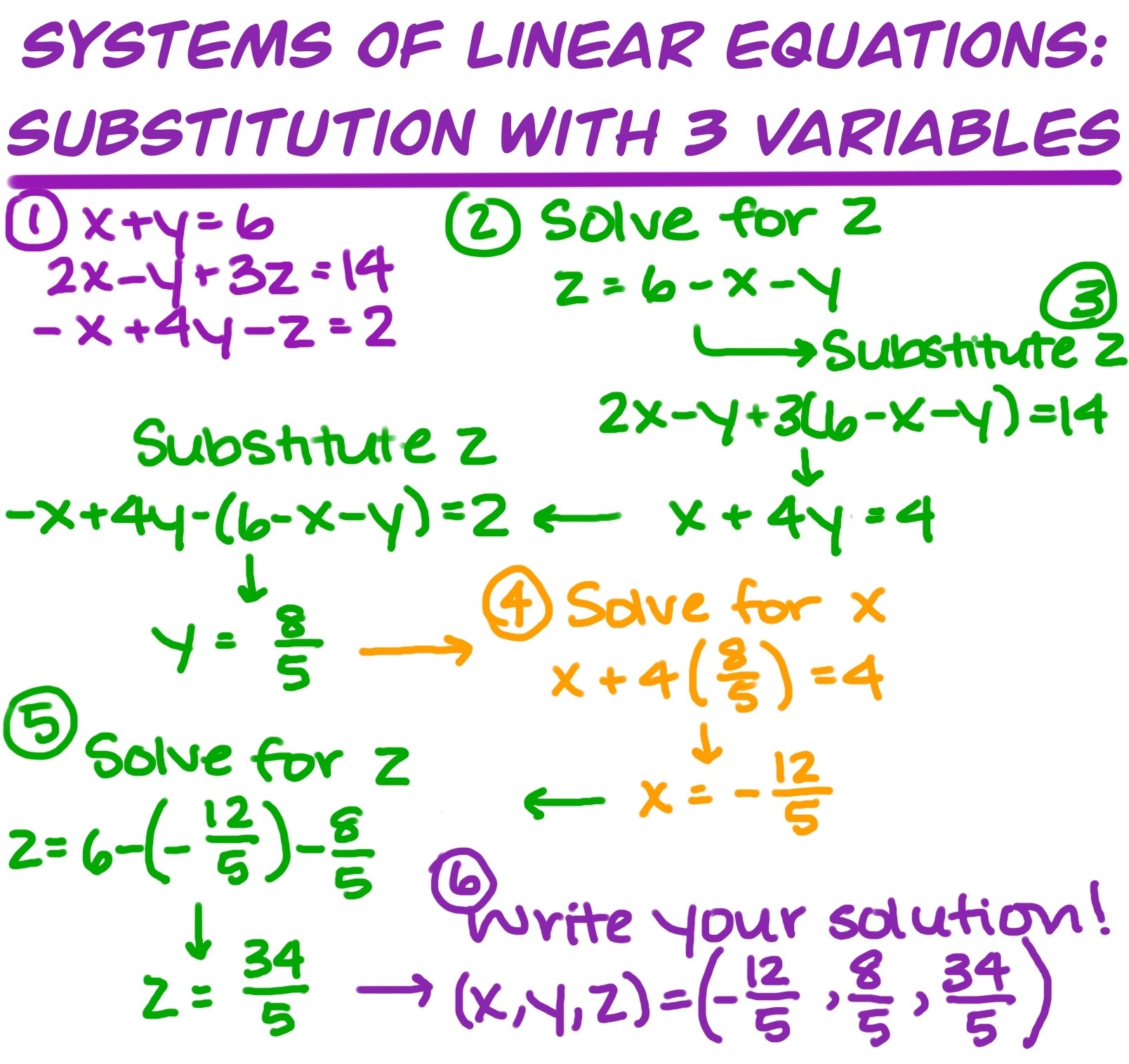
Systems of Linear Equations: Substitution with 3 Variables

Solving a system of linear equations with 3 variables can seem really overwhelming at first, but with a few steps, you'll be able to tackle any problem!

Systems of Linear Equations: Substitution with 3 Variables
1) x+y=6
2x-y+3z=14
-x+4y-z=2
2) Solve for z
z=6-x-y
3) Substitute z
2x-y+3(6-x-y) = 14
x+4y=4
Substitute z
-x+4y-(6-x-y)=2
y=8/5
4) Solve for x
x+4(8/5) = 4
x=-12/5
5) Solve for z
z=6-(-12/5)-8/5
6) Write your solution!
(x,y,z)=(-12/5, 8/5, 34/5)

Image source: by Anusha Rahman

In this example, we solve a system of three linear equations using the substitution method.

Steps:

  1. Start with the System: We have three equations with variables xx, yy, and zz.
  2. Isolate a Variable: Choose an equation to isolate zz in terms of xx and yy.
  3. Substitute: We substitute this expression for zz into the other two equations. This reduces the system to two equations with two variables.
  4. Solve for One Variable: After substituting, we solve for yy first, and then use that value to find xx. Find the Remaining Variable: Finally, we substitute our values of xx and yy back into the equation for zz. Conclusion: The solution to the system is the ordered triple (x,y,z)(x, y, z), representing the values that satisfy all three equations simultaneously.

By following these steps, you can tackle any system of linear equations with 3 variables using the substitution method!

Type a concept, like “slope” or “photosynthesis”.

↑ ↓ to choose · Enter to openSearch explanations and problems