Read · 1 min

A convenient feature of polar coordinates is that it separates acceleration that can change your radius and your angle. Remember that acceleration parallel to velocity changes the speed, acceleration tangential (transverse) to the velocity changes the orientation. To increase or decrease ω\omega, it is necessary to have a tangential acceleration. To increase or decrease rr, it is necessary to have radial acceleration. Also note that constant rr and ω\omega still requires a constant radial acceleration a=v2/r=ω2ra=v^2/r = \omega^2 r.

Illustrated · 1 min

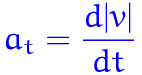
Tangential acceleration is the acceleration that an object feels that pulls it away from the center of rotation. Tangential acceleration comes from the force that you would feel when on a merry go round that makes you feel like you want to fly off the object. Tangential acceleration can be defined as the speed you would feel flying off the merry go round divided by the time it takes. The tangential acceleration can be expressed by the equation:

Radial acceleration is the acceleration you feel that pulls you toward the center of a circle. When spinning on the merry go round, the reason you stay spinning is because the radial acceleration keeps you moving around the circle. Radial acceleration's direction is always pointed towards the center of the circle, so the acceleration's direction is constantly changing. Radial acceleration can be expressed by the equation, where v is the speed the object moves and r is the distance the object is from the center of the circle.

Type a concept, like “slope” or “photosynthesis”.

↑ ↓ to choose · Enter to openSearch explanations and problems