Illustrated · 2 min

+3 contributors



The Last Phase of Mitosis

Image source: By LadyofHats (modified by expii) [Public domain], via Wikimedia Commons
The final phase of mitosis is called telophase.
In the previous phase, the chromosomes were split up so that there was a complete set on each side of the cell.
During telophase, the chromosomes begin to uncoil into a less condensed form. As this happens, a nuclear membrane forms around each set. This forms two nuclei.
Now, the cell is ready to split into two daughter cells in a process called cytokinesis. It's important to note that this process often occurs at the same time as telophase.
Cytokinesis in Plant and Animal Cells
Although the overall process of splitting is the same, it looks a bit different in animal cells and plant cells. Why is this the case? Well, plant cells have a tough cell wall surrounding their plasma membrane. If a plant cell splits right down the middle, it would be left with three covered sides and one side that's completely exposed. That's no good. So, what special steps do plants cells take to make sure all of their sides are covered by the cell wall? Take a look at the diagram below and see what you notice.
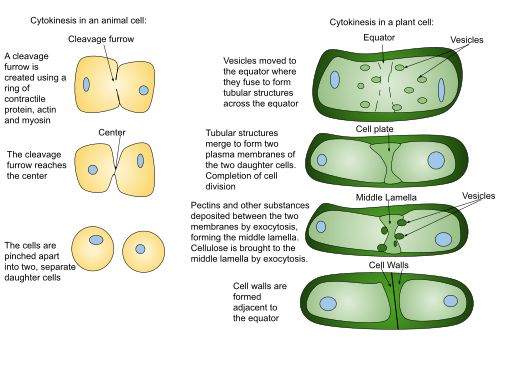
Division in animal cells vs. plant cells
Image source: By MathildaBrinton CC BY-SA 4.0, via Wikimedia Commons
First, vesicles form across the equator (middle) of the cell. Then, a cell plate forms in the middle, separating the two new cells. Next, pectin and cellulose are excreted into the middle of the cell, creating a structure called the middle lamella. Finally, a new cell wall forms, separating the two daughter cells. Now all four sides of the cells are covered.
The process is a bit simpler in animal cells. First, a ring made of actin and myosin forms in between the two cells. As the cleavage furrow contracts and reaches the center, it pinches the cells apart. This leaves us with two identical daughter cells.
And with that, the cell cycle is complete.
: The longest part of the cell cycle where the cell grows and DNA is replicated to prepare for nuclear division
: The process of dividing the nucleus
: The process of dividing one nucleus into two identical nuclei. Occurs in all cells except for sex cells
: The final step of cell division where the cytoplasm is divided to form daughter cells
: Cell that contains two sets of chromosomes