Telophase — Definition & Diagrams

Before this, knowAnaphase — Definition & Diagrams

Illustrated · 2 min

The Last Phase of Mitosis

During telophase, a new nuclear envelope forms. Chromosomes unfold back into chromatin. Nucleoli reappear. The cell continues to elongate.

Image source: By LadyofHats (modified by expii) [Public domain], via Wikimedia Commons

The final phase of mitosis is called telophase.

In the previous phase, the chromosomes were split up so that there was a complete set on each side of the cell.

During telophase, the chromosomes begin to uncoil into a less condensed form. As this happens, a nuclear membrane forms around each set. This forms two nuclei.

Now, the cell is ready to split into two daughter cells in a process called cytokinesis. It's important to note that this process often occurs at the same time as telophase.

Cytokinesis in Plant and Animal Cells

Although the overall process of splitting is the same, it looks a bit different in animal cells and plant cells. Why is this the case? Well, plant cells have a tough cell wall surrounding their plasma membrane. If a plant cell splits right down the middle, it would be left with three covered sides and one side that's completely exposed. That's no good. So, what special steps do plants cells take to make sure all of their sides are covered by the cell wall? Take a look at the diagram below and see what you notice.
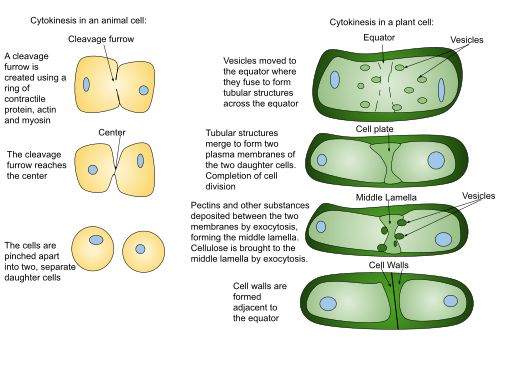
This is a diagram showing cytokinesis in an animal cell and in a plant cell.
On the left is two animal cells that are going through telophase. Text reads: "A cleave furrow is created using a ring of contractile protein, actin, and myosin."
In the next step, the cells are being pinched together even more. Text reads: "The cleavage furrow reaches the center."
In the final step, the two daughter cells have separated. Text reads: "The cells are pinched apart into two separate daughter cells."

On the right, two plant cells are dividing. Text reads: "Vesicles moved to the equator where they fuse to form tubular structures across the equator."
In the next image, a cell plate has formed between the cells. Text reads: "Tubular structures merge to form two plasma membranes of the two daughter cells. Completion of cell division."
In the third image, the middle lamella starts to form. Text reads: "Pectins and other substances deposited between the two membranes by exocytosis form the middle lamella. Cellulose is brought to the middle lamella by exocytosis."
In the final picture, a cell wall has formed between the two cells. Text reads: "Cell walls are formed adjacent to the equator."

Division in animal cells vs. plant cells

Image source: By MathildaBrinton CC BY-SA 4.0, via Wikimedia Commons

First, vesicles form across the equator (middle) of the cell. Then, a cell plate forms in the middle, separating the two new cells. Next, pectin and cellulose are excreted into the middle of the cell, creating a structure called the middle lamella. Finally, a new cell wall forms, separating the two daughter cells. Now all four sides of the cells are covered.

The process is a bit simpler in animal cells. First, a ring made of actin and myosin forms in between the two cells. As the cleavage furrow contracts and reaches the center, it pinches the cells apart. This leaves us with two identical daughter cells.

And with that, the cell cycle is complete.

Vocabulary Review:\color{#8925AE}{\text{Vocabulary Review:}}

Interphase\color{#8925AE}{\text{Interphase}} : The longest part of the cell cycle where the cell grows and DNA is replicated to prepare for nuclear division

Nuclear Division\color{#8925AE}{\text{Nuclear Division}} : The process of dividing the nucleus

Mitosis\color{#8925AE}{\text{Mitosis}} : The process of dividing one nucleus into two identical nuclei. Occurs in all cells except for sex cells

Cytokinesis\color{#8925AE}{\text{Cytokinesis}} : The final step of cell division where the cytoplasm is divided to form daughter cells

Diploid Cell\color{#8925AE}{\text{Diploid Cell}} : Cell that contains two sets of chromosomes

Illustrated · 1 min

How Does Mitosis End?

Telophase occurs after anaphase in both mitosis and meiosis. Cytokinesis is sometimes attached to this stage, but they are actually different processes.

At this stage, the nuclear envelope reforms around the chromosomes. The chromosomes begin to decondense back into their chromatin form. The mitotic spindle also breaks down.

This is basically the opposite of prophase. If you can remember what happens in prophase, put the steps in reverse and you will have telophase.

During telophase, the nuclear membrane reforms, nucleoli reappear, and chromosomes unwind into chromatin. During cytokinesis, the myosin II and actin filament ring contract to cleave the cell in two.

Image source: By Kelvinsong CC BY 3.0, via Wikimedia Commons

Video

(Video) Mitosis: Splitting Up Is Complicated

by CrashCourse

Telophase is the fourth and final stage of mitosis. In this video, Hank from Crash Course describes how cells reform structures in preparation for being split in half.

Summary:

During this phase, the nuclear membrane reforms around each group of chromosomes. Chromosomes relax back into chromatin. The cleavage furrow that was formed during anaphase begins to tighten, causing the cell to split in half. The process of splitting is called cytokinesis. The resulting cells, called daughter cells, are identical clones of each other and the parent cell.

Type a concept, like “slope” or “photosynthesis”.

↑ ↓ to choose · Enter to openSearch explanations and problems