Read · 1 min
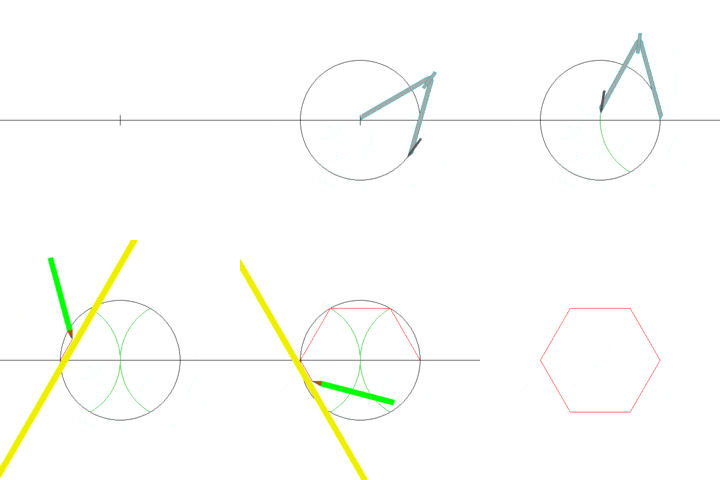
Constructions basically consist of constructing various geometric figures using only a straightedge and a compass. That means no rulers, protractors; more generally, no measurements. The straightedge is assumed to be infinite, have only one side, and have no markings, though using a ruler and disregarding the ticks on the side will suffice. The compass is assumed to collapse when taken off a page, though using a regular compass will suffice due to the compass equivalence theorem
The apparent lack of numbers may make it seem like a whimsical pastime of mathematicians--it is, in fact--but as one dives beneath the tip of the iceberg, one will see that construction is a very deep and subtle topic, producing problems known to Greeks, Indians, and Egyptians that stood for millennia, only being solved by 18th century mathematicians equipped with modern mathematical tools. Such problems are the doubling the cube problem and the angle trisection problem problem.