Consider the standard form for the equation of an ellipse whose axes are parallel to the coordinate axes:
a2(x−x0)2+b2(y−y0)2=1
This ellipse has center at (x0,y0) and axes of lengths 2a and 2b. For convenience, we will translate this ellipse so that its center is at the origin. Now, we have the ellipse:
a2x2+b2y2=1
Because the foci lie on the major axis, which is the longer axis, we have two cases to consider; they are perfectly symmetric, so we may assume that a≥b. In this case, the foci will lie on the x-axis, so their coordinates will be F1=(c1,0) and F2=(c2,0), where −a<c2≤c1<a. We wish to calculate c1 and c2 in terms of a and b.
First, note that P1=(a,0) and P2=(−a,0) are on the ellipse:
P1F1+P1F2=(a−c1)+(a−c2)=2a−(c1+c2)P1F1+P1F2=(c1−(−a))+(c2−(−a))=2a+(c1+c2)
By the definition of an ellipse, PF1+PF2 is a constant for all points on the ellipse. Therefore,
2a−(c1+c2)=2a+(c1+c2)c1+c2=0
This means that the foci are symmetric with respect to the origin. Perhaps this was obvious due to symmetry, but it's good to prove it. However, now that we know that c1+c2=0, it follows that the constant sum of distances PF1+PF2 must equal 2a.
Far less obvious is how far away the foci should be from the origin. Now, we use the points P3=(0,b) and P4=(0,−b) (it does not really matter which point we use). Let us use P3:
We know that this constant sum must equal 2a. Therefore, c12=a2−b2. Since c1+c2=0 and c1≥c2,
c1=a2−b2c2=−a2−b2
If b>a, we would instead obtain, through exactly the same process:
c1=b2−a2c2=−b2−a2
Now, we can simply translate the ellipse back to its original location. For the ellipse:
a2(x−x0)2+b2(y−y0)2=1
If a>b, the foci are located at:
F1=(x0+a2−b2,y0)F2=(x0−a2−b2,y0)
and if a<b, the foci are located at:
F1=(x0,y0+b2−a2)F2=(x0,y0−b2−a2)
Put ideas together
Contest problems often need this idea together with one or two others. That is where understanding goes deeper than memory. These are real problems from the AMC 12 and AIME, the national math competitions for middle and high school students, each with a worked solution on LIVE by Po-Shen Loh.
In this video by Anusha Rahman, you will learn about the foci of an ellipse.
Summary
An ellipse is defined as a closed curve that resembled a flattened circle.
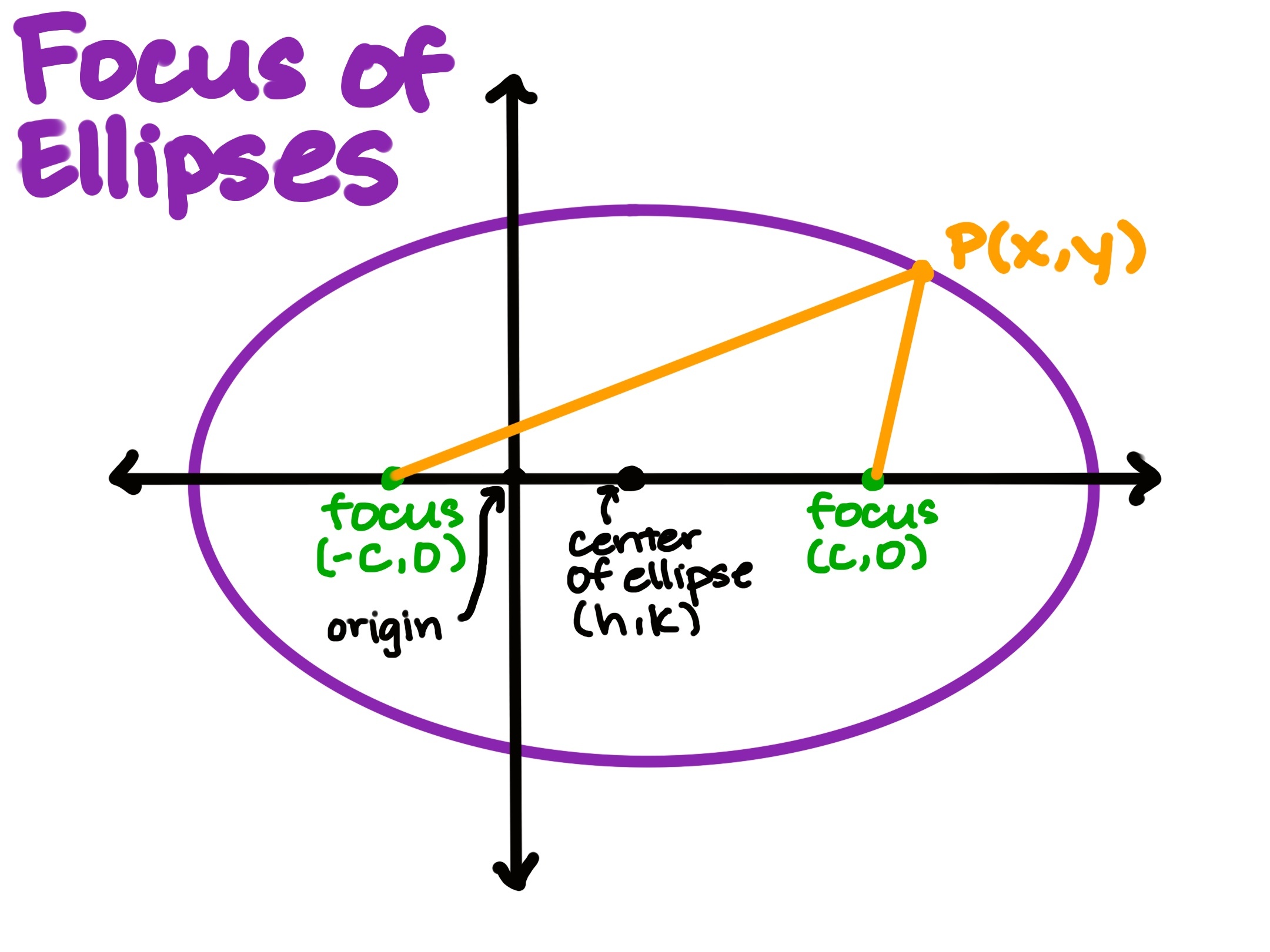
The foci of an ellipse are two special points that play a crucial role in defining the shape of the ellipse, often denoted as F1 and F2. The sum of the distances from any point on the ellipse to the two foci is constant.
The foci of an ellipse are two fixed points such that the sum of the distances from any point on the ellipse to the two foci is constant. This constant sum is equal to the length of the major axis of the ellipse.
The foci of an ellipse are two fixed points located along the major axis, equidistant from the center (labeled in green below). These points play a crucial role in defining the shape of the ellipse, as the sum of the distances from any point on the ellipse to each focus is constant.
Image source: by Anusha Rahman
The distance from the center of the ellipse to each focus is called the focal length, which is less than the length of the semi-major axis. In essence, the foci help to characterize the ellipse's eccentricity, influencing its overall shape and how elongated it appears.