Illustrated · 3 min

+3 contributors



Why Is It Important to Regulate Temperature?
Thermoregulation is the collection of processes used by an organism to maintain a stable internal temperature.
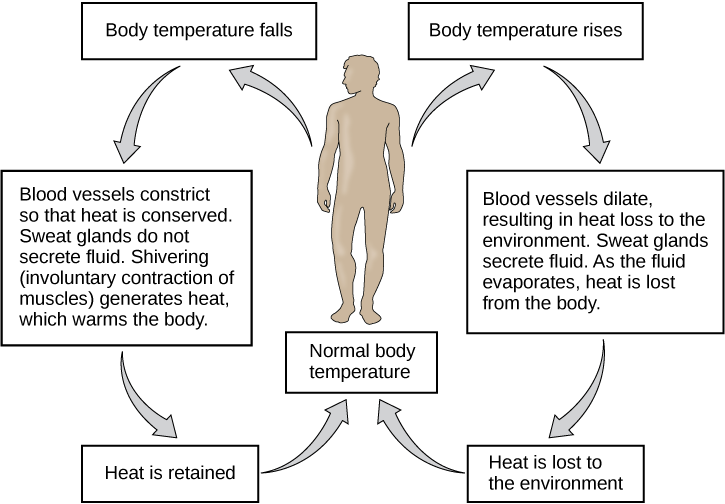
Organisms need to have homeostatic control over body temperature when external temperatures change. A stable temperature is crucial because the enzymes inside our body only work at certain temperatures, somewhere around 37°C. Also, changes in temperature affect the fluidity of cell membranes. When the core body temperature of an organism is too high or too low, certain bodily functions can shut down, leading to the death of the organism.
Image source: By Google ; editor Li Chao, CC BY-SA 4.0, via Wikimedia Commons
Warm-blooded Vs. Cold-blooded Animals
Almost all organisms thermoregulate in some way. Warm-blooded organisms, like humans, use internal processes to regulate their body heat.
Organisms that cannot produce their own heat metabolically need to adjust their behavior to keep their temperature in check. Animals have to use various tactics to stay warm or cool off. For example, cold-blooded animals, like lizards, might lay out in the sun to warm up.
Humans often do similar things. When you're cold and put on a coat, or you're hot and drink a cold glass of water, you are helping your body regulate its temperature.
However, humans and other warm-blooded animals rely mostly on automatic processes, like altering metabolic rates, in the body to maintain a steady temperature.
Exchanging Heat
There are four main ways in which heat can be exchanged between an organism and its environment. They are radiation, convection, evaporation, and conduction.
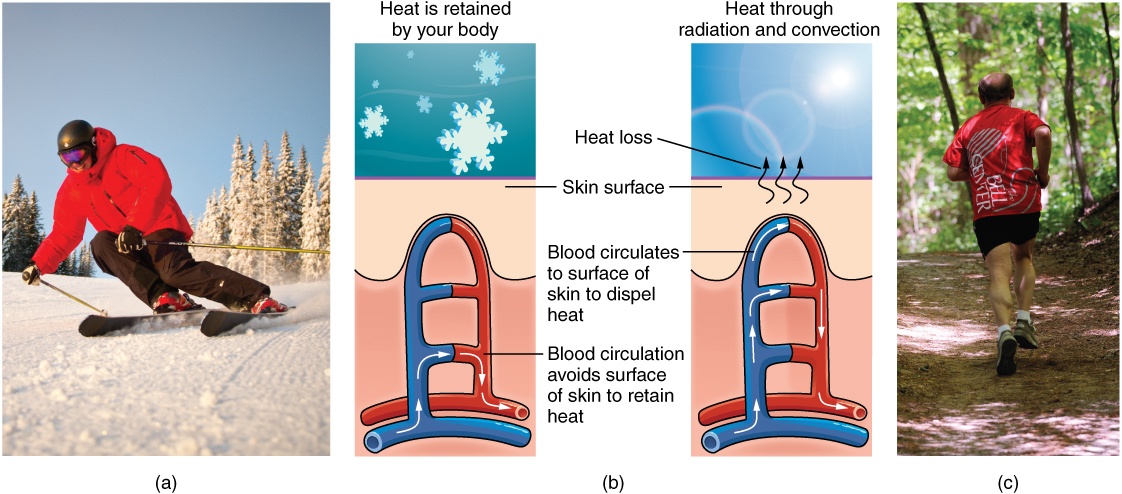
Radiation is the exchange of heat through electromagnetic waves. The sun gives off heat this way to warm up our planet, which also makes internal body temperature increase. Similarly, heat radiates from dry skin to cool off the body. Certain animals, like jackrabbits and elephants, have large ears loaded with tiny blood vessels which help them quickly lose heat through radiation. This is a helpful technique for desert animals so they don't get overheated.
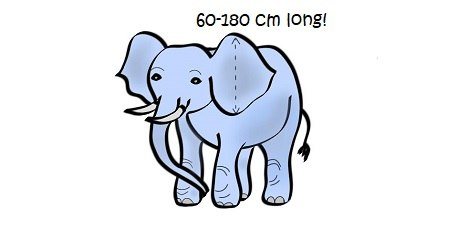
Did you know that different species of elephants can have ears that are 60 to 180 cm long and 30 to 115 cm wide?
Image source: By Gabi Slizewska
Convection happens when heat is transferred from the warm air near the skin to the cold air around it. The warm air rises and is replaced with cold air to restart the cycle. You can think of convection as the transfer of heat between two liquids or two solids. The two substances are in the same phase; air around your skin and air surrounding the skin are both gases.

When you bring water to a boil, the water closest to the heat source (at the bottom) will warm up first. The heat from the warm water will be transferred to the cold water above. This is another form of convection.
Image source: By Gabi Slizewska
Evaporation happens when a liquid turns into a gas. When you sweat, the liquid on your skin evaporates into the atmosphere to cool you off. When you see a dog panting on a hot day, they are actually increasing evaporation from their tongue and mouth to cool off.
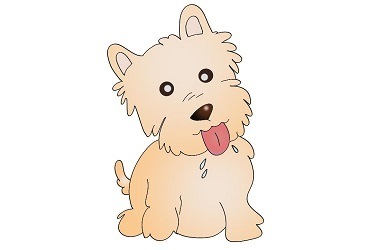
Image source: By Gabi Slizewska
Conduction transfers heat through direct contact. This happens when an animal lies down on a hot surface, like a rock. Conduction is used by many organisms as a method to both heat up and cool down their body temperature.

Lizards and other reptiles sit on hot surfaces like rocks on a hot day to absorb heat through convection.
Image source: By Gabi Slizewska
Limiting Heat Loss
It's important to remember that the processes above are automatic, so we can't always control them. For example, convection and radiation are happening nonstop. So how do we make sure that we don't lose too much heat?
Luckily, many organisms have strategies and adaptations to limit heat loss and regulate body temperature.
Many animals have some type of insulation, like fur or fat. A polar bear will have both to keep up its body temperature in its cold and harsh climate.
Shivering is another great adaptation. When we are cold, we shiver because our muscles begin to involuntarily contract. The little muscle contractions increase heat production. Goosebumps have a similar effect.