Read · 3 min
As we've studied thermodynamics, we've learned its laws. The first law was easy. "We cannot create or destroy energy. We only transfer it between different storage methods." We were doing great! The first law helped us understand internal energy, enthalpy, and heat. We learned how to calculate and measure enthalpy and work. We discovered some cool tricks like Hess's law and heats of formation. We could find the energy released by so many chemical reactions!
Then, we looked at the second law of thermodynamics. We introduced entropy. And, honestly, for most people, it gets confusing fast. For myself, even in college, my professors didn't explain entropy well. I was confused! Even worse, I was taking a semester-long thermodynamics class. It was a long, frustrating semester.
Today, we'll study the third law. But first, let's make sure we understand entropy.
Entropy Refresher
The interpretation of entropy I find the most helpful is energy dispersion. Entropy measures the amount of energy and its spread at a specific temperature. For example, say we had an ideal gas in a container. If we increased the volume of the container, the gas would expand. Let's say the temperature was constant. The total energy is the same. But, it's more spread out. So, we increased entropy. That's why entropy relates to pressure and volume. They are physical measures of a system's dispersion.
As another example, consider phase changes. Do you remember phase change diagrams? They have flat lines at the melting/freezing and vaporization/condensation temperatures. We are adding energy, but our temperature is constant. As the molecules change phases, they overcome their intermolecular forces. So, our internal energy is changing. The molecules also have new types of motion. The kinetic energy is also more spread out. We increased entropy. The temperature is constant because the internal energy change equals the entropy change. We see that entropy relates to internal energy and temperature.
I like this concept because we see this in our everyday lives. What happens when we puncture a balloon? The air leaks out. The molecules in the balloon are now in the atmosphere. So, their energy is more spread out.
What happens when we leave a hot kettle on the stove? Its temperature decreases by transferring energy to the air. The air's gas molecules collide with the kettle. After the collision, they have more kinetic energy. The kettle's molecules have less kinetic energy. Again, the energy dispersed. Here we see both the amount of energy and its spread.
For a final example, why does diffusion happen? Let's say we have 50.0 milliliters of two liquids. By mixing them, we double our total volume. What's the mixture's most dispersed state? It's each liquid spread throughout the whole 100.0 milliliters.
The Second Law and Energy Dispersion
The second law of thermodynamics states, " the universe's entropy is increasing." What does that even mean?! Can energy dispersion help us understand the second law of thermodynamics? It can! It would state, "energy disperses unless something prevents it." Entropy is how we quantify the dispersion at a specific temperature.
Third Law of Thermodynamics and Energy Dispersion
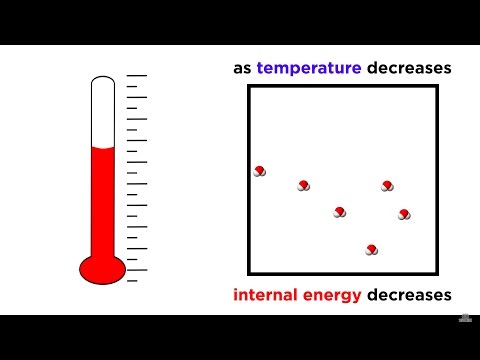
Now that we understand entropy, we can look at the third law of thermodynamics. The technical definition states, "the entropy of a pure crystal lattice, at absolute zero, equals zero." Again, what does that even mean?! At absolute zero, we stop all molecular movement. So, energy cannot spread out. Therefore, we define the entropy as zero.
What's the point of the third law? It's a definition we created to set the boundary for entropy calculations. A substance's entropy above absolute zero will always be a positive value. That energy can spread. It also allows us to calculate the substance's standard molar entropy. The molar entropy is the energy required for one mole of a substance to be stable at a specific temperature. It has units of joules per kelvin (). Absolute zero is our baseline. To go from absolute zero to whatever temperature required a specific amount of energy. We average the total energy over the whole temperature change.