
Interactive · 1 question
Special Relativity's Time Dilation
Time dilation is an established consequence of Einstein's general relativity.
To begin we must understand that all things- save light's speed- are relative, and when we say everything we mean everything. This includes time and space. Furthermore, realize that physics is stubborn. If there is to be one constant in existence then there is absolutely no circumstance under which that constant is allowed to be challenged.
This is the preface to our understanding of time dilation. Time dilation deals with the behavior of time in regards to maintaing the speed of light's status as a constant.
In the next few paragraphs we will explore one type of dilation and its mathematical representations.
Time Dilation due to Relative Velocities
The formula for determining time dilation in special relativity is:
where
is 'proper time' or the perceived change in time of the observer,
is the time observed for the person moving at relative velocity
is the relative velocity between the observer and the moving clock
is the speed of light.
At a glance, the equation seems trivial, and this is true of both the mathematical proof and its applied use. Now let us try and understand what this means in the physical world, and why it might be that way.
Time Dilation due to Relative Velocities Considered in an Applied Sense
To understand this dilemma let us consider a classical example: light on a train.
Let us consider that there are two observers; one is on a platform, standing stationary relative to a moving train. We will call him Observer A. The other one who is moving on the train with a velocity to the right, is Observer B. The cart in which Observer B is riding has a height of and there is a laser/detector stationed on the ground, and a mirror suspended from height . The laser/detector measures time by calculating how long it takes for the laser beam to bounce off the mirror and make its way back to the detector.
Therefore, thanks to the distance formula () we can easily see that the time it takes for one trip of the laser according to Observer B on the train, is:
This is depicted in the first segment of the figure below.
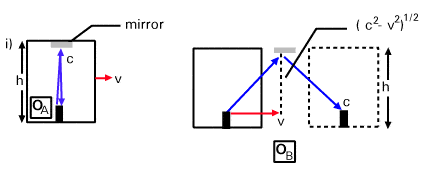
Observer B's and Observer A's frame of reference respectively
Now let us consider what Observer A sees from the platform. From the station, standing still, Observer A would watch the light travel a farther distance to keep up with the motion of the train. Use the diagram above if this concept is difficult. Notice that the light, according to Observer A, moves diagonally to hit the mirror, which is reflected off the mirror and must move diagonally again to hit the detector.
This is all because the train is in motion relative to Observer A on the platform (I hope you're beginning to understand why we call it relativity). To Observer A, the light beam must move a longer distance to keep ensure that the beam hits the detector. This prompts Observer A to claim that Observer B's clock must run slower than he orginally claimed (which you might recall was ) ! And to Observer A, this is true, but let's try to understand why mathematically.
Understanding Observer A's Point of View and solving for
Let us continue to use the above diagram
Observer B's and Observer A's frame of reference respectively
First, how far is does Observer B's light travel in total according to Observer A?
Simple! Considering our trusty distance formula the distance travelled is obviously:
Alright, now that that's settled, it would be safe to say that the precisely half that distance would be:
We consider this because if we look at precisely half the distance travelled by this beam of light, we notice that we form a right triangle (if you're confused check the figure above). If we want to find the distance the light travels along the diagonal we realize it is simply:
Logically from there, since we're dealing with distance, we understand that the vertical component of this right triangle is , or the height as we established earlier. From here, we can construct a very familiar equation. Can you guess its fundamental name?
Fill in the blank with the theorem's name.
Precisely!
We can now construct the following:
With just the slightest bit of algebraic manipulation we will have our answer as to what is!
If we move like terms to the same side and solve for we should get:
If we square root both sides we get:
Conclusion
Look carefully! Do you notice that we've seen before?
It is indeed the equivalent of or the time according to Observer B.
But now we might come to understand why Observer A claims that Observer B's clock is running slow! According to Observer A, Observer B's clock doesn't take for one oscillation, but instead and then some ('and then some', of course, being precisely defined as ).
This is a consequence of relativity. It is why time and space are relative; no matter what, light's speed must be preserved. Therefore, observers might say that someone in motion has a clock that is running slow because it covers more distance when lights rate is the same for both observers!
Hopefully, this has helped you understand physics, relativity and our universe a little better!