
Illustrated · 5 min
We have discussed Strong Acid-Strong Base titrations, Strong Acid-Weak Base titrations, and Weak Acid-Strong Base titrations thus far, but there is still another, slightly different type of titration to introduce!
On this page, we will be learning about Titrations of Polyprotic Acids. Let's start by first discussing what a polyprotic acid is all about.
Polyprotic Acid
In our titrations, we will see that we can either have monoprotic or polyprotic acids.
Monoprotic acids are acids that are only able to donate one proton per molecule during ionization. The common examples we talked about during our strong acid-weak base titration, such as hydrochloric acid () and nitric acid (), are monoprotic acids.
Polyprotic acids, on the other hand, have the ability to donate more than one proton per molecule. You will most often see two kinds of polyprotic acids:
- diprotic acid:
- triprotic acid:
Notice how the diprotic acid has 2 protons () to donate, and the triprotic acid has 3 for donation
Diprotic acid dissociation occurs in 2 steps and each step has its own successive dissociation constant () value, one for each proton.
Triprotic acid dissociation then, occurs in 3 steps and has 3 different values
Citric acid is a common triprotic acid that can successively lose three protons in order to form a citrate ion. Phosphoric acid () is another triprotic acid that you have most likely seen before.
To learn more about polyprotic acids before we discuss titration, check out the link!
Common Examples of Weak Polyprotic Acids
You will most commonly find weak polyprotic acids being titrated by strong bases. Some examples of weak polyprotic acids and strong bases are provided below for reference. It may be worth becoming familiar with the names-- you may not always be informed of the type of acid-base titration you are dealing with.
Weak Polyprotic Acids
Strong Bases
Titration of Polyprotic Acids
Like we have previously discussed, the purpose of performing a titration is to use a solution of known concentration to determine the concentration of an unknown solution. In a polyprotic acid titration, the polyprotic acid is our unknown (or the analyte) and we will use a strong base as our solution of known concentration, or titrant.
In any typical titration experiment, the titrant is poured into a buret that is suspended above an Erlenmeyer flask that contains the analyte. The figure below shows this typical set-up.
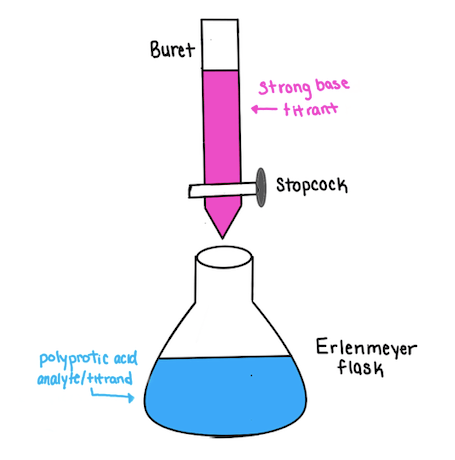
Conventional setup of a laboratory titration by Summer Black
During a titration, there are a few different specific points of interest that chemists will look at. When an acid is titrated, there will be a point where the moles of base (titrant) that has been added is equal to the moles of acid (analyte/titrand). This point is called an equivalence, or stoichiometric point. In the monoprotic acid titrations we previously discussed, there was a single equivalence point. However, when a polyprotic acid is titrated, an equivalence point occurs when each proton () is dissociated. This means that diprotic acids will have 2 equivalence points, triprotic acids will have 3, and so on.
Chemists are also interested in the midpoint of the titration. At this point, the number of moles of strong base = moles of weak polyprotic acid present in solution. Since the midpoint is half of the equivalence point, there are the same number of midpoints that there are equivalence points.
Titration Curve of Polyprotic Acids
Taking a look at the example of a titration curve for a weak triprotic acid, we can see how there are three equivalence points on the most vertical parts of the curve and three midpoints at the curve's most horizontal points.
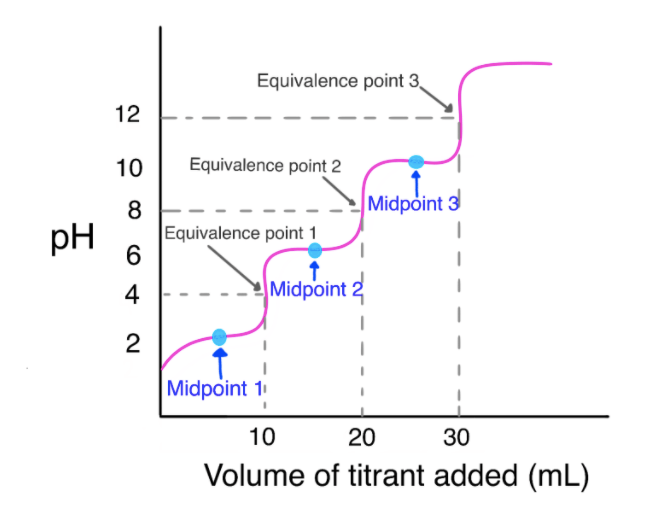
Weak triprotic acid titration curve By Summer Black
For this titration curve, let's talk through what happens when a weak triprotic acid () is titrated with a strong base, say . has three protons (), so there are three opportunities for dissociation to occur. This means that there are 3 equivalence points and 3 midpoints. At the midpoints, the , following the Henderson-Hasselbalch equation.
If you look back at the calculations that are involved with finding the pH at the midpoint, equivalence point, and at any point during the titration of a weak base and strong acid, you can see that there is a single reaction. For that reaction, there is one midpoint and one equivalence point. For a triprotic acid, there are three dissociation reactions involved, so there are three midpoints and equivalence points. The math that you see on that page is simply repeated for each of the dissociation reactions, in terms of (In that explanation, the base is the analyte, so it is done in terms of )
Let's recall the three dissociation reaction equations that a triprotic acid can undergo during titration:
At the first midpoint, after about 5 mL of titrant:
The first equivalence point is reached when 10 mL of titrant has been added.
Adding more strong base titrant pushes the reaction forward
Adding another 10 mL (total of 20 mL) allows for another to dissociate, and the second equivalence point is reached. Since the midpoint is the equivalence point, when 15 mL of titrant are added the second midpoint is reached.
At the second midpoint,
Adding more titrant pushes for another to dissociate
When 30 mL total of strong base titrant has been added, another equivalence point is reached- which means another midpoint halfway.
In terms of pH, the curve experiences a climb in pH before the first midpoint. Past the midpoint, it gradually increases before experiencing a sharp jump right before the equivalence point. By the next midpoint, the solution steadies itself and the curve is most horizontal, this is when the solution is most neutralized. Solutions that are at this point in the curve are known as buffer solutions.
When you add a strong base increments to a buffer solution, the pH will barely change. When more titrant is added and the buffer capacity is surpassed, the pH beings to change again.
When the curve nears the next equivalence point, there is another sharp increase in pH. This pattern continues for the number of protons that dissociate.
When completing calculations, here are some useful relations to remember:
- Acid dissociation constant:
is the conjugate base and HA is the undissociated acid
